


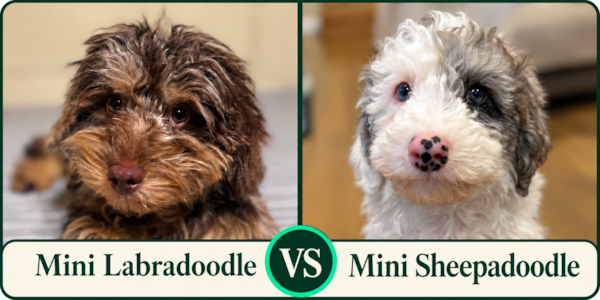
Published Thursday, October 22, 2026 by Pilesgrove Pups
The Mini Labradoodle vs Mini Sheepadoodle comparison puts two intelligent, affectionate Poodle mixes together, but their similar fluffy appearance can hide a very different way of experiencing the world. Both can have soft waves or curls, expressive faces, playful personalities, and strong family bonds. Both also carry genuine working ability underneath the teddy bear coat.
The shared Poodle gives them plenty in common. Intelligence, trainability, athletic ability, close human attachment, and the possibility of a low-shedding coat can appear in either cross. The bigger difference comes from the Labrador Retriever behind the Mini Labradoodle and the Old English Sheepdog behind the Mini Sheepadoodle.
The Labrador Retriever brings sporting and water-working history. Labs are outgoing, energetic dogs with strong retrieving instincts, a famous interest in food, and a willingness to work closely with people. Their ancestors worked around Newfoundland fisheries before the breed developed into one of the world's best-known hunting retrievers.
The Old English Sheepdog came from a different working tradition. Its historical role centered largely on droving, which meant helping move sheep and cattle to market. That job favored strength, stamina, watchfulness, and close awareness of how livestock moved through the environment.
Those histories can shape daily life in useful ways. A Mini Labradoodle may focus heavily on toys, food, retrieving, water, people, and whatever activity is happening next. A Mini Sheepadoodle may show greater interest in movement itself, with more potential for following, circling, watching, blocking, or trying to involve itself when children or other pets start running around.
Their bodies differ too. Mini Labradoodles usually occupy the lighter end of the small-to-medium range, while Mini Sheepadoodles commonly carry more bone, more coat, and more physical substance. A Mini Sheepadoodle can feel surprisingly substantial even when its height is not dramatically greater.
Neither dog is automatically easier. Mini Labradoodles can bring considerable youthful exuberance, while Mini Sheepadoodles can require more grooming and more work around watchfulness or movement-focused behavior. The better choice depends on whether your household fits the Labrador Retriever's outgoing sporting style or the Old English Sheepdog's sturdy, playful drover influence.
Table of Contents
- Mini Labradoodle vs Mini Sheepadoodle at a Glance
- Mini Labradoodle and Mini Sheepadoodle Overview and History
- Mini Labradoodle vs Mini Sheepadoodle Appearance
- Mini Labradoodle vs Mini Sheepadoodle Temperament
- Mini Labradoodle vs Mini Sheepadoodle: Which One Should You Choose?
- Choose a Mini Labradoodle if You Want a Compact Sporting Companion
- Choose a Mini Sheepadoodle if You Want a Sturdy, Playful Working Companion
- Which Is Bigger: Mini Labradoodle or Mini Sheepadoodle?
- Which Is Calmer: Mini Labradoodle or Mini Sheepadoodle?
- Which Is More Energetic?
- Which Needs More Mental Stimulation?
- Which Is Easier to Train?
- Which Is Better for First-Time Dog Owners?
- Which Is Better With Young Children?
- Which Is Better With Older Children?
- Which Is Better With Other Dogs?
- Which Is Better With Cats?
- Which Has Stronger Herding or Droving Behavior?
- Which Likes Fetch More?
- Which Is Better for Swimming?
- Which Is More Food Motivated?
- Which Is More Watchful?
- Which Is More Likely to Bark?
- Which Is More Social With Strangers?
- Which Is More Affectionate?
- Which Sheds Less: Mini Labradoodle or Mini Sheepadoodle?
- Which Needs More Grooming?
- Which Is Better for Allergies?
- Which Is Better for Apartment Living?
- Which Is Better for Seniors?
- Which Is Better for an Active Lifestyle?
- Which Handles Cold Weather Better?
- Which Handles Warm Weather Better?
- Which Has the More Demanding Puppy Stage?
- Mini Labradoodle vs Mini Sheepadoodle: The Final Comparison
Mini Labradoodle vs Mini Sheepadoodle at a Glance
| Trait | Mini Labradoodle | Mini Sheepadoodle |
| Parent Breeds | Labrador Retriever × Poodle | Old English Sheepdog × Poodle |
| General size | Small-medium | Small-medium to medium |
| Common adult weight | Often about 15–30 pounds | Commonly about 25–45 pounds |
| Common adult height | Often around 14–17 inches | Commonly around 15–20 inches |
| Build | Athletic, sturdy, compact | Square, substantial, muscular |
| Coat | Straight, wavy, or curly | Shaggy, wavy, or curly |
| Shedding | Low to moderate, coat-dependent | Low to moderate, coat-dependent |
| Grooming | Moderate to high | High for many coats |
| Common colors | Black, chocolate, cream, apricot, red, caramel and more | Black and white, gray and white, blue-gray, brown, silver and more |
| Eye colors | Usually brown or dark brown | Brown, blue, or one of each may occur |
| Energy | Moderate to high | Moderate to moderately high |
| Mental stimulation | Moderate to high | Moderate to high |
| Trainability | Very high | High to very high |
| Retrieving interest | Frequently strong | Individual-dependent |
| Water interest | Frequently strong | Individual-dependent |
| Movement-control behavior | Usually limited | Possible |
| Watchfulness | Usually moderate | Often stronger |
| Social style | Outgoing, lively, affectionate | Playful, affectionate, watchful |
| Best fit | Active families wanting a sporty companion | Families wanting a sturdy, playful working companion |
These ranges are useful guides rather than official standards. Neither cross has one universally recognized mini size, and breeding programs may use slightly different definitions. The Mini Sheepadoodle usually sits higher on the scale because the Old English Sheepdog is a large, heavy-boned breed.
Mini Labradoodle and Mini Sheepadoodle Overview and History
The Mini Labradoodle and Mini Sheepadoodle share the Poodle, yet their other breeds developed around jobs that asked for very different forms of attention.
Labradors worked as water dogs and retrievers. Their success depended on enthusiasm, physical stamina, confidence in water, carrying ability, and a willingness to respond to people repeatedly throughout a working day.
Old English Sheepdogs worked primarily as drovers. Their job was less about retrieving an object for a person and more about helping influence the movement of livestock over distance. That called for a strong body, intelligence, watchfulness, and an ability to stay aware of changing movement around them.
The Poodle adds another active working background to both crosses. Poodles developed around water retrieval and combine athletic ability with exceptional learning skills.
Both crosses can therefore offer serious intelligence. The practical difference lies in what tends to capture that intelligence. The Mini Labradoodle may direct more of its attention toward retrieving, food, water, toys, and direct cooperation. The Mini Sheepadoodle may pay more attention to movement, household activity, and the shifting positions of people and animals around it.
Mini Labradoodle History and Background
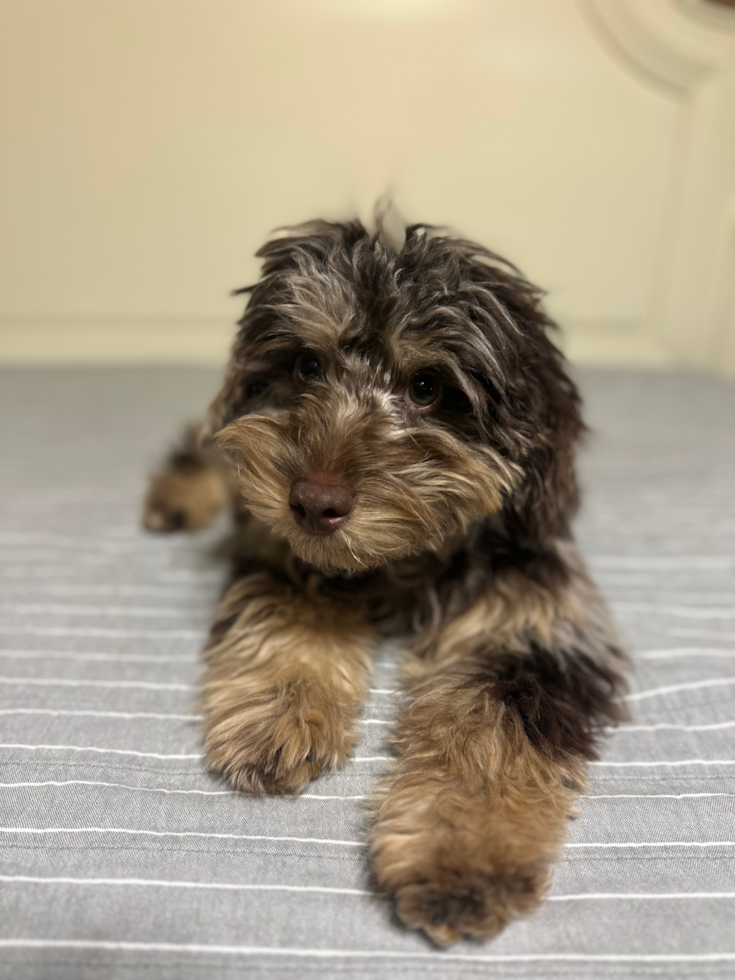
The Mini Labradoodle combines Labrador Retriever and Poodle ancestry while breeding toward a smaller adult size. Different generations can fall under the Mini Labradoodle name, so the label does not describe one exact formula.
The Labrador Retriever's history starts in Newfoundland. The breed's early ancestors included the St. John's Water Dog, a working dog associated with fishermen and coastal life.
These dogs developed a reputation for excellent swimming and retrieving. Historical accounts describe them helping with fishing gear, retrieving objects from water, and working confidently in cold conditions.
Dogs exported to Britain attracted sportsmen, who refined the breed further for hunting and retrieving. The modern Labrador kept the water enthusiasm and carrying instinct while developing into a highly cooperative gundog.
Labradors are now used far beyond hunting. Their intelligence, social confidence, trainability, and strong motivation have supported work in guide programs, detection, search and rescue, assistance roles, and many other fields.
The Poodle adds its own water-retrieving heritage and a coat that can release far less visible hair. It also contributes fast learning and athletic ability.
The first well-documented Labradoodle litter was bred in Australia in 1989 as part of an effort to produce a guide dog that could combine Labrador working ability with a lower-shedding Poodle coat. Smaller Labradoodles came later as the cross expanded into different size ranges.
Mini Labradoodle and Australian Labradoodle Are Not Always the Same
The names Mini Labradoodle and Mini Australian Labradoodle are sometimes used as though they describe exactly the same dog, but that can create confusion.
A Mini Labradoodle generally refers to a smaller cross centered on Labrador Retriever and Poodle ancestry. Australian Labradoodles developed through multigenerational breeding programs and may carry additional historical breed influences.
For this comparison, Mini Labradoodle refers to the smaller Labrador Retriever and Poodle cross. That keeps the comparison with the Mini Sheepadoodle focused and avoids mixing different breeding histories together.
Mini Sheepadoodle History and Background
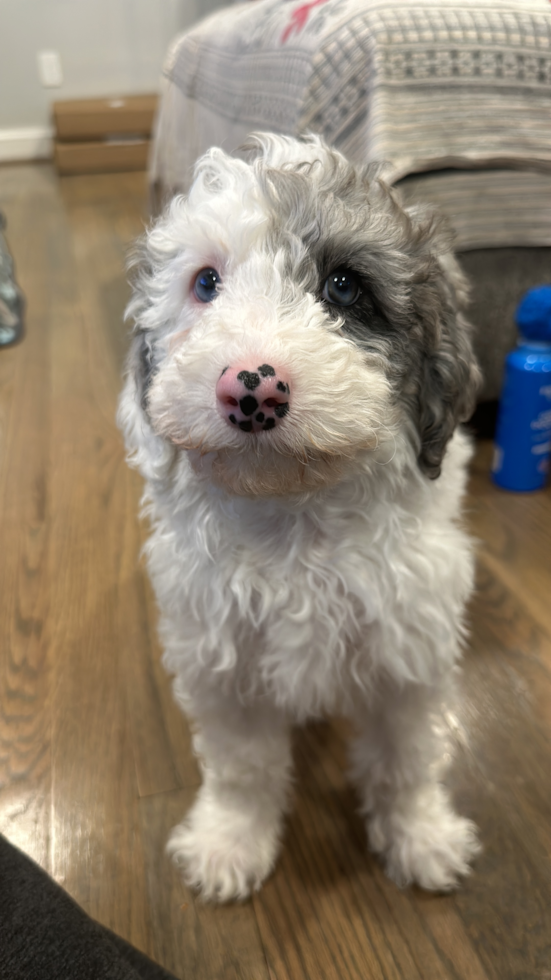
The Mini Sheepadoodle combines Old English Sheepdog and Poodle ancestry while breeding toward a smaller size than the Standard Sheepadoodle. Miniature Poodle influence helps bring the adult dog into a more manageable small-to-medium or medium range.
The Old English Sheepdog developed in western England and is not quite as ancient as its name suggests. Its recognizable form dates back a few centuries.
Its original work centered heavily on droving. Old English Sheepdogs helped move sheep and cattle toward markets, which required endurance and the ability to influence the direction and pace of livestock.
That background is important because the breed was not simply a decorative shaggy farm dog. Underneath the enormous coat is a compact, muscular working body with substantial bone and surprising agility.
Old English Sheepdogs also developed a reputation for intelligence, watchfulness, family attachment, and a loud distinctive bark. Their personality can combine a mellow side with a real enjoyment of romping and physical play.
The Poodle reduces the size and adds another intelligent working breed. It can also introduce stronger curl and a different coat texture.
The Mini Sheepadoodle therefore combines a drover's movement awareness with Poodle responsiveness. The result can be a playful family dog that notices far more of the activity around it than its stuffed-animal appearance might suggest.
Mini Labradoodle vs Mini Sheepadoodle Appearance
The Mini Labradoodle and Mini Sheepadoodle can both have the rounded Doodle face, floppy ears, dark eyes, facial furnishings, and soft body coat that make them look related. Their underlying structures are much easier to separate.
Labradors are sturdy sporting dogs built for swimming and repeated retrieving. Their bodies are strong but efficient, with enough muscle for long periods of active work.
Old English Sheepdogs are square, thickset, heavily boned working dogs. Their physical structure supported droving rather than retrieving, and the famous shaggy coat adds even more visual mass.
Poodle influence reduces size in both, but the Mini Labradoodle usually looks sportier and lighter while the Mini Sheepadoodle tends to look broader and more substantial.
Mini Labradoodle Appearance
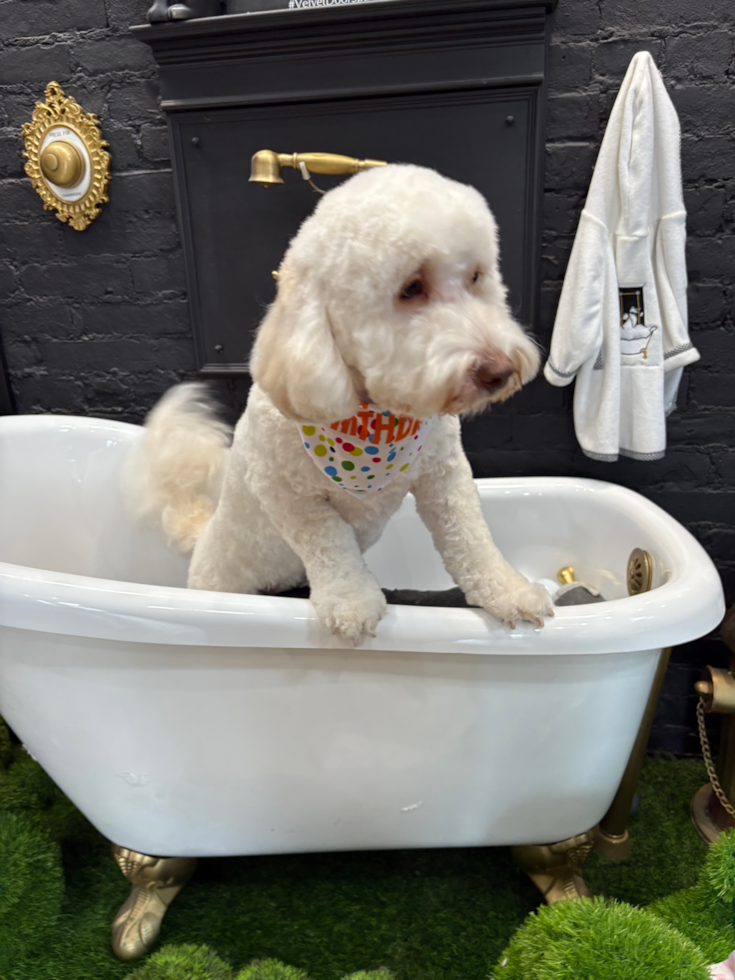
Mini Labradoodles commonly fall around 15 to 30 pounds, with many standing somewhere around 14 to 17 inches. Some dogs sit outside those ranges because mini sizing is not standardized.
The body is generally athletic and sturdy. Labrador influence can add muscle, while the Poodle can lighten the frame and reduce overall size.
A Mini Labradoodle may therefore feel surprisingly solid even when it weighs only 20 pounds. The body is suited to running, swimming, retrieving, and active family life rather than delicate companion-dog activity.
Mini Labradoodle Coat Type and Texture
Mini Labradoodles can have straight, wavy, or curly coats. The Labrador Retriever contributes a short, dense double coat with excellent weather resistance. The Poodle contributes dense curls that hold loose hair inside the coat.
Loose waves are especially familiar in Mini Labradoodles. This texture can create the soft shaggy look many people associate with the cross while preserving an athletic outline underneath.
Curlier dogs usually leave less visible hair around the home. Straighter coats may show more Labrador-style shedding and can feel less fluffy despite still carrying facial furnishings.
Mini Labradoodle Colors and Markings
The Labrador Retriever naturally contributes black, yellow, and chocolate. Poodle ancestry expands the color possibilities considerably.
Mini Labradoodles may appear in black, chocolate, brown, cream, apricot, caramel, red, gray, or other shades. White markings and more complex patterns can appear in some lines.
Solid colors are particularly common-looking in the cross. A black or chocolate Mini Labradoodle can have a very different visual presence from a cream or apricot dog with the same body type.
Some Poodle-influenced colors can lighten with age, so the adult shade may look softer than the puppy coat.
Mini Labradoodle Eyes and Facial Features
Mini Labradoodles usually have brown or dark brown eyes, with lighter brown shades possible in some chocolate dogs.
Labrador influence can create a broader head and stronger muzzle. Greater Poodle influence can narrow the face and create a more refined outline.
The ears hang beside the face and may carry soft waves or curls. Facial furnishings around the muzzle and brows create the classic Doodle expression.
The overall look is generally friendly and alert without the very heavy shaggy effect associated with the Old English Sheepdog.
Mini Labradoodle Build and Size
Mini Labradoodles usually have the lighter, sportier body in this comparison. Labradors were built for repeated movement on land and through water. Their strong hindquarters and sturdy frames support energetic retrieving and swimming.
Miniature Poodle influence reduces the overall body size while keeping plenty of athletic ability. A healthy Mini Labradoodle can therefore handle long walks, hiking, swimming, retrieving, and active games.
This smaller athletic package can be attractive for households that want a genuine working-dog personality without the physical size of a full Labrador.
Mini Labradoodle Shedding
Mini Labradoodle shedding can vary from very low to noticeable. The Labrador is a natural shedder despite its short coat. Poodle ancestry can reduce visible hair substantially when the dog inherits stronger curl and furnishings.
Straight or lightly waved dogs may release more hair, especially when more undercoat is present. Curly dogs may leave less hair around the house but need more brushing because loose strands stay caught inside.
Low shedding and easy grooming are not the same thing.
Mini Labradoodle Grooming Needs
Wavy and curly Mini Labradoodles require regular brushing and combing to prevent mats. Behind the ears, under the legs, around collars and harnesses, and through the tail can tangle quickly. A coat that looks fluffy on top may still have tight knots closer to the skin.
Straighter dogs may need more undercoat management and somewhat less clipping. Professional grooming is common for furnished coats. Short practical trims can make care much easier for dogs that swim, hike, or spend a lot of time outdoors.
Mini Sheepadoodle Appearance
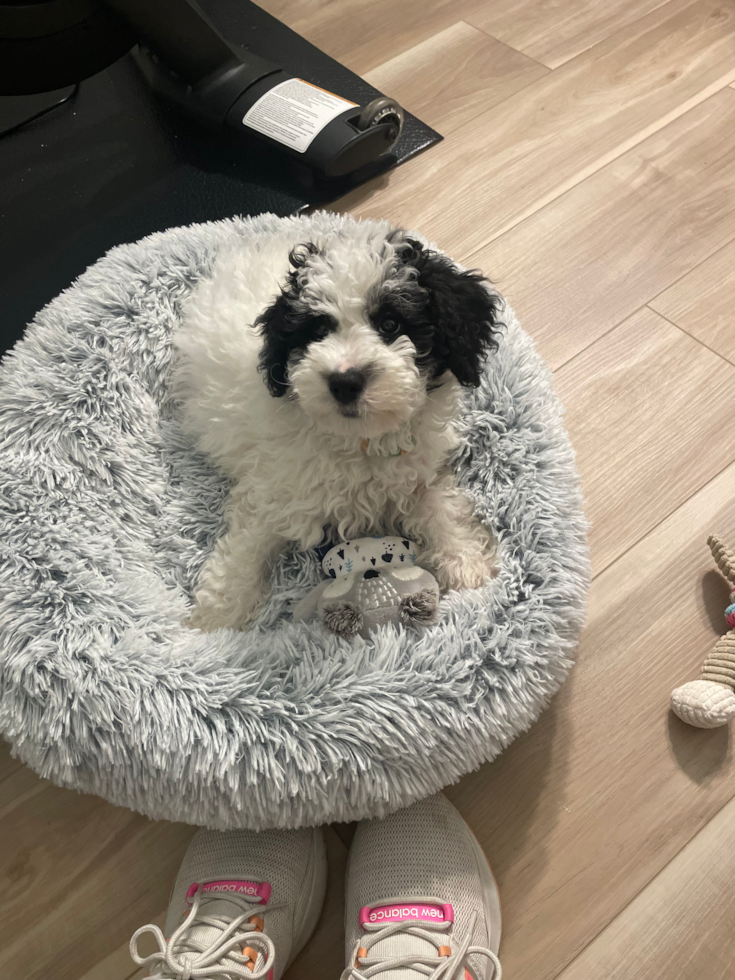
Mini Sheepadoodles commonly fall around 25 to 45 pounds and approximately 15 to 20 inches tall. Some sit below or above those ranges.
The Old English Sheepdog contributes a sturdy, square body with substantial bone. Miniature Poodle influence reduces size and can add a little more refinement.
The dog can still feel much heavier than its height suggests. Thick coat adds visual bulk, but plenty of genuine muscle and bone also sit underneath.
Mini Sheepadoodle Coat Type and Texture
Mini Sheepadoodle coats can be shaggy, wavy, or curly. Old English Sheepdogs have profuse double coats with a dense undercoat and a textured outer coat. Poodles contribute dense curls.
The combination can create an especially full coat with considerable volume. Some dogs develop loose shaggy waves, while others have stronger curls.
Cottony textures can be particularly prone to matting because hairs grip one another easily. A coat that feels wonderfully soft can therefore ask for serious upkeep.
Mini Sheepadoodle Colors and Markings
Black and white is one of the most recognizable Mini Sheepadoodle combinations. Many puppies also develop more gray or silver tones as adult hair grows in.
Old English Sheepdog colors include shades such as gray, grizzle, blue, and blue-gray, frequently paired with white. Poodle ancestry can widen the possibilities further.
Mini Sheepadoodles may therefore appear black and white, gray and white, blue-gray and white, brown, silver, or other Poodle-influenced combinations.
These cooler shades create a strong contrast with the black, chocolate, cream, apricot, and red palette frequently seen in Mini Labradoodles.
Mini Sheepadoodle Eyes and Facial Features
Mini Sheepadoodles can have brown eyes, blue eyes, or one of each. Old English Sheepdogs allow both dark and blue eyes, which gives the cross more eye-color variety than the Mini Labradoodle usually has.
The head may look broader and more square when Sheepdog traits show strongly. Poodle influence can refine the muzzle.
Heavy hair around the face creates the classic shaggy appearance, although many families keep the eye area shorter for practical visibility and easier maintenance.
Mini Sheepadoodle Build and Size
The Mini Sheepadoodle is generally the heavier-built dog. Old English Sheepdogs are compact, muscular workers with substantial bone. Even after downsizing, that physical foundation can create a Mini Sheepadoodle that feels sturdy and broad.
The dog is not slow simply because it looks heavy. Old English Sheepdogs are agile and capable workers, and the Poodle adds another athletic influence. Mini Sheepadoodles can therefore enjoy hiking, long walks, play, and outdoor family activity while carrying noticeably more body mass than many Mini Labradoodles.
Mini Sheepadoodle Shedding
Mini Sheepadoodle shedding also varies. Old English Sheepdogs carry dense double coats, while the Poodle contributes very low visible shedding. Curlier dogs may leave surprisingly little hair around the home.
Shaggier dogs with stronger undercoat can release more. Some loose hair also stays caught inside the coat rather than dropping onto furniture.
That trapped hair needs to come out through brushing before it contributes to mats.
Mini Sheepadoodle Grooming Needs
The Mini Sheepadoodle usually has the more demanding grooming profile. Old English Sheepdogs already require serious coat maintenance, and adding Poodle texture can create a dense combination that tangles quickly.
The coat needs to be brushed and combed all the way through, not merely smoothed across the surface. Behind the ears, beneath the legs, around the neck, through the rear, and around the feet deserve special attention.
A shorter professional trim can dramatically simplify care. Families who love the dramatic full shaggy look should understand that keeping it comfortable requires regular work.
Mini Labradoodle vs Mini Sheepadoodle Appearance Comparison: What Is the Difference?
The clearest physical difference is sporting compactness versus shaggy working-dog substance.
The Mini Labradoodle usually carries a lighter, more athletic body. Labrador Retriever influence adds muscle without the heavy bone of an Old English Sheepdog.
The Mini Sheepadoodle generally has a broader frame and more total body mass. Thick coat can exaggerate the effect, but the extra substance is not merely hair.
Size reflects that difference. Mini Labradoodles often sit around 15 to 30 pounds, while Mini Sheepadoodles commonly occupy the 25-to-45-pound range.
Their coats also create distinct visual styles. Mini Labradoodles can range from relatively straight to strongly curled, with many soft wavy coats in between. Mini Sheepadoodles commonly carry greater volume and a shaggier or denser appearance.
If you want a compact athletic Doodle with retriever structure, the Mini Labradoodle may appeal more. If you prefer a sturdy shaggy dog with dramatic coat volume and Old English Sheepdog coloring, the Mini Sheepadoodle has a very different presence.
Mini Labradoodle vs Mini Sheepadoodle Temperament
Both dogs can be affectionate, clever, social family companions. Their biggest temperament difference is not friendliness or intelligence. It is what tends to capture their attention and drive their behavior.
The Mini Labradoodle carries strong sporting ancestry. Food, toys, water, retrieving, people, and outdoor activity can all trigger enthusiastic interest.
The Mini Sheepadoodle carries drover ancestry. It can be equally playful while showing greater awareness of movement, household activity, and changes in the environment.
The Poodle adds responsiveness and problem-solving ability to both, which makes training especially valuable. The same intelligence that helps these dogs learn quickly also allows inconvenient habits to stick when they repeatedly work.
Mini Labradoodle Temperament
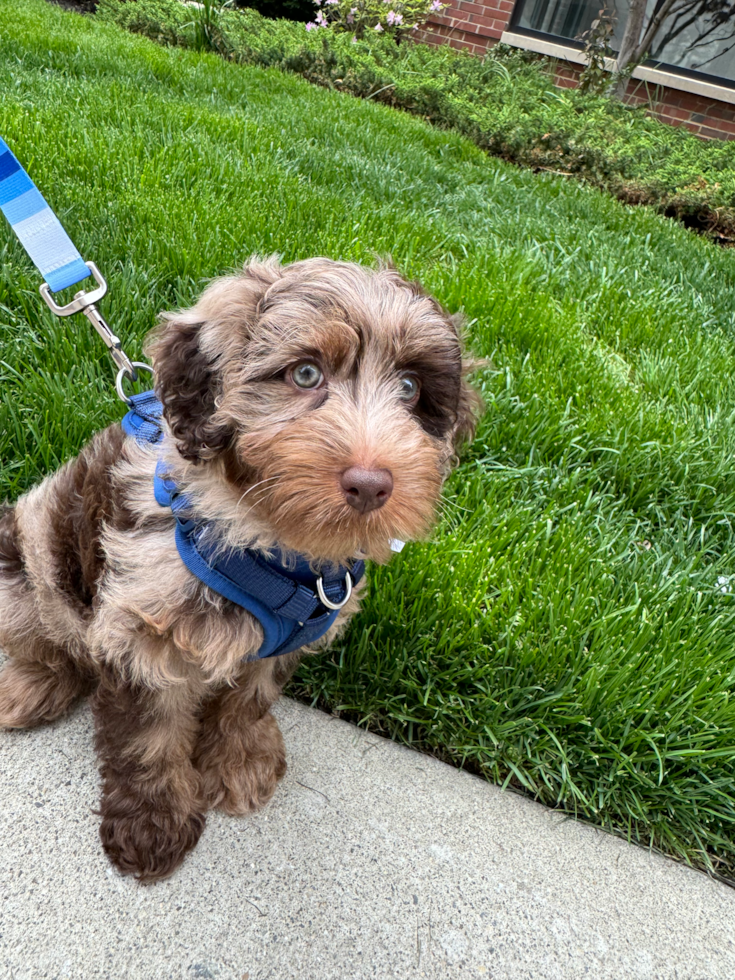
Mini Labradoodles tend to be outgoing, cheerful, energetic dogs that enjoy active involvement with people.
Labrador influence can add considerable enthusiasm. Food, visitors, toys, swimming, walks, and other dogs may all inspire a big response from a relatively compact dog.
The Poodle adds another people-oriented working breed and often sharpens the dog's ability to learn routines quickly.
This combination suits families that genuinely enjoy interacting with their dog rather than wanting a companion that is content to watch from the sidelines.
Mini Labradoodle Intelligence and Training
Mini Labradoodles have excellent training potential. Labradors are used for hunting, assistance work, detection, search and rescue, guide work, and other demanding roles. Poodles are similarly versatile learners.
Many Mini Labradoodles respond readily to positive reinforcement. Food can be especially powerful, while toys, praise, retrieving, and access to activities can also work well.
Training should include self-control from the beginning. Knowing how to sit is useful, but knowing how to sit when someone drops food or another dog runs past is much more valuable.
Mini Labradoodle Energy Level
Mini Labradoodles generally have moderate to high energy. Labrador Retrievers are active sporting dogs, and Poodles add another athletic influence. A Mini Labradoodle can therefore need much more activity than someone expects from its modest body size.
Brisk walks, retrieving, swimming, training, sniffing, and active games can all contribute to a satisfying routine.
The dog does not need endless exercise. Mental engagement and deliberate calm time are equally important, especially during adolescence.
Mini Labradoodle Retrieving Instinct
Retrieving is one of the clearest strengths in the Mini Labradoodle. Labradors were developed around carrying and retrieving, while Poodles add their own water-retriever history. Both sides can therefore reinforce interest in picking objects up and bringing them back.
Fetch can provide easy exercise and training. A ball, soft toy, or floating object can turn an ordinary activity into something highly satisfying for the dog.
Carrying behavior can also appear around the home. Teaching which objects are available prevents socks, shoes, and children's toys from entering the retrieving rotation.
Mini Labradoodle Food Motivation
Many Mini Labradoodles show strong food interest through the Labrador side. This can make training wonderfully efficient. Small rewards can reinforce recall, leash manners, grooming cooperation, polite greetings, and calm behavior.
The same appetite can create counter surfing or opportunistic food hunting when household management is loose.
Used thoughtfully, food motivation is one of the cross's biggest training advantages rather than a problem.
Mini Labradoodle Water Interest
The Mini Labradoodle has excellent aquatic ancestry. The Labrador's early history centers on Newfoundland water dogs and work around fishermen. Poodles bring another strong water-retrieving background.
Many Mini Labradoodles enjoy swimming, retrieving floating toys, and joining families around safe water.
Individual preference still matters, and dogs should always get a gradual, positive introduction rather than being forced into deep water.
Mini Labradoodle Affection and Social Style
Mini Labradoodles generally have an outgoing social personality. Labrador Retrievers are famously friendly, and the Poodle adds another breed that forms close relationships with people. Many dogs show strong interest in visitors as well as family.
Affection can be enthusiastic. Bringing toys, following people, leaning into contact, and checking whether anything interesting is happening can all feature in daily life.
Independence should still be practiced so that strong social interest does not create difficulty during normal periods alone.
Mini Labradoodles With Children
Mini Labradoodles can be excellent family dogs. Their smaller size can give families plenty of Labrador-style playfulness without the full physical power of a 70-pound retriever. Older children may especially enjoy fetch, swimming, walks, training, and outdoor games.
Young dogs can still be exuberant. Jumping, rushing into games, or carrying toys through crowded rooms can create accidental bumps around toddlers.
Calm greetings and impulse control help turn the dog's friendliness into good family manners.
Mini Labradoodles With Other Dogs and Pets
Mini Labradoodles usually have strong potential with other dogs. Labradors are broadly social, and Poodles can also live comfortably with canine companions. An active playmate may suit a lively Mini Labradoodle extremely well.
The main challenge can be enthusiasm. A quieter dog may need breaks when the Labradoodle wants the game to continue.
Cats can also share the home successfully. Puppy chasing should be redirected, but the cross lacks the specialized movement-control background found in the Mini Sheepadoodle.
Mini Labradoodle Barking and Alertness
Mini Labradoodles can bark, though serious watchdog behavior is not usually their defining quality.
Labrador influence generally pushes the dog toward social curiosity rather than suspicion. Poodle ancestry can add more awareness of noises and outside activity.
Excitement may drive vocal behavior. Visitors, another dog, or anticipation of a walk can create plenty of noise in an enthusiastic youngster.
Teaching a calm response to predictable triggers helps keep that energy manageable.
Mini Sheepadoodle Temperament
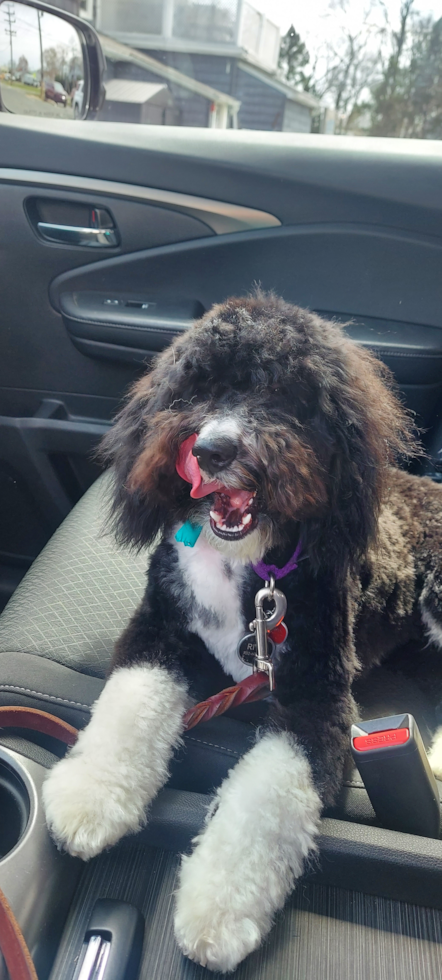
Mini Sheepadoodles tend to be affectionate, playful, intelligent dogs with a stronger awareness of movement and household activity.
Old English Sheepdogs are known for a mellow, agreeable side, but they are also agile working dogs that enjoy exploring and physical play. The cross should not be mistaken for a low-energy stuffed animal simply because of its shaggy appearance.
Poodle influence adds quick learning and responsiveness. This can create a dog that notices patterns around the home and quickly works out what usually happens next.
Mini Sheepadoodle Intelligence and Training
Mini Sheepadoodles have excellent training potential. Old English Sheepdogs are intelligent, agreeable workers, while Poodles add another highly trainable mind. Many Mini Sheepadoodles learn household routines quickly.
Variety can make training more effective. Short sessions that mix obedience, tricks, search games, and impulse-control exercises may hold attention better than constant repetition.
Movement-related skills deserve special attention. Recall, leave it, settling, and calmly watching activity can make everyday life much easier when the dog shows strong drover influence.
Mini Sheepadoodle Energy Level
Mini Sheepadoodles generally have moderate to moderately high energy. Old English Sheepdogs are large, able-bodied workers that require regular exercise, while Poodles add more athletic ability.
Their energy can feel different from a Mini Labradoodle's. Instead of focusing so heavily on retrieving and water, the Mini Sheepadoodle may show more interest in romping, following activity, exploring, wrestling, or joining whatever is happening around the home.
A healthy adult needs genuine daily exercise but can also develop a comfortable indoor rhythm when calm behavior is taught alongside activity.
Droving and Movement Awareness in Mini Sheepadoodles
Old English Sheepdogs were developed mainly as drovers, helping move sheep and cattle toward market.
That history can show as greater interest in movement. Some Mini Sheepadoodles may follow running children closely, circle groups, block paths, or use their bodies during play as though the movement itself needs supervision.
Not every dog displays these behaviors strongly. When they do appear, early redirection is much easier than allowing the habit to grow through repeated practice.
Recall, place training, calm observation, and structured games give the dog clearer ways to respond when family activity gets exciting.
Mini Sheepadoodle Play Style
Mini Sheepadoodles can have an especially physical and entertaining play style. The Old English Sheepdog is a sturdy dog that enjoys a good romp. Poodle influence adds agility and speed, which can create an energetic combination.
Wrestling, chasing toys, running around the yard, and active interaction with other dogs may all hold strong appeal.
This can make the cross great fun in an active family. A quieter household may need to put more effort into teaching the dog when playtime is over.
Mini Sheepadoodle Affection and Family Attachment
Mini Sheepadoodles tend to form strong bonds with their families. Old English Sheepdogs have long been valued as affectionate household companions in addition to their working history, while Poodles add another people-focused influence.
Many Mini Sheepadoodles like to stay involved with whatever the family is doing. Affection can combine cuddling with a desire to supervise the day's activity.
Comfortable alone time still deserves practice so closeness does not turn into overdependence.
Mini Sheepadoodles With Children
Mini Sheepadoodles can make wonderful family dogs and are frequently playful with children.
Their sturdy bodies can handle active family life, and their intelligence gives children plenty of ways to participate through games and training.
The main consideration is movement-focused behavior. Running children may inspire following, circling, bumping, or attempts to control where the game goes.
Those behaviors are usually easier to manage when adults recognize them early and teach a calmer alternative.
Mini Sheepadoodles With Other Dogs and Pets
Mini Sheepadoodles generally have good potential with other dogs. Many enjoy active canine play and can be enthusiastic wrestling or chasing partners. Another sturdy dog with similar energy may be an excellent match.
Some individuals may try to influence another dog's movement during play. A dog that keeps circling or following after the other animal has disengaged needs help learning when the interaction is finished.
Cats can also live successfully with the cross, though a running cat may attract more interest than it would from some retriever-based mixes.
Mini Sheepadoodle Barking and Watchfulness
The Mini Sheepadoodle generally has the stronger watchful side. Old English Sheepdogs are sensible watchdogs and are known for a loud, distinctive bark. Their historical work also rewarded awareness of what was happening in the surrounding environment.
A Mini Sheepadoodle may therefore notice visitors, outdoor activity, hallway sounds, or unfamiliar movement more readily than a Mini Labradoodle.
Training can keep that awareness useful. A dog can alert once and then learn that the family has the situation under control.
Mini Labradoodle vs Mini Sheepadoodle Temperament Comparison: What Is the Real Difference?
The clearest temperament distinction is retriever enthusiasm versus drover awareness.
The Mini Labradoodle generally directs more attention toward people, food, toys, water, and retrieving. Labrador influence can create a dog that approaches life with broad enthusiasm and finds direct interaction extremely rewarding.
The Mini Sheepadoodle generally adds more awareness of movement and household activity. Old English Sheepdog influence can create a dog that notices who is running, where another pet is going, who has entered the house, and whether something interesting needs its attention.
Both are playful, but the play can feel different. A Mini Labradoodle may repeatedly bring a ball back because the retrieving cycle itself is rewarding. A Mini Sheepadoodle may be equally entertained by the people running after the ball and the dog trying to join or organize the action.
Training priorities differ for the same reason. Mini Labradoodles may need extra work around impulse control when food, water, dogs, or toys are exciting. Mini Sheepadoodles may need extra work around disengaging from movement, watchfulness, and knowing when physical play is finished.
Neither style is better. The right choice depends on which set of behaviors fits more naturally into the household.
Mini Labradoodle vs Mini Sheepadoodle: Which One Should You Choose?
The Mini Labradoodle and Mini Sheepadoodle can both offer intelligence, affection, playfulness, and enough athletic ability for an active family. Their differences show most clearly through size, working instincts, grooming, and the type of interaction they seek.
The Mini Labradoodle is usually smaller, sportier, and more focused on classic retriever activities. The Mini Sheepadoodle generally carries more physical substance, a heavier coat, and a greater chance of watchful or movement-focused behavior.
Choose a Mini Labradoodle if You Want a Compact Sporting Companion
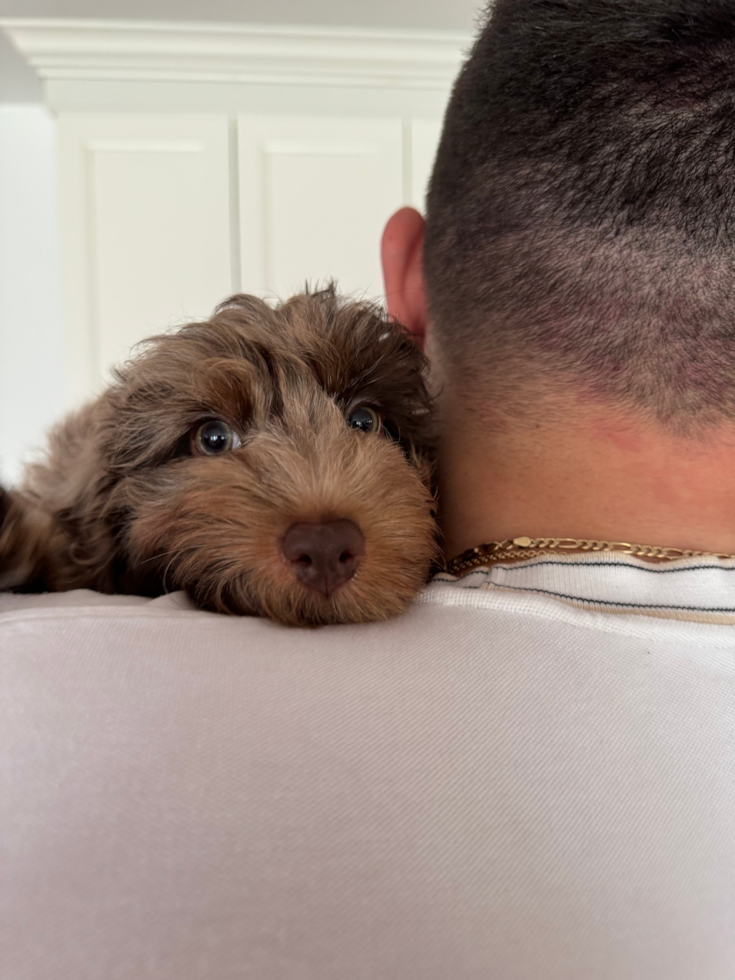
A Mini Labradoodle puppy may suit you better if you enjoy walking, swimming, retrieving, training, travel, and a dog that approaches shared activities with obvious enthusiasm.
Labrador and Poodle ancestry gives the cross two strong working backgrounds tied to water and retrieval. That can make exercise easy to build around activities the dog naturally enjoys.
The smaller average body can also simplify travel, lifting, apartment living, and everyday handling.
The tradeoff is youthful intensity. A Mini Labradoodle may need plenty of work around jumping, excitement, food manners, and learning how to relax when nothing interesting is happening.
Choose a Mini Sheepadoodle if You Want a Sturdy, Playful Working Companion
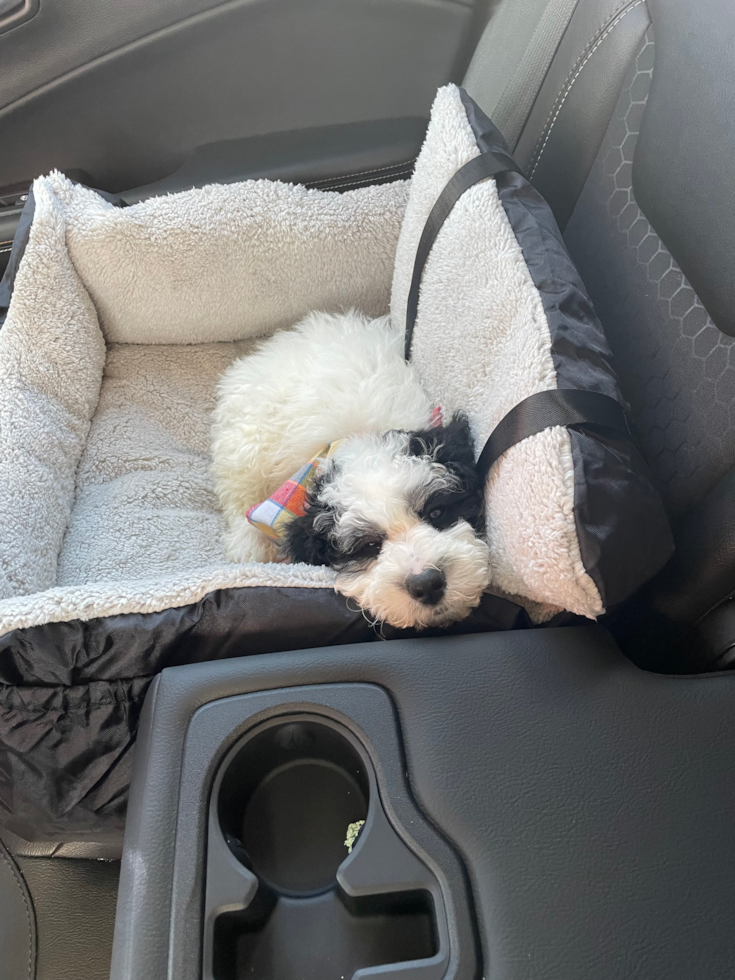
A Mini Sheepadoodle puppy may suit you better if you want a larger small-to-medium dog with a substantial body, a playful personality, and more of a shaggy working-dog feel.
Old English Sheepdog influence can add watchfulness and a strong awareness of family activity. The dog may enjoy being involved in everything without directing that enthusiasm primarily toward fetch or water.
The cross can work especially well for families that enjoy physical play and do not mind teaching boundaries around chasing, circling, barking, or following when those habits appear.
The main practical commitment is coat care. A Mini Sheepadoodle can ask for significantly more grooming than its cute shaggy appearance suggests.
Which Is Bigger: Mini Labradoodle or Mini Sheepadoodle?
The Mini Sheepadoodle is usually larger and heavier. Mini Labradoodles commonly fall around 15 to 30 pounds, while Mini Sheepadoodles often sit around 25 to 45 pounds. There is overlap, but the difference can be substantial at the opposite ends of those ranges.
Body structure adds to the effect. Old English Sheepdog ancestry contributes more bone and a squarer frame, while Mini Labradoodles generally have the lighter body of a sporting cross.
For families concerned about lifting, carrying, travel, or limited floor space, the Mini Labradoodle usually offers the easier physical size.
Which Is Calmer: Mini Labradoodle or Mini Sheepadoodle?
The answer is closer than their working histories might suggest. Mini Labradoodles can bring plenty of Labrador exuberance, especially during puppyhood and adolescence. Food, water, visitors, toys, and other dogs can inspire an energetic response.
Old English Sheepdogs are active workers but also have a mellow, agreeable side. A Mini Sheepadoodle may therefore show considerable playfulness and watchfulness without constantly asking for high-speed exercise.
The better distinction is what activates them. Labradoodles may react more strongly to opportunities for action, while Sheepadoodles may pay more attention to movement and changes around the environment.
Which Is More Energetic?
The Mini Labradoodle may have the slight advantage for sustained sporting energy. Labrador Retrievers were designed for repeated retrieves and can work enthusiastically for long periods. Poodle ancestry reinforces athletic ability.
Mini Sheepadoodles need real exercise too. Old English Sheepdogs are agile, strong workers, and their shaggy appearance should not be confused with laziness.
The Labradoodle may ask for more retrieving, swimming, and forward activity, while the Sheepadoodle may use more of its energy through romping, exploring, and physically interactive play.
Which Needs More Mental Stimulation?
Both need regular mental engagement, but the type of work can differ. Mini Labradoodles can benefit from retrieving exercises, scent games, food-based training, obedience, and swimming activities. These give the dog structured ways to use sporting intelligence.
Mini Sheepadoodles may especially benefit from impulse-control exercises and games that teach them to notice movement without reacting to everything they see.
Neither dog requires an endless supply of puzzles. Short, thoughtful training sessions woven into ordinary life can satisfy the brain far better than constant entertainment.
Which Is Easier to Train?
Both are excellent learners, but the Mini Labradoodle may have a slight advantage for straightforward reward-based training.
Labrador Retrievers are famously food motivated and cooperative, while Poodles add fast problem-solving ability. That combination can make training extremely efficient.
Mini Sheepadoodles also have plenty of intelligence. Their Old English Sheepdog side can respond well to training but may appreciate more variety and less repetition.
The Sheepadoodle may also need more specific work around movement and alert behavior, while the Labradoodle may need more self-control around highly rewarding distractions.
Which Is Better for First-Time Dog Owners?
The Mini Labradoodle may have the easier overall profile for many first-time owners, especially those who enjoy training and regular exercise.
Its smaller size can simplify physical management, and food motivation can make the learning process very clear. The challenge is keeping up with sporting enthusiasm during the younger years.
A Mini Sheepadoodle can also make an excellent first dog, but the owner should be comfortable with heavier grooming and the possibility of watchful or movement-focused behavior.
Detailed customer reviews from people who live with either cross can help first-time owners understand how exercise, adolescence, grooming, and household behavior feel beyond the puppy stage.
Which Is Better With Young Children?
Both can be excellent with children, but their challenges are different. The Mini Labradoodle may have the simpler instinct profile around running children because it lacks the Old English Sheepdog's drover history. Its main issue is likely to be enthusiasm, such as jumping or rushing into a game.
The Mini Sheepadoodle can be patient, affectionate, and playful with children. Running and shouting may simply trigger more interest in following or influencing the movement.
Teaching calm greetings helps the Labradoodle, while teaching disengagement from movement can be especially useful for the Sheepadoodle.
Which Is Better With Older Children?
Both can be fantastic with older children who enjoy interacting with the dog. The Mini Labradoodle offers easy shared activities through fetch, swimming, walking, hiking, scent games, and training. Its sporting background gives children plenty of structured ways to participate.
The Mini Sheepadoodle can add a more clownish physical personality. Tricks, outdoor play, exploration, and active games can make the dog extremely entertaining.
The better choice depends on whether the family leans toward retriever-style games or more general physical play and working-dog interaction.
Which Is Better With Other Dogs?
Both can live very successfully with other dogs. Mini Labradoodles generally bring broad Labrador sociability and may enjoy long sessions of running or retrieving with another active companion.
Mini Sheepadoodles can also be highly playful. Their style may include more wrestling, following, or attention to where the other dog is moving.
A calm senior may find either energetic adolescent tiring, but the movement-focused habits of a Sheepadoodle deserve particular attention if another dog dislikes being followed or managed.
Which Is Better With Cats?
The Mini Labradoodle may have a slight advantage for cat households, especially when the cat prefers a quiet relationship.
Neither cross has terrier-style vermin history, but Old English Sheepdog ancestry can make movement particularly interesting to the Mini Sheepadoodle.
A running cat may therefore trigger following or chasing more readily. This is usually connected to movement rather than hunting intent.
Early calm introductions, retreat areas for the cat, and rewards for disengaging help either cross learn respectful boundaries.
Which Has Stronger Herding or Droving Behavior?
The Mini Sheepadoodle has the clear advantage for movement-control behavior. Old English Sheepdogs were used mainly as drovers to help move sheep and cattle to market. Some Mini Sheepadoodles may show this heritage by circling, following, blocking, body positioning, or paying intense attention to running people or animals.
Mini Labradoodles do not have the same background. Their working instincts center much more heavily on retrieving and water work.
Families with young children, cats, or several dogs may find this one of the most useful differences between the crosses.
Which Likes Fetch More?
The Mini Labradoodle has the stronger natural foundation for fetch. Labrador Retrievers and Poodles both have retrieving history. Many Mini Labradoodles therefore enjoy picking up objects, carrying toys, and repeating retrieving games.
Mini Sheepadoodles can enjoy fetch too, especially through Poodle influence. Old English Sheepdog ancestry simply does not reinforce the behavior to the same degree.
If regular ball games are already part of the dog life you picture, the Mini Labradoodle is the more natural fit.
Which Is Better for Swimming?
The Mini Labradoodle has the stronger water-working background. Labrador ancestors worked around Newfoundland fisheries, and the modern Lab developed into an exceptional water retriever. Poodles also have deep aquatic working history.
Mini Sheepadoodles can certainly swim and may enjoy water, but their Old English Sheepdog side does not add specialized aquatic ability.
Their dense coats can also hold a significant amount of water, which means swimming may lead to more drying and detangling afterward.
Which Is More Food Motivated?
The Mini Labradoodle usually has the stronger tendency toward food motivation. Labradors have a famous appetite, and this trait can make training easier when rewards are used thoughtfully. Recall, polite greetings, handling, and leash skills can all benefit.
Food enthusiasm also requires sensible boundaries. Counters, bags, dropped snacks, and unattended plates can look extremely appealing to a clever dog.
Mini Sheepadoodles may enjoy food rewards too, but it is less central to their typical working style.
Which Is More Watchful?
The Mini Sheepadoodle usually has the stronger watchful side. Old English Sheepdogs were working dogs that needed to pay attention to livestock and their surroundings. They are also known as sensible watchdogs with a powerful bark.
A Mini Sheepadoodle may therefore notice visitors, outdoor movement, unusual sounds, or changes around the home quickly.
Mini Labradoodles can alert too, but their Labrador side generally pushes them toward social curiosity rather than a strong watchdog attitude.
Which Is More Likely to Bark?
The Mini Sheepadoodle may have the greater tendency toward alert barking. Old English Sheepdogs are known for a distinctive, loud bark, and their watchful nature can carry into the cross.
Mini Labradoodles may bark more from excitement. A visitor, another dog, food preparation, or anticipation of an outing can all trigger enthusiastic noise.
Training matters with either dog, but the reason behind the barking can guide the solution. One may need help settling excitement, while the other may need more practice noticing activity without continuing to announce it.
Which Is More Social With Strangers?
The Mini Labradoodle usually has the stronger tendency toward immediate outgoing sociability.
Labradors are famously friendly, confident dogs, and Poodles can add another socially responsive influence.
Mini Sheepadoodles can also be friendly and affectionate, but Old English Sheepdog watchfulness may create a little more initial observation in some dogs.
A socially confident dog does not need to greet everyone. Calm comfort around unfamiliar people is more important than automatic enthusiasm.
Which Is More Affectionate?
Both can be extremely affectionate, so there is no useful universal winner. The Mini Labradoodle may express affection through enthusiastic involvement. Toys, games, greetings, physical contact, and following family members can all form part of the bond. The Mini Sheepadoodle may mix cuddling with a strong desire to stay aware of family activity. It may want to rest nearby while still keeping track of where everyone is going.
The better choice depends on whether you prefer retriever-style enthusiasm or a more watchful, shaggy working-dog personality.
Which Sheds Less: Mini Labradoodle or Mini Sheepadoodle?
There is no dependable universal winner. Both combine a Poodle with a breed that naturally carries a shedding double coat. Labradors release plenty of short dense hair, while Old English Sheepdogs carry a profuse undercoat and longer outer coat.
Curlier individuals in either cross may leave very little visible hair. Straighter or shaggier dogs may release more.
Customer reviews that mention adult coat texture and shedding can give readers a useful picture of what each type feels like in a real home.
Which Needs More Grooming?
The Mini Sheepadoodle usually needs more grooming. Old English Sheepdogs already have an extremely substantial coat, and combining that density with Poodle texture can create serious matting potential.
Mini Labradoodles can also require regular brushing, combing, and professional grooming. Their coats simply tend to involve less total volume.
Owners drawn to the dramatic full Sheepadoodle coat should understand that a shorter practical haircut can save significant time while keeping the dog more comfortable.
Which Is Better for Allergies?
Neither cross can be guaranteed suitable for dog allergies. Poodle influence can reduce visible shedding, but allergens come from saliva and dander as well as hair.
A low-shedding Mini Labradoodle or Mini Sheepadoodle can still trigger symptoms in a sensitive person.
Direct personal tolerance is much more useful than assuming the word Doodle automatically means allergy-friendly.
Which Is Better for Apartment Living?
The Mini Labradoodle usually has the easier apartment profile, mainly because it tends to be smaller and less watchful.
Its higher sporting energy still needs an outlet. Regular walks, play, training, and outdoor activity are important even when the dog fits neatly into the home.
Mini Sheepadoodles can live successfully in apartments too, but their heavier bodies, coat care, watchfulness, and possible barking can make compact living more demanding.
A good routine matters more than simply having a yard. Either dog can struggle in a large house when physical and mental needs are ignored.
Which Is Better for Seniors?
The Mini Labradoodle may suit more active seniors who value a lighter dog. Its smaller average size can simplify lifting, travel, grooming appointments, and physical handling. The owner should still enjoy regular walking because the cross can have significant energy.
A Mini Sheepadoodle may suit someone who prefers a sturdier companion and enjoys grooming or uses professional grooming consistently.
Individual adult energy matters in either case, so owner reviews that discuss mature dogs can provide especially useful perspective.
Which Is Better for an Active Lifestyle?
The Mini Labradoodle may have a slight advantage for a consistently active lifestyle. Labrador and Poodle ancestry supports swimming, retrieving, hiking, training, and sustained outdoor activity. The smaller body can also make travel convenient.
Mini Sheepadoodles are very capable active dogs too. Hiking, exploration, physical play, and training can all suit them extremely well.
The difference is less about ability and more about preferred activity. The Labradoodle usually leans toward sporting pursuits, while the Sheepadoodle may enjoy broader physical interaction and exploration.
Which Handles Cold Weather Better?
The Mini Sheepadoodle may have a slight advantage in colder conditions when its dense coat is kept at a useful length.
Old English Sheepdogs have profuse double coats developed for outdoor work in the British countryside. Their heavier bodies can also provide more insulation.
Labradors handle cold and cold water impressively because of their dense weather-resistant coats, and Mini Labradoodles can enjoy winter activity too.
Poodle influence and grooming style change the equation for either cross. A short clip offers less insulation than a longer winter coat.
Which Handles Warm Weather Better?
The Mini Labradoodle generally has the easier warm-weather profile because it is usually lighter and carries less total coat.
Mini Sheepadoodles can have dense, heavy coats and substantial bodies, which can make hot and humid conditions more challenging.
Mini Labradoodles can still overheat during vigorous exercise. Their enthusiasm may encourage them to keep playing when a break would be wiser.
Cooler walking hours, shade, fresh water, and indoor cooling are sensible for both.
Which Has the More Demanding Puppy Stage?
Both can test a household, but the challenges differ. A Mini Labradoodle puppy may bring intense curiosity, chewing, food interest, jumping, retrieving, and seemingly endless enthusiasm for activity. Teaching impulse control early can make adolescence much smoother.
A Mini Sheepadoodle puppy may add physical play, watchfulness, coat care, and movement-focused behavior to the usual puppy challenges. A larger body can also make poor manners more noticeable quickly.
Neither puppy is automatically difficult. The better fit depends on which type of training the household is more willing to do consistently.
Mini Labradoodle vs Mini Sheepadoodle: The Final Comparison
Choosing between a Mini Labradoodle vs Mini Sheepadoodle gets much easier once you stop comparing fluffy coats and start comparing the working instincts underneath them.
The Mini Labradoodle adds the Labrador Retriever, an outgoing sporting dog whose history runs from Newfoundland fisheries to skilled hunting retrieval. That influence can create a compact athlete with strong food motivation, water enthusiasm, retrieving instinct, broad sociability, and plenty of energy for shared activities.
The Mini Sheepadoodle adds the Old English Sheepdog, a sturdy British drover developed to help move livestock. That influence can create a heavier, shaggier dog with more watchfulness, physical playfulness, and greater interest in movement around the household.
Their sizes create a practical divide. Mini Labradoodles frequently fit into the 15-to-30-pound range, which can make travel, lifting, and smaller homes easier. Mini Sheepadoodles commonly sit closer to 25 to 45 pounds and may feel even more substantial because of their bone and coat.
Grooming also deserves real weight in the decision. Both can mat and both may need professional grooming, but the Mini Sheepadoodle generally carries the more demanding coat. The Old English Sheepdog's profuse hair combined with Poodle texture can turn a long coat into a serious weekly commitment.
Their family personalities overlap in affection but differ in focus. The Mini Labradoodle often wants to participate through toys, food, water, retrieving, and direct interaction. The Mini Sheepadoodle may pay more attention to movement, play, visitors, and where everyone in the household is going.
For children, that distinction matters. A Labradoodle may need help controlling enthusiasm. A Sheepadoodle may need help controlling enthusiasm and learning that running children do not need to be followed or organized.
For active owners, both offer plenty. The Mini Labradoodle has the clearer sporting advantage for swimming and retrieving. The Mini Sheepadoodle can be a wonderful hiking and play companion with a more substantial working-dog feel.
If you want a smaller, outgoing, sporty dog with strong retrieving ability, food motivation, water enthusiasm, and easy access to interactive training, the Mini Labradoodle may fit your life better.
If you want a sturdier, shaggier companion with playful Old English Sheepdog character, greater watchfulness, and more movement awareness, the Mini Sheepadoodle may be more appealing.
Breed-specific customer reviews can add useful real-world context. Reviews that discuss adult energy, grooming time, barking, interactions with children, swimming, shedding, and behavior during normal workdays can help turn broad breed tendencies into a clearer picture of daily life.
The right choice is not which dog can do more. Both can offer far more ability than most families will ever need. The better choice is the one whose instincts, maintenance, and everyday rhythm fit comfortably into your household.
Frequently Asked Questions
What is the main difference between a Mini Labradoodle and Mini Sheepadoodle? Both share Poodle ancestry, but the Mini Labradoodle adds Labrador Retriever influence while the Mini Sheepadoodle adds Old English Sheepdog influence. The Mini Labradoodle generally leans toward retrieving, water, food motivation, broad sociability, and sporting activity. The Mini Sheepadoodle usually brings greater body substance, watchfulness, physical playfulness, and more potential for movement-focused behavior through its drover ancestry.
Which is bigger, a Mini Labradoodle or Mini Sheepadoodle? The Mini Sheepadoodle is usually bigger and heavier. Mini Labradoodles often fall around 15 to 30 pounds, while Mini Sheepadoodles commonly sit around 25 to 45 pounds. The Sheepadoodle also tends to carry heavier bone and more coat. Two dogs with only a small difference in height can therefore feel very different physically.
Which is calmer, a Mini Labradoodle or Mini Sheepadoodle? Neither cross has an overwhelming advantage for calmness. Mini Labradoodles can bring considerable Labrador enthusiasm, while Mini Sheepadoodles can bring active play and watchfulness. The difference is more about what triggers activity. Labradoodles may react strongly to food, toys, water, people, and retrieving opportunities, while Sheepadoodles may pay more attention to movement and household activity.
Which is easier to train, a Mini Labradoodle or Mini Sheepadoodle? Both are highly trainable. The Mini Labradoodle may have a slight advantage for straightforward reward-based training because Labrador food motivation and Poodle intelligence can work extremely well together. Mini Sheepadoodles also learn quickly but may need more variety and additional impulse-control work around movement. Positive, engaging training suits both crosses.
Do Mini Sheepadoodles have herding instincts? They can show behaviors tied to Old English Sheepdog drover ancestry. These may include following, circling, blocking paths, body positioning, or paying close attention to running people and animals. Not every Mini Sheepadoodle shows these habits strongly. When they appear, early redirection and good impulse-control training can make them much easier to manage.
Which sheds less, a Mini Labradoodle or Mini Sheepadoodle? There is no dependable universal winner. Both combine a low-shedding Poodle with a breed that naturally has a double coat. Curlier dogs may leave little visible hair around the home, while straighter or shaggier coats may release more. Loose hair can also stay caught inside the coat and contribute to matting instead of falling onto the floor.
Which needs more grooming, a Mini Labradoodle or Mini Sheepadoodle? The Mini Sheepadoodle usually needs more grooming. Old English Sheepdogs already have profuse double coats, and Poodle texture can add even more matting potential. Mini Labradoodles also need consistent brushing, combing, and professional trims when the coat is fluffy. The Sheepadoodle simply tends to carry more coat and more total grooming work.
Is a Mini Labradoodle or Mini Sheepadoodle better with children? Both can make excellent family companions. The Mini Labradoodle may have the simpler instinct profile around running children, although Labrador enthusiasm can create jumping or overly energetic greetings. Mini Sheepadoodles can be wonderfully affectionate and playful with children but may pay more attention to running or fast movement. Families should redirect chasing, circling, or body-blocking behavior early if it appears.
Which is better for an active family, Mini Labradoodle or Mini Sheepadoodle? Both can fit active households well. The Mini Labradoodle has the stronger natural fit for swimming, retrieving, long walks, hiking, and structured sporting games. Mini Sheepadoodles can enjoy hiking, physical play, training, and outdoor exploration just as enthusiastically. The better choice depends on whether your family prefers retriever-style activity or a sturdier, more movement-aware working companion.
Should I choose a Mini Labradoodle or Mini Sheepadoodle? Choose a Mini Labradoodle if you want a smaller, outgoing, athletic dog with strong retrieving instincts, food motivation, water enthusiasm, and a lively social personality. Choose a Mini Sheepadoodle if you want a larger, sturdier, shaggy companion with a playful working-dog temperament, stronger watchfulness, and more potential for movement-focused behavior. Both are intelligent and affectionate, but they bring very different working instincts into everyday family life.