


Published Monday, October 19, 2026 by Pilesgrove Pups
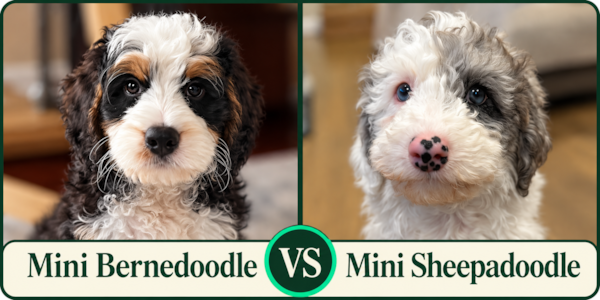
A Mini Bernedoodle vs Mini Sheepadoodle comparison can be surprisingly difficult from photographs alone. Both may grow into shaggy, wavy, or curly-coated dogs with floppy ears, expressive faces, sturdy bodies, and the oversized teddy bear look that draws so many families toward Poodle crosses in the first place.
Living with them can feel considerably different.
Both share the Miniature Poodle, so intelligence, trainability, athletic ability, close human attachment, and low-shedding coat potential can appear in either dog. The real difference comes from the other parent. The Mini Bernedoodle adds the powerful, good-natured Bernese Mountain Dog. The Mini Sheepadoodle adds the Old English Sheepdog, a strong, agile drover with genuine herding instincts and a much more movement-aware working history.
That distinction shapes far more than energy level. Bernese Mountain Dogs were versatile Swiss farm dogs whose work included pulling carts, helping move cattle, watching property, and living closely with farming families. Old English Sheepdogs were developed in western England primarily as drovers that could move sheep and cattle to market. They needed stamina, confidence, awareness, and enough physical presence to influence livestock while remaining responsive to their handlers.
The Mini Bernedoodle therefore tends to lean toward a steadier, somewhat calmer family style. The Mini Sheepadoodle can bring more bounce, watchfulness, physical play, and interest in movement. It may be more likely to follow, circle, chase, or attempt to organize activity around the home when its sheepdog ancestry comes through strongly.
Size does not separate them as neatly as people sometimes expect. Both crosses pair a very large breed with a much smaller Miniature Poodle, so adult weight can vary significantly. Mini Bernedoodles may commonly fall somewhere around 20 to 50 pounds depending on generation and parents, while many Mini Sheepadoodles mature around 25 to 45 pounds. Neither should be chosen on the assumption that “mini” means tiny.
The better choice comes down to the kind of companion you want. The Mini Bernedoodle generally offers more Bernese steadiness and a calmer working style, while the Mini Sheepadoodle adds more herding influence, playful physical energy, and shaggy sheepdog character to the shared Poodle intelligence.
Table of Contents
- Mini Bernedoodle vs Mini Sheepadoodle at a Glance
- Mini Bernedoodle and Mini Sheepadoodle Overview and History
- Mini Bernedoodle vs Mini Sheepadoodle Appearance
- Mini Bernedoodle vs Mini Sheepadoodle Temperament
- Mini Bernedoodle vs Mini Sheepadoodle: Which One Should You Choose?
- Choose a Mini Bernedoodle if You Want Greater Steadiness
- Choose a Mini Sheepadoodle if You Want a Playful, Interactive Family Dog
- Which Is Bigger: Mini Bernedoodle or Mini Sheepadoodle?
- Which Is Calmer: Mini Bernedoodle or Mini Sheepadoodle?
- Which Is More Energetic?
- Which Needs More Mental Stimulation?
- Which Is Easier to Train?
- Which Is Better for First-Time Dog Owners?
- Which Is Better With Young Children?
- Which Is Better With Older Children?
- Which Is Better With Other Dogs?
- Which Is Better With Cats?
- Which Has Stronger Herding Instincts?
- Which Is More Playful?
- Which Is More Likely to Bark?
- Which Sheds Less: Mini Bernedoodle or Mini Sheepadoodle?
- Which Needs More Grooming?
- Which Is Better for Allergies?
- Which Is Better for Apartment Living?
- Which Is Better for an Active Lifestyle?
- Which Handles Cold Weather Better?
- Which Handles Warm Weather Better?
- Which Is More Affectionate?
- Which Is More Social With Strangers?
- Which Is More Predictable in Size?
- Mini Bernedoodle vs Mini Sheepadoodle: The Final Comparison
Mini Bernedoodle vs Mini Sheepadoodle at a Glance
| Trait | Mini Bernedoodle | Mini Sheepadoodle |
| Parent breeds | Bernese Mountain Dog × Miniature Poodle | Old English Sheepdog × Miniature Poodle |
| General size | Small-medium to medium | Small-medium to medium |
| Common adult weight | About 20–50 pounds, generation-dependent | Commonly about 25–45 pounds |
| Common height | Roughly 13–22 inches | Commonly around 15–20 inches |
| Build | Broad, sturdy, substantial | Square, sturdy, muscular, agile |
| Coat | Straight, wavy, or curly | Shaggy, wavy, or curly |
| Shedding | Low to moderate, coat-dependent | Low to moderate, coat-dependent |
| Grooming | Moderate to high | High for many coats |
| Typical color influence | Black, white, rust/tan, brown, sable and other Poodle-influenced colors | Black, white, gray, blue, grizzle and Poodle-influenced colors |
| Eye colors | Usually brown | Brown, blue, or mixed colors may occur |
| Energy | Moderate | Moderate to moderately high |
| Mental stimulation | Moderate to high | Moderate to high |
| Trainability | High | High |
| Herding behavior | Usually limited | Possible and sometimes noticeable |
| Watchfulness | Moderate | Moderate to high |
| Social style | Affectionate, gentle, steady | Affectionate, playful, outgoing, watchful |
| Best fit | Families wanting a calmer, substantial Doodle | Families wanting a playful, active, shaggy companion |
These figures are useful ranges rather than standards. Neither cross has one official adult size, and generation can change the outcome considerably. The Miniature Poodle may be much smaller than either the Bernese Mountain Dog or Old English Sheepdog, which makes the actual parent dogs particularly important when adult size matters.
Mini Bernedoodle and Mini Sheepadoodle Overview and History
The Mini Bernedoodle and Mini Sheepadoodle both combine the Poodle with a large European working breed, but their non-Poodle parents were shaped around different jobs. That historical distinction gives us one of the most useful ways to understand the dogs today.
The Bernese Mountain Dog was a general-purpose Swiss farm worker. Strength was essential because Berners were used for draft work, including pulling carts, while also helping around cattle and watching farm property. Their job required usefulness around the family as well as physical capability, which helped preserve the breed's affectionate, steady temperament.
The Old English Sheepdog developed as a drover. Its job centered more heavily on moving livestock, particularly sheep and cattle, over distance. The breed needed a powerful body, agility, intelligence, watchfulness, and the willingness to stay involved in movement around it.
The Miniature Poodle adds another working background to both crosses. Poodles were developed as water retrievers and remain athletic, highly trainable dogs with excellent problem-solving ability.
Both crosses therefore have intelligence and working ability on each side. What changes is the form that working ability takes. The Mini Bernedoodle combines Poodle responsiveness with a calmer farm-dog foundation. The Mini Sheepadoodle combines Poodle intelligence with a shaggy drover whose instincts were much more closely tied to controlling movement.
Mini Bernedoodle History and Background
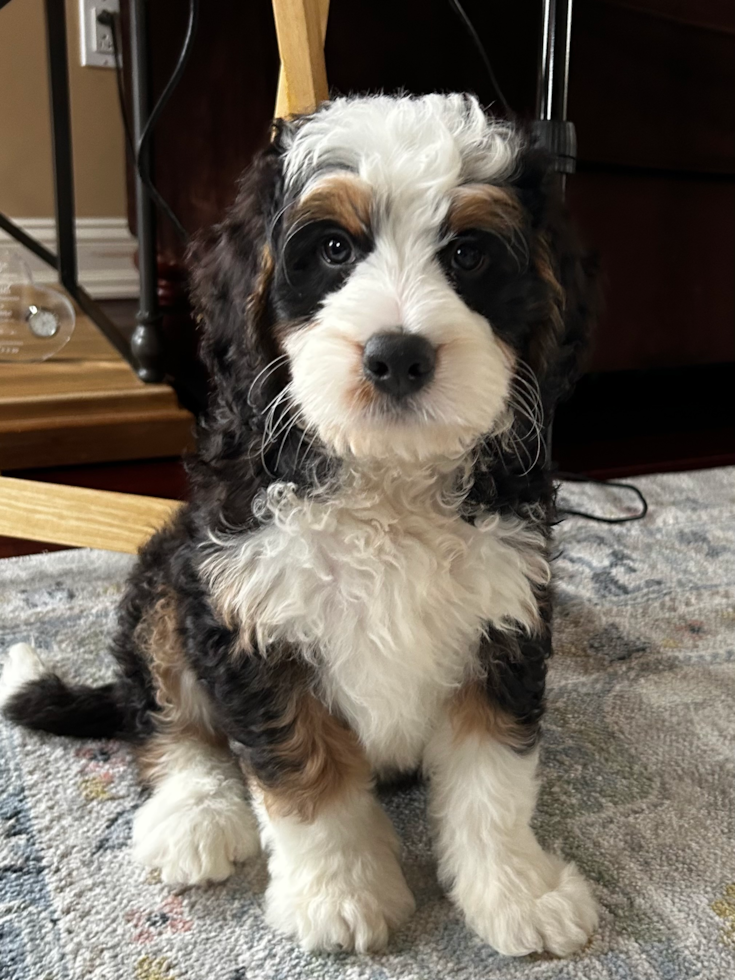
The Mini Bernedoodle combines Bernese Mountain Dog and Miniature Poodle ancestry. Modern Bernedoodles became increasingly established during the early twenty-first century, although there is no single formula behind every Mini Bernedoodle. First-generation, backcrossed, and multigenerational dogs can have different amounts of Bernese and Poodle ancestry.
The Bernese Mountain Dog originated in Switzerland and became closely associated with farms in the canton of Bern. It belongs to a group of Swiss mountain dogs developed for practical work rather than one narrow specialty.
Berners were strong enough to pull carts carrying goods and dairy products. They also worked around cattle and served as useful watchdogs and family companions. The official breed standard still emphasizes the strength and agility needed for draft and driving work.
Despite that physical power, the modern Bernese Mountain Dog is known for a gentle, good-natured temperament. The breed tends to form strong attachments to family and generally combines willingness to work with a more placid everyday style than a fast-moving herding breed.
The Miniature Poodle brings a smaller frame and a different form of working intelligence. Poodles are athletic retrievers with a long history of cooperation with humans, and Miniatures retain the trainability and physical ability found across the breed.
A Mini Bernedoodle can therefore inherit considerable intelligence without necessarily inheriting constant urgency. The Poodle may increase responsiveness, playfulness, and athletic ability, while the Bernese side contributes size, substance, patience, and a steadier approach to the world.
Mini Sheepadoodle History and Background
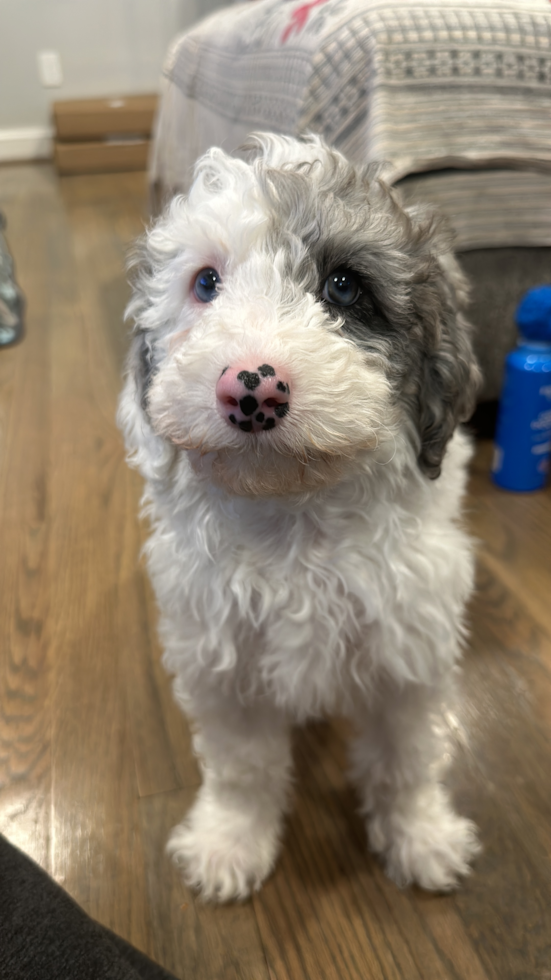
The Mini Sheepadoodle combines an Old English Sheepdog with a Miniature Poodle. The larger Sheepadoodle is more commonly produced from an Old English Sheepdog and Standard Poodle, while using a Miniature Poodle creates the smaller version discussed here.
The Old English Sheepdog is not quite as ancient as its name makes it sound. Its development can be traced back roughly two centuries to western England, particularly areas such as Devon, Somerset, and Cornwall.
Historical dogs of this type were known as drovers. Their job involved moving sheep and cattle to market, which required enough size and confidence to influence livestock and enough stamina to continue working over distance. The breed's traditional “Bobtail” nickname is connected with the historical practice of docking working dogs' tails.
The modern Old English Sheepdog still reflects that background. It is a large, thickset, muscular dog with surprising agility beneath its enormous coat. The breed is intelligent, adaptable, watchful, and famous for a playful, rough-and-tumble personality that can remain youthful for a long time.
Its coat is equally distinctive. A true Old English Sheepdog has a profuse, shaggy double coat rather than Poodle-style curls. The outer coat should have a harder texture, while a dense undercoat adds weather protection.
The Miniature Poodle changes size and coat possibilities while reinforcing intelligence and trainability. The Mini Sheepadoodle can therefore become a smaller, curlier version of that shaggy working companion, but the Old English Sheepdog's movement awareness, physical play, and family attachment can remain very much present.
Mini Bernedoodle vs Mini Sheepadoodle Appearance
Both crosses can deliver the large teddy bear appearance, but they arrive there through different coat and body structures. The Bernese Mountain Dog is broad, strong, slightly longer than tall, and covered in a thick coat that lies straight or slightly wavy. The Old English Sheepdog is square, compact, muscular, and famous for a profuse shaggy coat.
Those differences can survive even after Poodle influence changes the hair. Mini Bernedoodles commonly appear broad through the chest and body, with a softer outline reminiscent of the Bernese.
Mini Sheepadoodles may look more square and compact underneath their coat, with an enormous amount of visual volume created by the Old English Sheepdog side.
Grooming can hide these structural differences. A freshly clipped Mini Sheepadoodle may suddenly look far leaner and more athletic than the fluffy dog that walked into the grooming salon.
Mini Bernedoodle Appearance
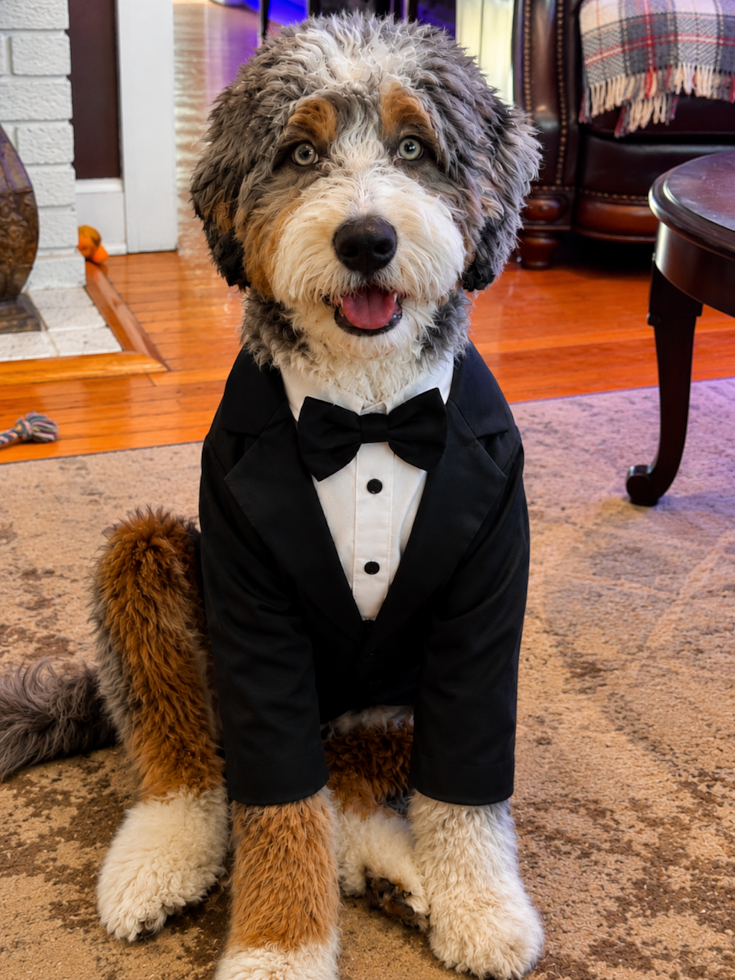
Mini Bernedoodles vary greatly in adult size because of the size difference between their parent breeds. Bernese Mountain Dogs commonly weigh 70 pounds or considerably more, while Miniature Poodles occupy a much smaller physical range.
Many Mini Bernedoodles mature somewhere around 20 to 50 pounds, although particular breeding programs may produce narrower ranges. Later-generation or Poodle-backcrossed dogs can stay much smaller than some first-generation Mini Bernedoodles.
The body commonly feels substantial. Even a Mini Bernedoodle that is not especially tall may have broad shoulders, sturdy bone, and more body mass than another Doodle of similar height.
Mini Bernedoodle Coat Type and Texture
Mini Bernedoodle coats can be straight, wavy, or curly. Bernese Mountain Dogs have thick, moderately long coats that are naturally straight or slightly wavy, while the Poodle contributes dense curl.
The loose wavy coat is especially familiar in the cross because it creates a shaggy appearance without the very tight curl of a Poodle. Some dogs develop much stronger curls, particularly when they have greater Poodle ancestry.
Straighter Mini Bernedoodles may inherit more obvious undercoat. These dogs can shed noticeably and may experience heavier coat release during seasonal changes.
Curlier dogs can leave less hair around the home, but that does not make grooming easier. Hair that stays trapped within curls may form tight mats if regular brushing and combing are skipped.
Mini Bernedoodle Colors and Markings
The classic Mini Bernedoodle appearance draws heavily from the Bernese Mountain Dog's black, white, and rust tricolor pattern. Dark bodies, white facial blazes and chests, and warm tan points can create a miniature version of the familiar Bernese look.
Poodle ancestry broadens the possibilities. Brown, black and white, sable, phantom, and other color combinations can appear according to the genes present in the breeding line.
Some nontraditional patterns may also occur in particular lines, but they should not be described as traits inherited from the Bernese Mountain Dog itself. Purebred Bernese Mountain Dogs have a specific tricolor standard rather than the broad pattern range found in many Poodle crosses.
Coat color can also change with maturity. Poodle-related fading can soften brown or darker shades as the puppy becomes an adult.
Mini Bernedoodle Eyes and Facial Features
Brown is the typical eye color associated with the Bernese Mountain Dog, and many Mini Bernedoodles retain warm brown or dark brown eyes.
The Bernese side may create a broader head and substantial muzzle, while the Miniature Poodle can refine both. Heavy facial furnishings make these structural differences much harder to see until the dog receives a shorter trim.
The ears hang beside the face and can carry considerable hair. Combined with a rounded muzzle trim, this produces the soft teddy bear expression closely associated with the cross.
A Mini Bernedoodle's face commonly appears gentle rather than intensely alert, although individual dogs naturally vary.
Mini Bernedoodle Build and Size
The Mini Bernedoodle is generally the broader and heavier-built dog in this comparison. Bernese Mountain Dogs carry sturdy bone and considerable body mass, and that physical influence does not disappear simply because a Miniature Poodle reduces the finished size.
An adult weighing 35 or 40 pounds may still be referred to as a Mini Bernedoodle because “mini” is relative to the much larger Standard Bernedoodle. Prospective owners should therefore think in terms of small-to-medium or medium dog rather than assuming toy-dog proportions.
The greater body mass can be useful in family life because the dog does not feel especially fragile. It can also make leash manners more important during adolescence, when enthusiasm arrives before adult self-control.
The Mini Bernedoodle's physical style is sturdy and capable rather than particularly quick or light.
Mini Bernedoodle Shedding
Mini Bernedoodle shedding can range from very low to noticeable. The Poodle contributes a coat known for retaining loose hair, while the Bernese Mountain Dog has a thick double coat and naturally sheds.
A curlier dog with strong furnishings may leave relatively little visible hair around the home. A straighter Mini Bernedoodle with substantial undercoat can shed much more.
Generation can shift the probabilities but does not guarantee the result. Even puppies with similar ancestry may mature into different coat types.
For someone who strongly dislikes loose dog hair, the actual parent coats and mature dogs from similar pairings provide much better information than the Mini Bernedoodle label.
Mini Bernedoodle Grooming Needs
Mini Bernedoodles require regular grooming regardless of whether the coat sheds. Wavy and curly hair can mat around the ears, neck, legs, tail, and areas where the coat rubs against a harness.
Straighter dogs may need more undercoat removal, particularly when seasonal shedding increases. A dog can therefore trade frequent clipping for increased brushing rather than becoming genuinely low maintenance.
Professional grooming is common for furnished coats, and a shorter pet trim can make home care much easier.
Their larger body also matters. Grooming a 45-pound fluffy dog simply takes more time than maintaining the same amount of coat on a 25-pound dog.
Mini Sheepadoodle Appearance
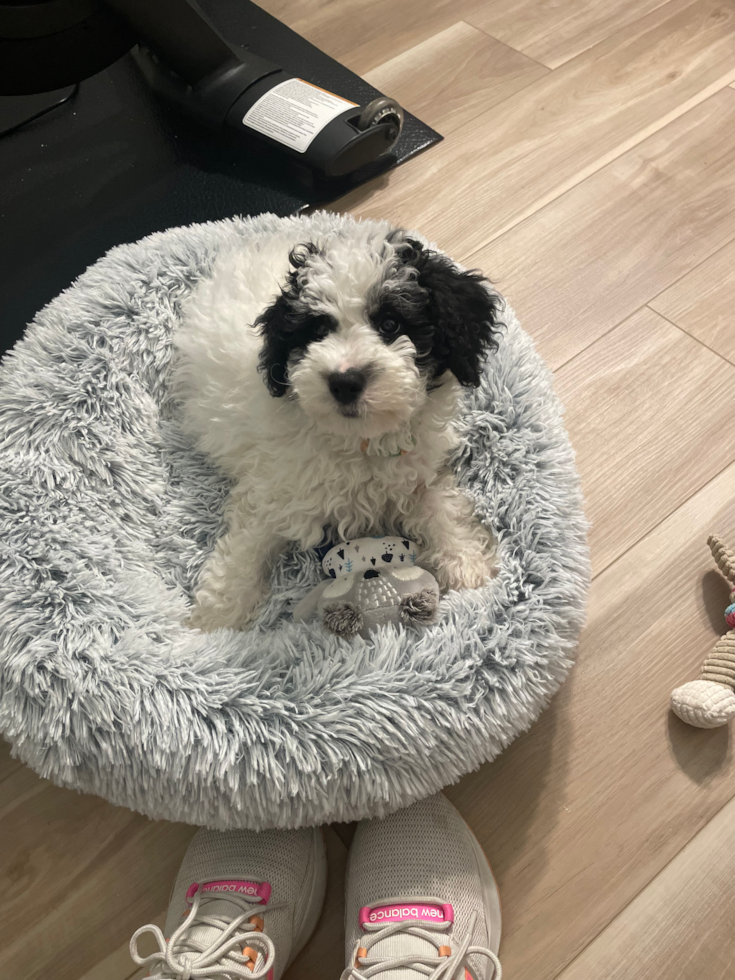
Mini Sheepadoodles commonly mature around 25 to 45 pounds and roughly 15 to 20 inches tall, although dogs outside those ranges are possible. The large size difference between an Old English Sheepdog and Miniature Poodle means first-generation puppies can still be difficult to predict precisely.
Their bodies are generally compact and muscular. Old English Sheepdogs are square, powerful dogs with plenty of bone, yet they are remarkably agile for their size.
The Miniature Poodle can lighten the frame and add more leg, but many Mini Sheepadoodles retain a solid physical feel. They may look enormous in full coat and surprisingly compact immediately after a haircut.
Mini Sheepadoodle Coat Type and Texture
The Mini Sheepadoodle combines two very different textured coats. Old English Sheepdogs have a shaggy double coat with a dense, weather-resistant undercoat, while Miniature Poodles have dense curls.
The result commonly ranges from loose shaggy waves to stronger curls. Many Mini Sheepadoodles develop a thick, soft-looking coat with substantial volume even when the individual hairs are not tightly curled.
Some coats feel more cottony than the typical Mini Bernedoodle coat. That softness can look beautiful but may create significant matting because neighboring hairs catch and tighten around one another.
The amount of undercoat can vary as well. A dog that inherits more Old English Sheepdog coat may need regular work to remove loose undercoat in addition to routine detangling.
Mini Sheepadoodle Colors and Markings
Black and white is the appearance most strongly associated with Sheepadoodles, reflecting the classic contrast seen in many Old English Sheepdogs. Gray and white can become increasingly apparent as puppies mature and dark coats lighten.
Old English Sheepdogs naturally occur in shades such as gray, grizzle, blue, and blue-gray, usually combined with white. The Poodle can add further variation depending on the lines used.
Mini Sheepadoodles may therefore appear black and white, gray and white, blue-gray and white, solid dark colors, or other Poodle-influenced combinations.
Color change can be especially noticeable in this cross. A puppy that appears strongly black and white may develop considerably more gray as the adult coat emerges.
Mini Sheepadoodle Eyes and Facial Features
Mini Sheepadoodles can have dark brown or blue eyes, and one eye of each color may occur through the Old English Sheepdog side.
The face may be broader and more square when sheepdog influence is strong, while the Poodle can narrow the muzzle and refine the head.
The thick coat around the eyes creates the classic shaggy-dog expression. Owners may choose to trim this area for easier maintenance and visibility rather than preserving the full peek-a-boo look of the Old English Sheepdog.
Their expression can appear playful and mischievous, which fits the cross's tendency toward cheerful physical interaction.
Mini Sheepadoodle Build and Size
Mini Sheepadoodles are generally sturdy, muscular dogs rather than delicate companions. The Old English Sheepdog contributes substantial bone and a compact body, while the Poodle adds agility and athletic refinement.
The result may be slightly less heavy than a Mini Bernedoodle of similar height, though individual dogs overlap considerably.
Movement can be surprisingly athletic. The Old English Sheepdog may look like a giant ball of hair, but underneath that coat is a dog developed to keep livestock moving over distance.
Mini Sheepadoodles can therefore enjoy long walks, active play, hiking, games, and other family activities without needing the intensity associated with some lighter herding breeds.
Mini Sheepadoodle Shedding
Mini Sheepadoodle shedding varies because the Old English Sheepdog contributes a true double coat while the Poodle contributes dense, low-shedding curls.
Curlier Mini Sheepadoodles may release very little visible hair. Straighter or shaggier individuals with stronger sheepdog undercoat can shed more, particularly as the coat changes seasonally.
The amount of hair on the floor does not tell the entire grooming story. Loose hair can remain trapped inside the coat and create mats rather than falling freely.
This is why a dog that barely sheds can still require considerably more grooming than a dog that leaves hair on the furniture.
Mini Sheepadoodle Grooming Needs
Grooming is one of the most important realities of Mini Sheepadoodle ownership. The Old English Sheepdog is already a demanding coat breed, and adding Poodle texture does not simplify things automatically.
A thick wavy or curly Mini Sheepadoodle may need brushing and combing several times each week, with longer coats requiring even more attention. The brush needs to reach down through the coat rather than smoothing only the fluffy surface.
Behind the ears, beneath the legs, around the neck, and through the hindquarters can become especially mat-prone. Dirt, leaves, snow, and moisture can also disappear surprisingly effectively inside all that hair.
For many families, a shorter professional trim is far more practical than trying to maintain a dramatic full coat. The dog still looks fluffy, but everyday maintenance becomes substantially easier.
Mini Bernedoodle vs Mini Sheepadoodle Appearance Comparison: What Is the Difference?
The two crosses overlap substantially in adult size, but their shape and coat volume can create different impressions.
The Mini Bernedoodle generally carries more Bernese-style breadth and body mass. Its frame can feel heavy and substantial even when the dog is not especially tall.
The Mini Sheepadoodle usually has a squarer, compact working structure beneath the coat. Old English Sheepdog ancestry contributes plenty of bone, but the body was also built for agile movement while driving livestock.
Coat is another useful distinction. Mini Bernedoodles frequently have the soft loose waves associated with modern Doodles, although straight and curly coats occur. Mini Sheepadoodles can develop an especially dense, shaggy or cottony texture because the Old English Sheepdog already contributes a profuse double coat.
Color tells the histories apart most clearly. Bernese-style black, white, and rust points are strongly associated with the Mini Bernedoodle. Black-and-white coats that mature toward gray, blue-gray, or grizzle are much more closely tied to the Mini Sheepadoodle's Old English Sheepdog ancestry.
If you want the broader tricolor teddy bear look, the Mini Bernedoodle may appeal more. If you love the shaggy black-and-white or gray sheepdog appearance and a squarer, playful body underneath it, the Mini Sheepadoodle has a character all its own.
Mini Bernedoodle vs Mini Sheepadoodle Temperament
This is where the comparison becomes more important than coat color.
The Bernese Mountain Dog and Old English Sheepdog are both intelligent working breeds that developed around farms, but their responsibilities were different. Berners needed strength, steadiness, and versatility. Old English Sheepdogs needed to stay involved with livestock movement and were particularly associated with droving.
That difference can still appear after both breeds are crossed with the same intelligent Miniature Poodle.
Mini Bernedoodles generally lean toward a calmer, more deliberate family temperament. Mini Sheepadoodles tend to bring more physical playfulness, watchfulness, movement awareness, and a stronger possibility of herding-related behavior.
Mini Bernedoodle Temperament
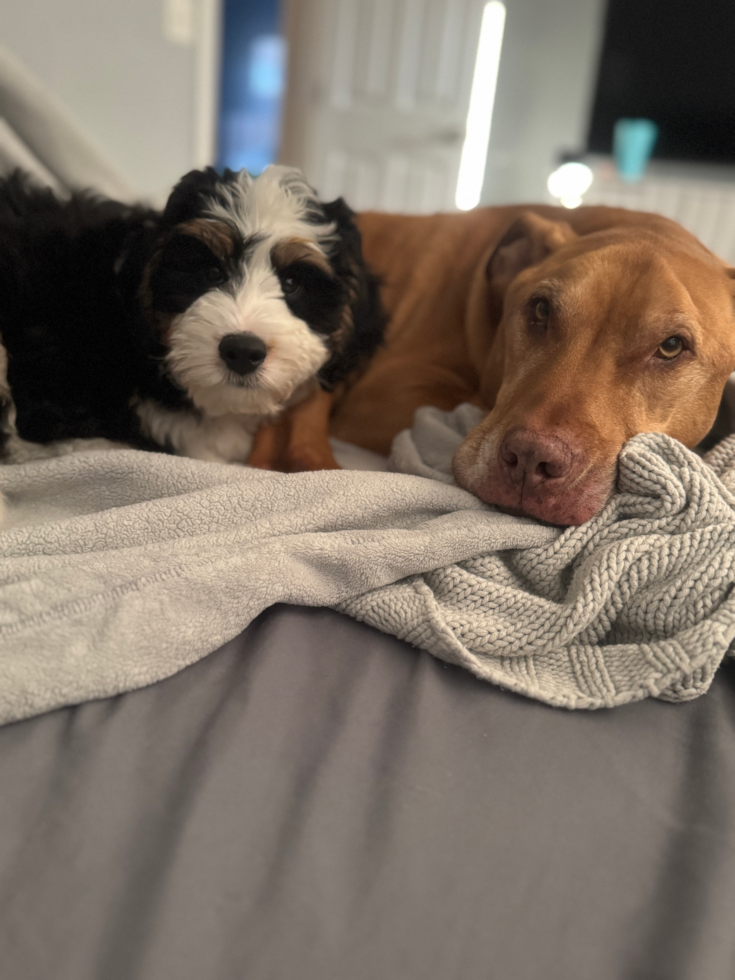
Mini Bernedoodles tend to be affectionate, intelligent dogs with a gentle family orientation. Bernese influence can create patience and steadiness, while the Poodle adds greater liveliness, responsiveness, and enthusiasm for learning.
Many enjoy being active without needing every hour of the day filled. Walks, family play, some training, and opportunities to explore can provide a satisfying routine for healthy adults.
Their emotional style may also feel softer. Bernese Mountain Dogs tend to form close bonds and can be sensitive dogs, so positive training and patient socialization are particularly appropriate.
Mini Bernedoodle Intelligence and Training
Mini Bernedoodles are highly capable learners. The Poodle contributes quick problem-solving ability, while the Bernese Mountain Dog brings intelligence shaped around practical farm work and cooperation with people.
Training may feel somewhat more deliberate than it does with a highly reactive herding cross. A Mini Bernedoodle can understand quickly without necessarily firing through behaviors at top speed.
That pace suits many family owners. Basic obedience, recall, leash manners, polite greetings, settling, grooming cooperation, and tricks can all become part of normal life without training needing to develop into a hobby.
Positive reinforcement works especially well. Confidence grows more reliably through clear rewards and consistency than through harsh correction.
Mini Bernedoodle Energy Level
The Mini Bernedoodle generally has moderate energy. Healthy adults can enjoy substantial walks, hiking, swimming, outdoor trips, and energetic games, but many do not need intense daily activity to remain comfortable at home.
Puppies can be much busier. A young Mini Bernedoodle may have plenty of zoomies, jumping, chewing, and enthusiasm before the steadier adult temperament begins to appear.
Teaching calmness matters during this stage. Puppies that learn to settle after activity are more likely to develop the off switch people value in the adult cross.
The finished dog can therefore suit families that enjoy activity without wanting exercise to dominate the household schedule.
Mini Bernedoodle Affection and Family Attachment
Mini Bernedoodles commonly form deep attachments to their families. Both parent breeds prefer close human relationships, and many dogs want to remain involved with household life throughout the day.
Their affection may have a physically close quality. A dog may settle against someone's feet, lean against a leg, follow family members between rooms, and choose whatever resting place keeps it closest to the group.
That devotion can become overdependence when independence is never practiced. Short periods of comfortable separation should begin during puppyhood.
Teaching a dog to relax alone does not weaken attachment. It gives an affectionate companion another useful life skill.
Mini Bernedoodles With Children
Mini Bernedoodles can be wonderful family dogs, particularly when Bernese gentleness comes through strongly.
Their substantial bodies make them less physically delicate than many smaller Doodle crosses. The downside is that an enthusiastic adolescent weighing 35 or 45 pounds can knock over a young child easily.
Calm greetings and polite play should therefore be taught rather than waiting for maturity to solve everything.
The cross generally lacks strong herding instincts, which can make relationships with running children somewhat simpler than they are with a Mini Sheepadoodle that wants to control movement.
Mini Bernedoodles With Other Dogs and Pets
Mini Bernedoodles usually have good potential in multi-pet homes. Neither parent is strongly defined by modern herding or prey behavior, which reduces some of the movement-control issues seen in other working crosses.
Another dog can become an excellent companion when play styles are compatible. A large Mini Bernedoodle may still overwhelm a tiny dog simply through enthusiastic movement, so size matters during play.
Cats can also fit comfortably into the household. Puppy chasing should still be redirected early, but there is less historical pressure toward controlling movement than on the Old English Sheepdog side of the Mini Sheepadoodle.
Stable parent temperaments and good introductions remain more important than the mix name alone.
Mini Bernedoodle Barking and Watchfulness
Mini Bernedoodles can be watchful. Bernese Mountain Dogs historically helped guard farms, so noticing unfamiliar people or activity is not unusual.
The temperament tends to be more measured than constantly vigilant. A dog may alert to someone at the door and then settle once it understands that the visitor belongs there.
Poodle alertness can increase responsiveness to noises, particularly in younger dogs.
Consistent household rules prevent normal awareness from becoming repetitive barking. Owners should reward the quiet response they want rather than responding dramatically every time the dog announces something.
Mini Sheepadoodle Temperament
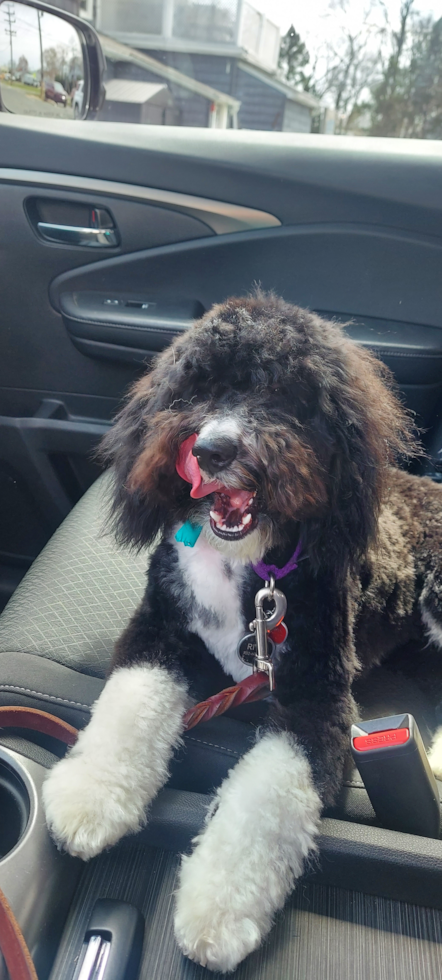
Mini Sheepadoodles tend to combine intelligence, affection, physical playfulness, and a strong interest in family activity. Old English Sheepdogs are known for being adaptable and even-tempered, but they also have a rough-and-tumble side and remain capable working dogs underneath the shaggy exterior.
The Poodle reinforces intelligence and trainability, which can make the Mini Sheepadoodle quick to learn both good habits and inconvenient ones.
Compared with the Mini Bernedoodle, the Mini Sheepadoodle may feel more animated. It can be more interested in movement around the house, more physically playful, and more likely to remain involved when family activity becomes exciting.
Mini Sheepadoodle Intelligence and Training
Mini Sheepadoodles have excellent training potential. Old English Sheepdogs are intelligent and agreeable workers, while Poodles bring another strong layer of learning ability.
The dog may respond particularly well to training that feels interactive. Tricks, obedience, search games, retrieving, and simple obstacle courses can provide useful outlets for both mind and body.
Herding ancestry makes impulse control especially valuable. A clever dog that becomes excited by movement should learn how to disengage, return when called, settle on a mat, and leave moving targets alone when asked.
Training should stay varied enough to remain interesting. The Mini Sheepadoodle is capable of far more than basic commands, even if family manners are the owner's main priority.
Mini Sheepadoodle Energy Level
The Mini Sheepadoodle generally has moderate to moderately high energy. Old English Sheepdogs need regular exercise and enjoy active play, while the Miniature Poodle adds another athletic parent.
The dog may be particularly playful rather than simply endurance-driven. Running, chasing toys, romping with another dog, exploring new places, and engaging with family members can all be highly rewarding.
Young dogs may have a substantial amount of bounce. The Old English Sheepdog is known for a happy, rough-and-tumble personality, and that quality can create a Mini Sheepadoodle adolescent that is both entertaining and occasionally exhausting.
Adult dogs can settle beautifully, but expecting calmness without adequate exercise and training is unrealistic.
Herding and Droving Behavior in Mini Sheepadoodles
Old English Sheepdogs were historically drovers, used to help move sheep and cattle. Their working style was not identical to that of every modern precision herding breed, but controlling livestock movement was still part of their purpose.
A Mini Sheepadoodle can therefore show interest in moving people or animals. Following, circling, chasing, blocking paths, or staying unusually focused on running children can appear in some dogs.
Physical nudging may also become part of excited play. A sturdy, enthusiastic dog does not need to bite heels to become annoying when it repeatedly attempts to influence where everyone is going.
These behaviors are best redirected early through recall, impulse control, toys, structured games, and calm alternatives. The goal is not to punish the dog's ancestry but to teach it where those instincts do and do not belong.
Mini Sheepadoodle Affection and Family Attachment
Mini Sheepadoodles can be extremely affectionate. Old English Sheepdogs prefer life with their families rather than being left outside to entertain themselves, and Poodles are equally people-oriented.
The cross may express affection through both physical closeness and play. A Mini Sheepadoodle can spend twenty minutes romping enthusiastically and then attempt to become a lapdog despite having clearly exceeded traditional lap dimensions.
Many enjoy being part of whatever is happening. Family trips, backyard activity, training, visitors, and games may all be preferable to being separated from the action.
Independence still needs deliberate practice so that family involvement does not become an inability to cope alone.
Mini Sheepadoodles With Children
Mini Sheepadoodles can be excellent family dogs. Old English Sheepdogs have a strong reputation as patient, affectionate companions, while their playful nature can make them especially appealing to children.
The herding and droving background creates an extra consideration. Running, shouting, and fast changes of direction can make children fascinating to a young dog that is genetically interested in movement.
Chasing, circling, bumping, and attempts to control the game should be redirected before they become established habits.
Older children can become wonderful training and play partners. The dog's intelligence provides plenty of opportunities for tricks, retrieving games, and other structured activities that give all that enthusiasm a useful direction.
Mini Sheepadoodles With Other Dogs and Pets
Mini Sheepadoodles generally have good potential with other dogs, especially when both animals enjoy active play. Their sturdy bodies and playful temperament can make them enthusiastic wrestling or chasing partners.
The challenge is knowing when another pet has had enough. A Mini Sheepadoodle that keeps circling, following, or inviting play may become tiring for a quiet senior dog.
Cats can live very successfully with the cross, but movement may trigger chasing or attempts to control where the cat goes. Early calm introductions are particularly useful.
The ideal goal is not merely preventing aggression. It is teaching the dog to respect another animal's desire to move or rest without being managed.
Mini Sheepadoodle Barking and Watchfulness
The Mini Sheepadoodle may have the stronger watchdog voice in this comparison. Old English Sheepdogs are naturally watchful and historically known for a distinctive, powerful bark.
That does not mean every Mini Sheepadoodle will bark excessively. The cross may simply be more likely to notice activity and express its opinion about it.
Poodle intelligence can make the behavior especially responsive to household patterns. If barking reliably brings someone to the window, the dog has learned an effective system.
Teaching a quiet cue, limiting rehearsals at busy windows, and rewarding calm observation can keep watchfulness useful rather than exhausting.
Mini Bernedoodle vs Mini Sheepadoodle Temperament Comparison: What Is the Real Difference?
The strongest temperament contrast is steadiness versus playful working awareness.
The Mini Bernedoodle generally leans toward the steadier side. Bernese influence can produce an affectionate dog that enjoys activity but does not necessarily feel compelled to participate in every movement around the house. The dog can be clever and playful while still developing a comfortable, more deliberate pace.
The Mini Sheepadoodle generally brings more movement awareness and physical playfulness. Old English Sheepdog ancestry adds a dog whose job depended on moving livestock and remaining engaged with its surroundings. Combined with the Poodle, that can create a quick learner that wants to participate actively in family life.
This does not make the Mini Sheepadoodle dramatically more difficult. Old English Sheepdogs themselves are known for an agreeable, adaptable temperament, and many Mini Sheepadoodles develop excellent off switches.
The distinction becomes important when choosing the kind of everyday interaction you enjoy. A Mini Bernedoodle may be content to accompany the family. A Mini Sheepadoodle may be more likely to involve itself in what everyone is doing and occasionally offer unsolicited assistance with the organization.
Mini Bernedoodle vs Mini Sheepadoodle: Which One Should You Choose?
The Mini Bernedoodle and Mini Sheepadoodle are close enough in size and appearance that choosing by photographs alone would miss the most important differences. Both can become affectionate, highly trainable family dogs. Both need substantial grooming. Both can participate in an active lifestyle without requiring the exercise schedule of an extreme working breed.
The real choice lies in temperament, movement awareness, coat maintenance, and the style of family interaction you prefer.
Choose a Mini Bernedoodle if You Want Greater Steadiness
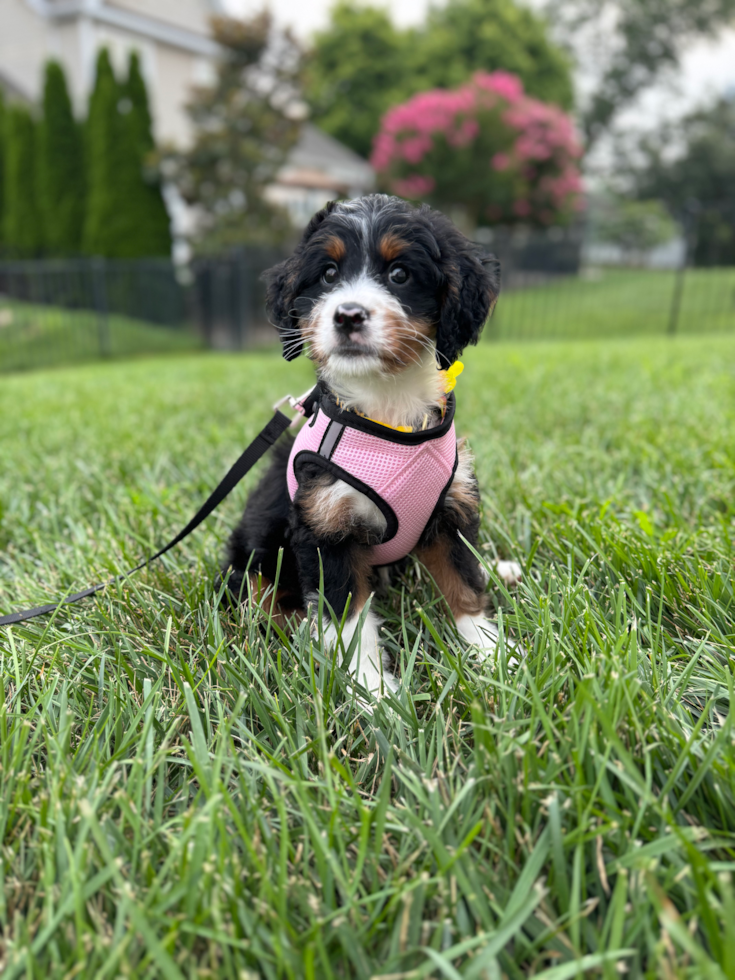
A Mini Bernedoodle puppy may suit you better if you want an intelligent dog with enough activity for walks and adventures but prefer a calmer everyday rhythm.
Bernese influence can create a dog that feels substantial both physically and emotionally. Many Mini Bernedoodles enjoy family involvement without needing to turn every event into a game or task.
That can be particularly appealing in households with young children, quieter pets, or adults who enjoy weekend adventures but have fairly ordinary working weeks.
The tradeoff is size and coat unpredictability. A first-generation Mini Bernedoodle can become considerably larger than expected, and straighter coats may shed much more than the fluffy Doodle appearance suggests.
Choose a Mini Sheepadoodle if You Want a Playful, Interactive Family Dog
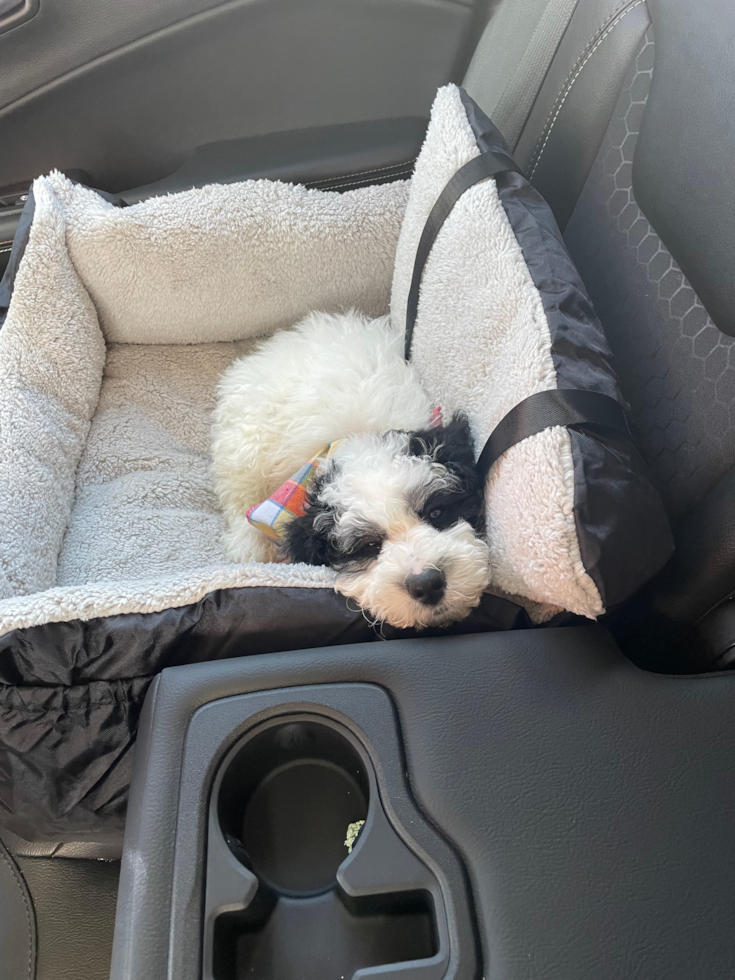
A Mini Sheepadoodle puppy may suit you better if you enjoy a dog with more bounce, humor, physical play, and interest in household activity.
Old English Sheepdog influence can create a wonderful combination of gentleness and clownish enthusiasm. The dog may be very affectionate without feeling passive and can become an entertaining training partner for families that like interacting with their pets.
The shared Poodle intelligence adds even more learning ability, while the sheepdog side can contribute watchfulness and movement awareness.
The main consideration is whether you are comfortable shaping those instincts. Chasing, circling, overenthusiastic play, and alert barking are much easier to live with when addressed during puppyhood rather than accepted until adolescence.
Which Is Bigger: Mini Bernedoodle or Mini Sheepadoodle?
The Mini Bernedoodle has the greater potential to be heavier, while the typical ranges overlap substantially.
Mini Bernedoodles may mature around 20 to 50 pounds depending on generation and parent size. Mini Sheepadoodles commonly fall around 25 to 45 pounds, with many standing roughly 15 to 20 inches.
Both crosses come from a very large parent paired with a Miniature Poodle. Bernese Mountain Dogs commonly weigh 70 to more than 100 pounds, while Old English Sheepdogs generally fall around 60 to 100 pounds.
For either dog, the actual parents are far more useful than the word “mini.” A breeder should be able to show you the adult sizes behind the puppy rather than relying only on a broad marketing category.
Which Is Calmer: Mini Bernedoodle or Mini Sheepadoodle?
The Mini Bernedoodle generally has the calmer profile.
Bernese Mountain Dogs are powerful working dogs but are also known for a placid, good-natured temperament. Their influence can produce a dog that enjoys activity without remaining intensely focused on movement around the home.
Mini Sheepadoodles may be more playful and physically expressive. The Old English Sheepdog's droving background can create more interest in movement, while the Poodle adds further intelligence and activity.
Mature individuals of either cross can have excellent off switches. The Mini Bernedoodle simply has the stronger average advantage when calmness is one of the household's main priorities.
Which Is More Energetic?
The Mini Sheepadoodle usually has the higher everyday activity level, though the difference is moderate rather than extreme.
Old English Sheepdogs are agile working dogs that enjoy exercise and active play. Add the athletic Miniature Poodle, and the resulting cross can have considerable stamina and enthusiasm.
Mini Bernedoodles can still hike, swim, fetch, and accompany active families. Many simply reach satisfaction with somewhat less sustained activity.
For someone who enjoys a playful dog that actively seeks games and participation, the Mini Sheepadoodle may be more entertaining. For someone who wants activity without quite as much bounce, the Mini Bernedoodle may be easier.
Which Needs More Mental Stimulation?
Both are intelligent dogs, but the Mini Sheepadoodle may benefit from slightly more ongoing mental engagement.
Old English Sheepdogs had to manage moving livestock and remain aware of their environment, while Poodles add another strong problem-solving background. Training, search games, retrieving, sniffing, and interactive play can all give the Mini Sheepadoodle useful outlets.
Mini Bernedoodles enjoy enrichment too and should never be treated as unintelligent simply because they are calmer. Training provides useful structure and strengthens communication with the family.
The difference is that a Mini Bernedoodle may be more willing to accept a quiet day without inventing another project for itself.
Which Is Easier to Train?
Both crosses have excellent training potential.
The Mini Sheepadoodle may bring more immediate enthusiasm for interactive training, particularly when the dog enjoys movement and games. Old English Sheepdogs are intelligent, agreeable workers, while the Poodle adds another highly trainable parent.
The Mini Bernedoodle may feel easier for basic household manners because its overall temperament can be steadier. Some dogs may respond a little more deliberately, but speed of learning and ease of living are not always the same thing.
Positive reinforcement, variety, and clear expectations work beautifully with either. The biggest mistake would be assuming an intelligent dog needs less training because it will somehow figure out the correct rules independently.
Which Is Better for First-Time Dog Owners?
The Mini Bernedoodle may have a slight advantage for many first-time dog owners because of its calmer average temperament and lower likelihood of obvious herding behavior.
A beginner still needs to handle a potentially substantial adult dog, maintain a demanding coat, teach leash manners, and establish independence from puppyhood.
The Mini Sheepadoodle can also be an excellent first dog for someone who enjoys training and does not mind a more playful, active personality. Its intelligence can make learning together extremely rewarding.
The important question is whether the owner likes the process of shaping behavior. A Mini Sheepadoodle puppy with movement-control habits is easier for someone who finds training interesting than for someone hoping the dog will simply grow out of them.
Which Is Better With Young Children?
The Mini Bernedoodle may have a slight advantage with very young children because it is less likely to develop obvious movement-control behavior.
Bernese influence can also add patience and gentleness. The larger body still requires good manners because a friendly adolescent can knock over a child without intending harm.
Mini Sheepadoodles can be wonderful with children and may become particularly playful family companions. The extra concern is that running children can trigger chasing, circling, or physical attempts to influence movement.
Those behaviors are manageable, but families should know they may need to manage them rather than being surprised later.
Which Is Better With Older Children?
The comparison becomes much closer with older children. In fact, the Mini Sheepadoodle may be particularly fun for children who genuinely want to interact with the dog.
Training tricks, playing fetch, creating simple obstacle courses, walking, and participating in games can give an intelligent Mini Sheepadoodle constructive ways to engage with older kids.
Mini Bernedoodles are excellent companions for older children too and may be the better fit when the family prefers a somewhat calmer household rhythm.
The child's personality matters. An active teenager may adore the Sheepadoodle's playful involvement, while a quieter child may form an equally strong bond with the Bernedoodle's gentler style.
Which Is Better With Other Dogs?
Both can live very successfully with other dogs.
Mini Bernedoodles may have the easier profile for calm canine companions because they are less likely to bring herding behavior into the relationship. Their play can still be enthusiastic, but many adults settle into a fairly easygoing social rhythm.
Mini Sheepadoodles can be wonderfully social and playful. They may be especially well matched with dogs that enjoy chasing, wrestling, and active interaction.
The potential problem is persistence. A Sheepadoodle that continues circling or inviting play after another dog has had enough needs help learning when the interaction is over.
Which Is Better With Cats?
The Mini Bernedoodle may have a small advantage for quieter cat households, largely because the Old English Sheepdog's movement-control ancestry is absent.
Mini Sheepadoodles can absolutely live happily with cats. The issue is that a running cat may become interesting enough to chase, follow, or attempt to organize.
Early introductions are valuable with either cross. Cats should have safe spaces where the puppy cannot follow, and calm behavior around movement should be rewarded.
A puppy raised around a confident cat may learn household boundaries very quickly regardless of which cross it belongs to.
Which Has Stronger Herding Instincts?
The Mini Sheepadoodle has the clearer potential for herding and droving behavior because of the Old English Sheepdog parent.
This may appear as circling, following movement, blocking paths, chasing running family members, or becoming particularly interested in where other animals are going.
Mini Bernedoodles can show chasing or playful control behavior because any dog can, but it is not supported by the same specialized movement-oriented ancestry.
The difference becomes most relevant in homes with children, cats, or several dogs. Those households simply need to put more deliberate work into impulse control with a Mini Sheepadoodle when herding behavior appears.
Which Is More Playful?
Both are playful, but the Mini Sheepadoodle often brings the more openly physical, clownish play style.
Old English Sheepdogs have a reputation for happy, rough-and-tumble behavior, and the Miniature Poodle adds another energetic, interactive personality. A young Mini Sheepadoodle can be extremely entertaining when the family enjoys that enthusiasm.
Mini Bernedoodles play readily too, particularly during puppyhood and adolescence. Their adult style may become calmer and less insistent once the game ends.
People who want a dog that regularly initiates interaction may prefer the Mini Sheepadoodle. Those wanting play followed by a relatively easy return to relaxation may lean toward the Mini Bernedoodle.
Which Is More Likely to Bark?
The Mini Sheepadoodle may have the stronger tendency toward noticeable alert barking.
Old English Sheepdogs are watchful dogs with a famously powerful bark. Their working history required awareness of the environment, and some of that can remain in a Mini Sheepadoodle.
Mini Bernedoodles can alert too. Bernese Mountain Dogs historically served as farm watchdogs, so strangers and unusual activity may still earn an announcement.
Training and environment can easily magnify either tendency. A dog that spends every afternoon rehearsing reactions at a front window becomes much more committed to the job than one taught to notice and disengage.
Which Sheds Less: Mini Bernedoodle or Mini Sheepadoodle?
There is no dependable universal winner because both pair a Poodle with a double-coated breed.
The Bernese Mountain Dog sheds substantially, while the Old English Sheepdog also has a dense undercoat that changes with grooming and season. Poodle influence can reduce visible shedding in both crosses.
A curly dog of either type may release very little hair onto furniture. A straighter dog with more undercoat may shed noticeably.
The best clues come from coat generation, furnishings, the parents, and mature relatives. Neither cross should be promised as completely non-shedding.
Which Needs More Grooming?
Both need considerable coat care, but the Mini Sheepadoodle may have the more demanding coat on average when Old English Sheepdog density combines with Poodle texture.
The Old English Sheepdog is already a high-maintenance grooming breed. Its thick shaggy coat needs thorough work down to the skin, and adding curl can create even more opportunity for matting.
Mini Bernedoodles are certainly not easy-care dogs. Long wavy and curly coats can mat badly, while straighter coats need undercoat management.
If grooming tolerance is low, either dog should be kept in a practical shorter trim. Choosing between them because one appears fluffier in a photograph misses the amount of maintenance required to keep that fluff comfortable.
Which Is Better for Allergies?
Neither can be guaranteed suitable for someone with dog allergies.
Poodle influence can reduce visible shedding, but both crosses have another parent with a substantial double coat. Coat inheritance therefore varies from dog to dog.
Allergens are also present in saliva and dander rather than only loose hair. A dog that sheds very little can still trigger a reaction.
For meaningful allergies, direct exposure to the individual dog provides much more useful information than assuming either Doodle label guarantees compatibility.
Which Is Better for Apartment Living?
Neither cross is automatically an apartment dog simply because “mini” appears in the name, but both can live successfully in apartments with an appropriate routine.
The Mini Bernedoodle may have the temperament advantage because it generally requires less sustained activity and may develop a calmer indoor presence.
The Mini Sheepadoodle may sometimes have the size advantage, depending on the particular pairing, but it needs regular exercise, mental engagement, and control of barking or movement-focused behavior.
A well-trained 40-pound dog can live beautifully in an apartment. A bored 30-pound dog that spends the day barking at the hallway can make the same apartment feel very small.
Which Is Better for an Active Lifestyle?
The Mini Sheepadoodle may have the slight advantage for consistently active households, though both can become excellent outdoor companions.
Old English Sheepdogs are strong and agile, while Miniature Poodles contribute further athletic ability. A healthy Mini Sheepadoodle may particularly enjoy long walks, hiking, active games, and exploring new environments.
Mini Bernedoodles can do plenty as well. Their advantage is that they are usually more forgiving when active weekends are followed by quieter weekdays.
The decision should therefore depend less on maximum athletic ability and more on how frequently the household genuinely wants to use it.
Which Handles Cold Weather Better?
Both have excellent cold-weather ancestry.
The Bernese Mountain Dog was developed in Switzerland and carries a thick coat suited to cool Alpine conditions. The Old English Sheepdog also has a dense, weather-resistant double coat with an undercoat designed to provide protection while working outdoors.
The Mini Bernedoodle may have a slight edge when Bernese coat and body substance come through strongly, but individual coat type matters enormously after Poodle influence is introduced.
Either can enjoy cold-weather outings when healthy and properly acclimated. A short professional haircut naturally provides less insulation than a full winter coat.
Which Handles Warm Weather Better?
Neither cross is especially designed for hot weather because both non-Poodle parents carry large bodies and heavy coats.
The Mini Sheepadoodle may have a modest advantage when it matures smaller or lighter, but its dense coat can still retain considerable warmth. Mini Bernedoodles with strong Bernese body type may become uncomfortable more quickly during hot, humid conditions.
Walks during cooler hours, shade, fresh water, indoor cooling, and avoiding intense midday activity are sensible for both.
Which Is More Affectionate?
Both can be exceptionally affectionate, so this category does not have a meaningful winner.
Mini Bernedoodles may express affection through quiet physical closeness. Bernese influence can create a dog that enjoys leaning, resting against family members, and simply occupying the same space.
Mini Sheepadoodles can be equally devoted but may bring more playful interaction into the relationship. Affection can arrive in the form of following the family, initiating games, participating in activities, and then settling close once the excitement ends.
One style feels steadier, while the other may feel more animated. Neither reflects a weaker bond.
Which Is More Social With Strangers?
The Mini Sheepadoodle may have a slight advantage for a broadly outgoing social style, although individual temperament varies significantly.
Old English Sheepdogs are generally adaptable and even-tempered, while Poodles can be socially responsive. Some Mini Sheepadoodles therefore approach visitors with considerable enthusiasm.
Bernese Mountain Dogs are affectionate with family but can be somewhat reserved around unfamiliar people. A Mini Bernedoodle may prefer to observe a new visitor before deciding that friendship is appropriate.
Good socialization matters more than forcing friendliness. A calm dog that feels comfortable around strangers is socially successful even if it does not want to greet every person.
Which Is More Predictable in Size?
Neither cross is highly predictable in first-generation form because both combine a large breed with a much smaller Miniature Poodle.
Bernese Mountain Dogs commonly weigh roughly 70 to 115 pounds depending on sex, while Old English Sheepdogs generally weigh around 60 to 100 pounds. Both create a substantial gap when paired with a Miniature Poodle.
Mini Sheepadoodles are commonly described around the 25-to-45-pound range, while Mini Bernedoodles frequently span approximately 20 to 50 pounds depending on generation.
Later-generation pairings can narrow the range when both parents are already smaller. For either cross, actual adult parent measurements are far more valuable than averages.
Mini Bernedoodle vs Mini Sheepadoodle: The Final Comparison
Choosing between a Mini Bernedoodle vs Mini Sheepadoodle is difficult precisely because these dogs can satisfy many of the same wishes. Both can be affectionate family companions. Both are intelligent enough to make training rewarding. Both can accompany active households. Both can grow the fluffy teddy bear coats people associate with Doodles.
The difference becomes much clearer once you stop looking at the coat and start looking at the work behind the dog.
The Mini Bernedoodle adds the Bernese Mountain Dog, a large Swiss farm worker valued for strength, draft ability, watchfulness, and a calm, good-natured relationship with people. That influence tends to produce a broader, heavier dog with a steadier temperament and moderate exercise needs.
The Mini Sheepadoodle adds the Old English Sheepdog, a muscular, agile drover developed to keep livestock moving. That influence can create a dog with more physical playfulness, environmental awareness, interest in movement, and potential herding behavior. The Miniature Poodle adds intelligence and athleticism rather than removing those traits.
Neither is inherently easier in every category.
The Mini Bernedoodle may be easier when your priorities are calm family life, young children, quieter pets, and the ability to alternate active days with more ordinary ones. Its biggest practical challenges are size unpredictability, grooming, and the possibility of greater shedding when the Bernese coat dominates.
The Mini Sheepadoodle may be more rewarding when you enjoy a dog that participates enthusiastically in family life. It can bring intelligence, humor, playfulness, and a wonderfully social nature, but those qualities come with greater need to manage movement-focused behavior, activity, coat maintenance, and sometimes barking.
The coat should also influence the decision realistically. A full Mini Sheepadoodle coat can become a serious grooming project. Mini Bernedoodles are demanding too, but the dense sheepdog-and-Poodle combination gives the Sheepadoodle particularly strong potential for matting when coat care is neglected.
Think about the adult rather than the puppy sitting in front of you.
If you picture a sturdy dog that walks with the family, joins weekend adventures, learns readily, loves deeply, and is usually willing to relax when the day becomes quiet, the Mini Bernedoodle may fit beautifully.
If you picture a shaggy, intelligent companion that throws itself enthusiastically into games, family activity, walks, training, and the occasional attempt to supervise everyone's movements, the Mini Sheepadoodle may be exactly the personality you enjoy.
Frequently Asked Questions
What is the main difference between a Mini Bernedoodle and Mini Sheepadoodle? Both share Miniature Poodle ancestry, but the Mini Bernedoodle also has Bernese Mountain Dog ancestry while the Mini Sheepadoodle has Old English Sheepdog ancestry. Bernese influence generally adds a broader body, calmer pace, and steady family temperament. Old English Sheepdog influence adds a square, agile build, more physical playfulness, watchfulness, and greater potential for movement-focused or herding behavior. Both can be intelligent, affectionate, and highly trainable. The practical difference is whether you prefer Bernese steadiness or more of the Sheepdog's playful working awareness in everyday life.
Which is bigger, a Mini Bernedoodle or Mini Sheepadoodle? Their ranges overlap considerably. Mini Bernedoodles commonly fall around 20 to 50 pounds depending on generation, while Mini Sheepadoodles are frequently around 25 to 45 pounds. The Mini Bernedoodle may have greater potential to become heavy because Bernese Mountain Dogs can exceed 100 pounds. Old English Sheepdogs are also large dogs, though, so neither cross should be expected to remain genuinely tiny simply because “mini” appears in the name.
Which is calmer, a Mini Bernedoodle or Mini Sheepadoodle? The Mini Bernedoodle usually has the calmer average profile. Bernese Mountain Dogs are powerful workers but are also known for a placid, good-natured temperament, which can give the cross a useful off switch. Mini Sheepadoodles can settle very well too, but Old English Sheepdog influence may add more playfulness, movement awareness, and interest in family activity. Young Mini Sheepadoodles can be especially bouncy before maturity brings more balance.
Which is easier to train, a Mini Bernedoodle or Mini Sheepadoodle? Both have excellent training potential because the Poodle is shared and both other parent breeds are intelligent workers. Mini Sheepadoodles may be especially enthusiastic about interactive training, games, and activities that involve movement. Mini Bernedoodles may feel easier for basic family manners because of their steadier temperament. Positive reinforcement and consistent expectations suit both much better than harsh or repetitive training.
Do Mini Sheepadoodles have herding instincts? They can. Old English Sheepdogs were developed as drovers that helped move sheep and cattle, and their herding instinct has not disappeared from the modern breed. A Mini Sheepadoodle may chase, circle, follow movement closely, block paths, or become particularly interested in running children and other pets. Not every dog shows these behaviors strongly, but early impulse-control training is useful when they appear.
Which sheds less, a Mini Bernedoodle or Mini Sheepadoodle? There is no guaranteed winner. Both combine a Poodle with a double-coated breed, so coat inheritance strongly affects shedding. Curlier dogs may release very little visible hair, while straighter individuals with more undercoat can shed noticeably. Looking at the parents and mature dogs from similar pairings provides much better guidance than assuming either cross is automatically non-shedding.
Which needs more grooming, a Mini Bernedoodle or Mini Sheepadoodle? Both require regular coat care, but the Mini Sheepadoodle may have the more demanding coat on average. Old English Sheepdogs already have a profuse double coat, and combining that density with Poodle texture can create significant matting risk. Mini Bernedoodles need frequent brushing and professional grooming too, particularly when the coat is long or curly. Keeping either dog in a shorter practical trim can reduce the workload substantially.
Is a Mini Bernedoodle or Mini Sheepadoodle better with children? Both can make excellent family dogs. The Mini Bernedoodle may have a slight advantage with very young children because its temperament tends to be steadier and strong herding behavior is less likely. Mini Sheepadoodles can be wonderfully playful companions for children, especially older kids. Families should simply manage chasing, circling, bumping, or attempts to control running children if the Old English Sheepdog instincts become noticeable.
Is a Mini Bernedoodle or Mini Sheepadoodle better for an active family? Both can thrive in active homes, but the Mini Sheepadoodle may have a slight advantage for families that want regular physical play and engagement. Old English Sheepdogs are strong, agile workers, while the shared Miniature Poodle adds further athletic ability. Mini Bernedoodles are capable hiking and adventure companions too. Their advantage is flexibility, since many are equally comfortable when active weekends are followed by quieter weekdays.
Should I choose a Mini Bernedoodle or Mini Sheepadoodle? Choose a Mini Bernedoodle if you want an intelligent, affectionate, substantial family dog with moderate energy, a steadier adult temperament, and less likelihood of obvious herding behavior. Choose a Mini Sheepadoodle if you want an intelligent, playful, shaggy companion with more bounce, stronger movement awareness, and plenty of enthusiasm for family activity. Both require grooming, training, and close human involvement, but the best choice depends on whether Bernese steadiness or Old English Sheepdog playfulness fits your household better.