


Published Monday, October 19, 2026 by Pilesgrove Pups
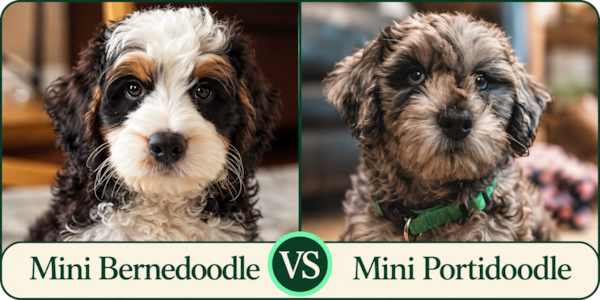
The Mini Bernedoodle vs Mini Portidoodle comparison puts two intelligent Poodle mixes together, but these dogs come from very different working backgrounds. Both share the Miniature Poodle, which can contribute trainability, athletic ability, low-shedding coat traits, and a strong interest in human interaction. The difference comes from whether that Poodle is paired with the powerful, steady Bernese Mountain Dog or the energetic, water-loving Portuguese Water Dog.
That distinction matters far beyond appearance. The Bernese Mountain Dog developed as a versatile Swiss farm dog that lived closely with farming families, watched the property, and was especially valued for draft work and dependable companionship. The Portuguese Water Dog spent generations working alongside fishermen, where swimming ability, endurance, quick responses, confidence, retrieving, and the willingness to keep working in a demanding environment all mattered.
Those histories create two different versions of an intelligent family dog. The Mini Bernedoodle generally leans toward greater physical substance, a calmer pace, and a steadier relationship with everyday activity. The Mini Portidoodle tends to be lighter, more athletic, and more inclined to seek movement, training, water play, and mentally engaging things to do.
Their size ranges differ too. An F1 Mini Bernedoodle can still mature into a substantial 30-to-50-pound dog because the Bernese Mountain Dog parent may weigh many times more than the Miniature Poodle. Mini Portidoodles are commonly much smaller, with many adults around 15 to 30 pounds, although generation and the actual Portuguese Water Dog and Poodle parents still matter.
Neither choice is simply “calm dog versus energetic dog.” Mini Bernedoodles can be excellent hiking companions, and Mini Portidoodles can learn to relax beautifully indoors. The more useful question is whether you want the steadier, more substantial Bernese influence or the athletic, water-working drive of the Portuguese Water Dog added to the shared Poodle foundation.
Table of Contents
- Mini Bernedoodle vs Mini Portidoodle at a Glance
- Mini Bernedoodle and Mini Portidoodle Overview and History
- Mini Bernedoodle vs Mini Portidoodle Appearance
- Mini Bernedoodle vs Mini Portidoodle Temperament
- Mini Bernedoodle vs Mini Portidoodle: Which One Should You Choose?
- Choose a Mini Bernedoodle if You Want a Steadier Family Companion
- Choose a Mini Portidoodle if You Want a Sporty, Highly Interactive Dog
- Which Is Bigger: Mini Bernedoodle or Mini Portidoodle?
- Which Is Calmer: Mini Bernedoodle or Mini Portidoodle?
- Which Is More Energetic?
- Which Needs More Mental Stimulation?
- Which Is Easier to Train?
- Which Is Better for First-Time Dog Owners?
- Which Is Better With Young Children?
- Which Is Better With Other Dogs?
- Which Is Better With Cats?
- Which Sheds Less: Mini Bernedoodle or Mini Portidoodle?
- Which Needs More Grooming?
- Which Is Better for Allergies?
- Which Is Better for Apartment Living?
- Which Is Better for an Active Lifestyle?
- Which Is Better for Swimming and Water Activities?
- Which Handles Cold Weather Better?
- Which Handles Warm Weather Better?
- Which Is More Independent?
- Which Is More Affectionate?
- Which Is More Likely to Bark?
- Which Is More Predictable in Size?
- Mini Bernedoodle vs Mini Portidoodle: The Final Comparison
Mini Bernedoodle vs Mini Portidoodle at a Glance
| Trait | Mini Bernedoodle | Mini Portidoodle |
| Parent breeds | Bernese Mountain Dog × Miniature Poodle | Portuguese Water Dog × Miniature Poodle |
| General size | Small-medium to medium | Small to medium-small |
| Common adult weight | F1 often 30–50 pounds; F1B commonly 20–30 pounds | Commonly about 15–30 pounds |
| Common height | Roughly 13–22 inches | Commonly around 12–18 inches |
| Build | Sturdy, broad, substantial | Compact, athletic, muscular |
| Coat | Straight, wavy, or curly | Usually wavy to curly |
| Shedding | Low to moderate, coat-dependent | Usually low, coat-dependent |
| Grooming | Moderate to high | Moderate to high |
| Color range | Tricolor, black and white, brown and white, sable, merle and more | Black, brown, white, black and white, brown and white, plus Poodle-influenced shades |
| Energy | Moderate | Moderate to high |
| Mental stimulation | Moderate to high | High |
| Trainability | High | Very high |
| Water interest | Individual-dependent | Frequently strong |
| Social style | Affectionate, gentle, steady | Affectionate, lively, confident, interactive |
| Best fit | Families wanting a calmer, substantial Doodle | Active owners wanting a sporty, highly trainable companion |
These ranges are guides rather than fixed standards. Both crosses can vary according to generation and parent size, but Mini Bernedoodles have a particularly large range because of the enormous size difference between the Bernese Mountain Dog and Miniature Poodle. Looking at the actual parents and mature dogs from similar pairings is far more useful than assuming the word “mini” guarantees one adult size.
Mini Bernedoodle and Mini Portidoodle Overview and History
The Mini Bernedoodle and Mini Portidoodle both combine the Poodle with an established working breed, which gives them more in common than their very different appearances may suggest. Intelligence, cooperation with people, and physical ability exist on both sides of each cross.
The kind of work behind them is different, though. Bernese Mountain Dogs needed strength, stability, and a temperament suited to life around a Swiss farm. Portuguese Water Dogs needed enough endurance, agility, independence, and swimming ability to work for long periods around fishing boats and coastal waters.
The Miniature Poodle adds another working background to both. Poodles were developed as water retrievers, so the Mini Portidoodle actually combines two breeds with strong aquatic histories, while the Mini Bernedoodle combines water-retriever intelligence with the steadier working style of a Swiss farm dog.
That difference gives each cross a distinct identity rather than simply creating two versions of a fluffy Poodle mix.
Mini Bernedoodle History and Background
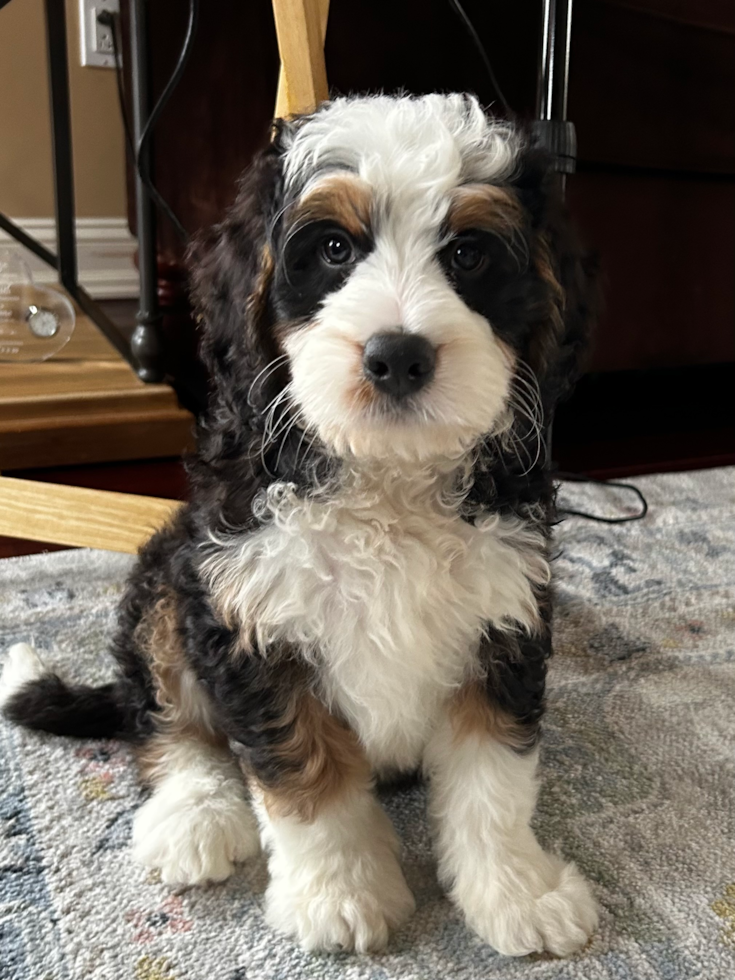
The Mini Bernedoodle combines a Bernese Mountain Dog with a Miniature Poodle. Modern Bernedoodles became increasingly familiar during the early twenty-first century, although Mini Bernedoodles can now appear in several generations and breeding combinations rather than one single formula.
The Bernese Mountain Dog developed in the agricultural regions around Bern, Switzerland. It was a large, muscular farm companion valued as a watchdog, family dog, and draft animal capable of pulling carts. Although Berners sometimes accompanied cattle, their historical identity was broader than that of a specialized herding breed.
This background helps explain the modern Berner's personality. Strength mattered, but so did steadiness around people, farm life, livestock, and ordinary daily activity. The breed became known for a calm, affectionate nature alongside its physical power.
Miniature Poodles bring another form of working intelligence. Poodles originated as water retrievers and were bred for athleticism, responsiveness, swimming ability, and close cooperation with people. The Miniature retains these traits despite its smaller body.
Combining the two can create a dog that is highly trainable without being constantly busy. The Poodle can add quicker learning and more athleticism, while Bernese influence may contribute patience, physical substance, and a more relaxed pace once daily needs are met.
Size is one of the least predictable parts of the first-generation cross. An F1 Mini Bernedoodle may have a Bernese parent weighing 70 pounds or more and a Miniature Poodle parent weighing a fraction of that, which explains why adult puppies from different pairings can land in very different places.
Mini Portidoodle History and Background
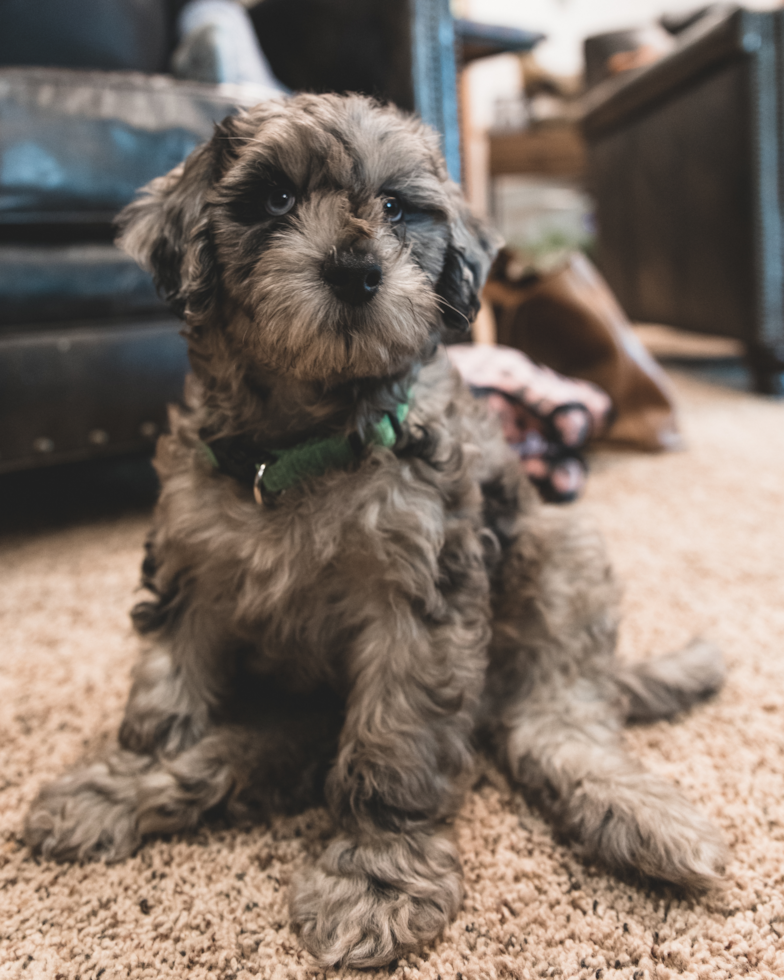
The Mini Portidoodle combines a Portuguese Water Dog with a Miniature Poodle. It may also be called a Portuguese Water Dog Poodle mix or Mini Portiepoo, although Mini Portidoodle has become a familiar name for the smaller version of the cross.
The Portuguese Water Dog developed along Portugal's coast as a working partner to fishermen. These dogs were expected to swim confidently, retrieve lost gear, carry messages between boats or from ship to shore, and help fishermen with demanding tasks around nets and the water.
This required much more than an ability to swim. Portuguese Water Dogs needed stamina, muscular strength, intelligence, confidence, trainability, and enough independent thought to work effectively in a changing environment.
The breed almost disappeared as modern fishing methods reduced the need for working boat dogs, but dedicated preservation efforts during the twentieth century saved it. Modern Portuguese Water Dogs still retain strong athletic ability and excel in activities such as obedience, agility, tracking, dock diving, and water work.
Pairing one with a Miniature Poodle creates an unusual amount of shared ancestry in terms of function. Both parents have historic ties to water work, retrieving, problem-solving, and close cooperation with people.
This helps explain why Mini Portidoodles can be exceptionally responsive and active companions. The Miniature Poodle reduces the size, but it does not necessarily reduce the appetite for exercise, learning, or interaction that comes from the Portuguese Water Dog side.
Mini Bernedoodle vs Mini Portidoodle Appearance
Mini Bernedoodles and Mini Portidoodles can share the soft, furnished appearance associated with Poodle crosses, but their underlying structures differ considerably. The Bernese Mountain Dog contributes substantial bone, a broad body, and a large working-dog frame. The Portuguese Water Dog contributes a medium-sized, muscular, athletic body built for swimming and sustained movement.
That difference remains visible even after the Miniature Poodle reduces overall size. Mini Bernedoodles tend to feel heavier and broader for their height, while Mini Portidoodles often look more compact and athletic.
Their natural parent coats also differ. Bernese Mountain Dogs have long, shedding double coats, while Portuguese Water Dogs naturally have low-shedding coats that can be tightly curled or loosely waved. This makes coat inheritance especially important when comparing shedding and grooming.
Mini Bernedoodle Appearance
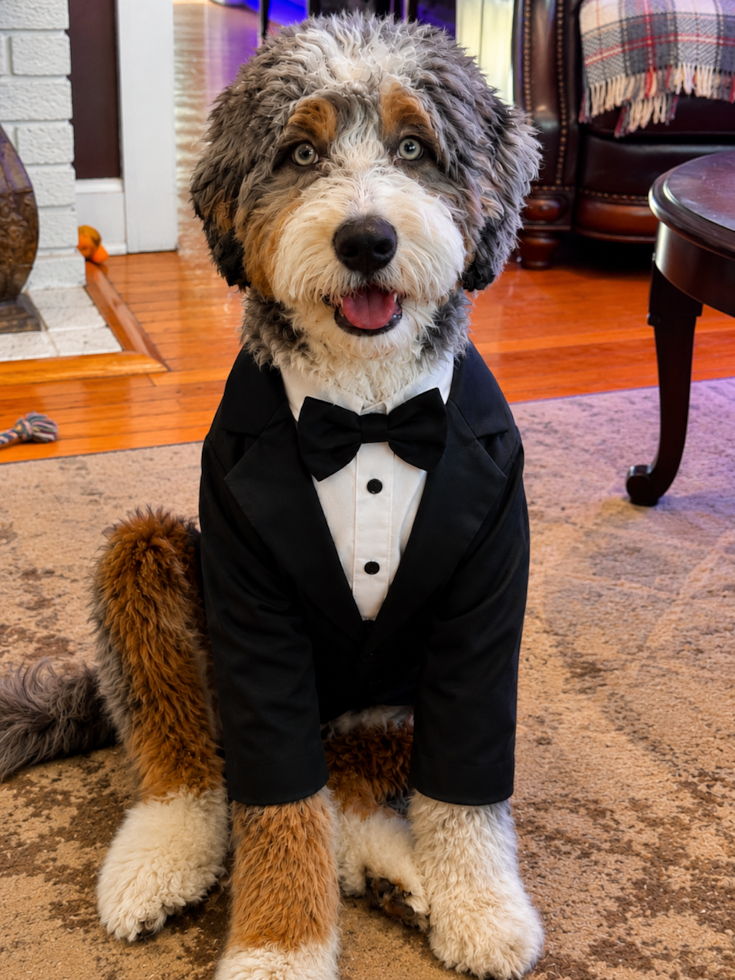
Mini Bernedoodle size varies significantly by generation. F1 Mini Bernedoodles commonly mature somewhere around 30 to 50 pounds, while F1B dogs with greater Poodle ancestry may fall closer to 20 to 30 pounds. Other generations and petite lines can produce different results.
Height commonly ranges from around 13 to 22 inches. A dog near the upper end can look much more like a medium-sized companion than what many people imagine when they hear the word “mini.”
The body is usually sturdy and well balanced. Even smaller Mini Bernedoodles can carry surprisingly substantial bone because the Bernese parent contributes such a large physical foundation.
Mini Bernedoodle Coat Type and Texture
Mini Bernedoodle coats can be straight, loosely wavy, or curly. Bernese Mountain Dogs contribute a longer double coat with a woolly undercoat, while the Poodle contributes dense curls.
A loose wave is one of the most familiar Mini Bernedoodle textures. It creates the shaggy teddy bear appearance that has become closely associated with the cross and can feel soft without standing as tightly away from the body as a full Poodle curl.
Straighter Mini Bernedoodles may retain more undercoat and can shed considerably more than curlier dogs. A strongly Poodle-influenced coat may release little visible hair but require much more deliberate brushing to prevent matting.
Generation changes the odds but not the certainty. Even puppies in the same broad generation can develop different adult coat textures.
Mini Bernedoodle Colors and Markings
The Mini Bernedoodle is famous for its Bernese-inspired tricolor look. Black, white, and rust or tan can create the familiar eyebrows, white blaze, chest markings, and warm points associated with the Bernese Mountain Dog.
Other colors are possible through Poodle ancestry and modern breeding lines. Mini Bernedoodles may be black and white, brown and white, sable, phantom, merle, or other combinations.
Pattern placement can vary dramatically. One tricolor dog may have a narrow white stripe down the face, while another carries extensive white across the head, chest, legs, and body.
Coat shades can change with age too. Poodle-related fading may soften darker colors, and longer adult hair can visually change how markings appear.
Mini Bernedoodle Eyes and Facial Features
Most Mini Bernedoodles have brown eyes with a soft expression. The Bernese Mountain Dog contributes dark eyes and a broad head, while the Poodle can refine the muzzle and create a somewhat lighter facial outline.
Blue or partially colored eyes may appear in lines where merle genetics are present, although these are not traditional Bernese traits.
Floppy ears and thick facial furnishings add to the rounded teddy bear appearance. Grooming can make the head look much broader or shorter-muzzled than the dog's actual underlying structure.
The expression frequently appears gentle and approachable, which suits the cross's reputation as an affectionate family companion.
Mini Bernedoodle Build and Size
Mini Bernedoodles tend to have greater physical substance than Mini Portidoodles. Bernese influence can add broader shoulders, more bone, and a heavier body even when the Miniature Poodle substantially reduces the overall size.
This can be appealing to people who want a sturdy dog rather than a lightly built small companion. A 35-pound Mini Bernedoodle feels very different in the home from a 20-pound Mini Portidoodle.
The heavier build can also affect agility and heat tolerance. Mini Bernedoodles can be highly capable outdoors, but they generally do not have the same naturally streamlined, water-athlete construction as the Portuguese Water Dog side of a Mini Portidoodle.
Their body is built more for strength and steady movement than quick aquatic work.
Mini Bernedoodle Shedding
Shedding varies considerably in Mini Bernedoodles because the parent coats sit at opposite ends of the spectrum. Bernese Mountain Dogs have heavy double coats and shed throughout the year, with more pronounced seasonal shedding.
The Poodle can reduce visible shedding significantly, particularly when the puppy inherits a curlier coat. Some Mini Bernedoodles release very little loose hair around the home.
Straighter dogs may retain more Bernese-style undercoat and shed noticeably. This is why promising that every Mini Bernedoodle is non-shedding would be inaccurate.
When low shedding is important, adult relatives with similar coat genetics provide much better clues than the crossbreed name itself.
Mini Bernedoodle Grooming Needs
Mini Bernedoodle grooming depends strongly on coat type. Curly and heavily furnished dogs can mat close to the skin, while straighter double-coated dogs may need significant brushing during seasonal coat release.
Behind the ears, beneath the legs, around the collar, and anywhere hair rubs together deserve particular attention. Larger Mini Bernedoodles also simply have more surface area to groom than a smaller Mini Portidoodle.
Professional grooming every several weeks is common for longer furnished coats. Shorter practical trims can dramatically reduce home maintenance, especially for dogs that spend a lot of time outdoors.
The fluffy look is attractive, but it comes with real work regardless of shedding level.
Mini Portidoodle Appearance
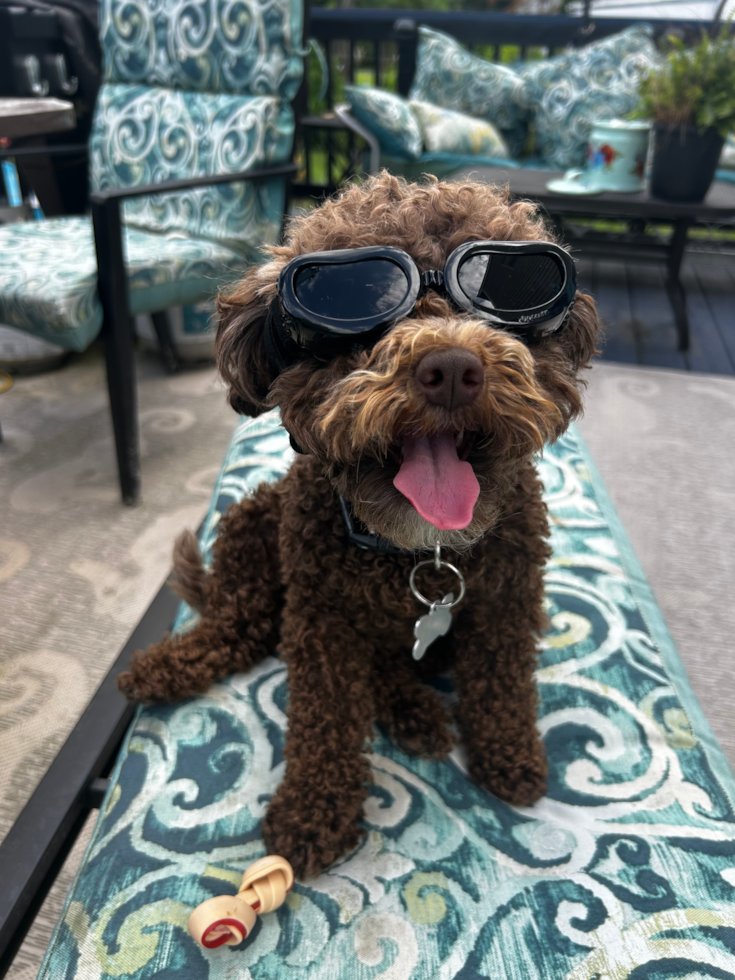
Mini Portidoodles are usually lighter and more athletic, with many adults around 15 to 30 pounds and roughly 12 to 18 inches tall. Individual dogs may fall outside that range depending on generation and parent size.
The Portuguese Water Dog parent is still a medium-sized dog, with adults commonly weighing roughly 35 to 60 pounds. Crossing one with a Miniature Poodle therefore still creates size variation, but the gap between the parent breeds is considerably smaller than in a first-generation Mini Bernedoodle pairing.
The body is typically compact, muscular, and balanced. Even smaller Mini Portidoodles can have an athletic feel rather than the delicate frame seen in some small companion crosses.
Mini Portidoodle Coat Type and Texture
The Mini Portidoodle has particularly strong potential for wavy or curly hair because both parent breeds naturally produce textured, low-shedding coats.
Portuguese Water Dogs can have tightly curled coats or looser waves. Miniature Poodles add dense curl, which means a straight coat is less central to this cross than it is in a Mini Bernedoodle.
Some Mini Portidoodles develop loose, flowing waves that closely resemble the wavy form of the Portuguese Water Dog coat. Others have tighter Poodle-like curls with substantial density.
The coat can also feel more naturally suited to water than the Mini Bernedoodle's shaggy furnishings. That does not make it self-maintaining, especially when the dog regularly swims.
Mini Portidoodle Colors and Markings
Portuguese Water Dogs naturally occur in black, brown, white, and combinations involving white markings. The Miniature Poodle can broaden the palette depending on the lines used.
Mini Portidoodles may therefore be black, brown, cream, white, black and white, brown and white, or other Poodle-influenced shades. Some have distinctive patches or tuxedo-like markings that make the Portuguese Water Dog heritage particularly obvious.
Their appearance can be visually simpler than the dramatic Bernese tricolor pattern, but that does not make the dogs less distinctive. A black-and-white Mini Portidoodle with loose waves can look especially close to a smaller Portuguese Water Dog.
Color may change somewhat with age, especially when fading genes from the Poodle side are present.
Mini Portidoodle Eyes and Facial Features
Mini Portidoodles commonly have dark brown eyes and an alert, thoughtful expression. Both Portuguese Water Dogs and Poodles were developed to work closely with people, and that attentive look can be obvious even in a relaxed dog.
The muzzle is moderate in length. Strong Poodle influence can produce a narrower face, while Portuguese Water Dog influence may add greater width and a more robust head.
Floppy ears sit close to the head and can carry substantial coat. Dogs that swim regularly need routine ear checks because moisture can remain inside dropped ears after water activity.
The overall expression tends to look lively and engaged rather than heavy or particularly soft.
Mini Portidoodle Build and Size
The Mini Portidoodle generally has the more athletic and streamlined build. Portuguese Water Dogs needed muscle, stamina, agility, and efficient movement for demanding work in and around the water.
Miniature Poodles reinforce rather than oppose those traits. They are active, agile dogs with their own water-retriever history, so both sides contribute athletic ability.
A Mini Portidoodle may therefore feel surprisingly capable for a dog weighing 20 or 25 pounds. Long walks, hiking, retrieving, swimming, agility-style games, and outdoor adventures can all fit naturally into the life of a healthy adult.
Its smaller size can make that level of athleticism particularly convenient for owners who want an active dog without moving into a large breed.
Mini Portidoodle Shedding
The Mini Portidoodle usually has the stronger advantage for consistently low visible shedding. Portuguese Water Dogs already have coats that shed very little, while the Miniature Poodle contributes the same general trait.
Individual texture still matters, and no cross should be promised as completely non-shedding. Some dogs release more coat than others during brushing and normal turnover.
The important difference is that the Mini Portidoodle does not have a heavily shedding double-coated parent on one side. That makes low shedding a more consistent expectation than it is in the Mini Bernedoodle.
Low shedding still does not guarantee that a person with allergies will tolerate the individual dog.
Mini Portidoodle Grooming Needs
Low shedding does not make the Mini Portidoodle easy to groom. Curly and wavy hair needs frequent brushing and combing because loose strands remain inside the coat rather than dropping freely.
Swimming creates another layer of maintenance. A dog that regularly enters pools, lakes, or the ocean should be rinsed when appropriate, dried thoroughly, and checked for tangles that can tighten as wet hair dries.
Ear care deserves attention after water activity because the ears hang close to the head. Regular checking helps owners notice trapped moisture or irritation early.
A shorter retriever-style pet trim can be especially practical for active Mini Portidoodles because it reduces matting and makes post-swim coat care much easier.
Mini Bernedoodle vs Mini Portidoodle Appearance Comparison: What Is the Difference?
The clearest difference is substance versus athletic compactness. Mini Bernedoodles commonly have broader bodies, heavier bone, and greater adult weight because of the Bernese Mountain Dog. Mini Portidoodles tend to be lighter and more athletic, reflecting two parent breeds with strong histories of movement and water work.
Size is also easier to keep modest in the Mini Portidoodle. The Portuguese Water Dog is much smaller than the Bernese Mountain Dog, so crossing it with a Miniature Poodle creates less extreme parent-size variation.
Coat texture overlaps, but the genetic starting point is different. Mini Bernedoodles may be straight, wavy, or curly because the Bernese parent contributes a conventional shedding double coat. Mini Portidoodles have textured coats coming from both sides, which makes waves and curls especially characteristic.
Color provides another easy distinction. The Mini Bernedoodle is famous for Bernese-style tricolor markings, while the Mini Portidoodle commonly leans toward black, brown, white, or combinations of those colors.
If you want a substantial teddy bear dog with classic tricolor possibilities, the Mini Bernedoodle may appeal more. If you prefer a smaller, athletic dog with a naturally wavy or curly water-dog appearance, the Mini Portidoodle has the advantage.
Mini Bernedoodle vs Mini Portidoodle Temperament
Both dogs are intelligent and people-oriented, but the similarities end before their activity styles become identical. The Bernese Mountain Dog and Portuguese Water Dog were developed for different environments and different kinds of work.
Bernese Mountain Dogs needed strength and steadiness around farms. Portuguese Water Dogs needed energy, quick responses, endurance, and the ability to perform varied jobs around boats and water.
The Poodle reinforces trainability in both crosses. In the Mini Portidoodle, however, it also reinforces many of the same athletic and water-oriented qualities already present in the Portuguese Water Dog.
Mini Bernedoodle Temperament
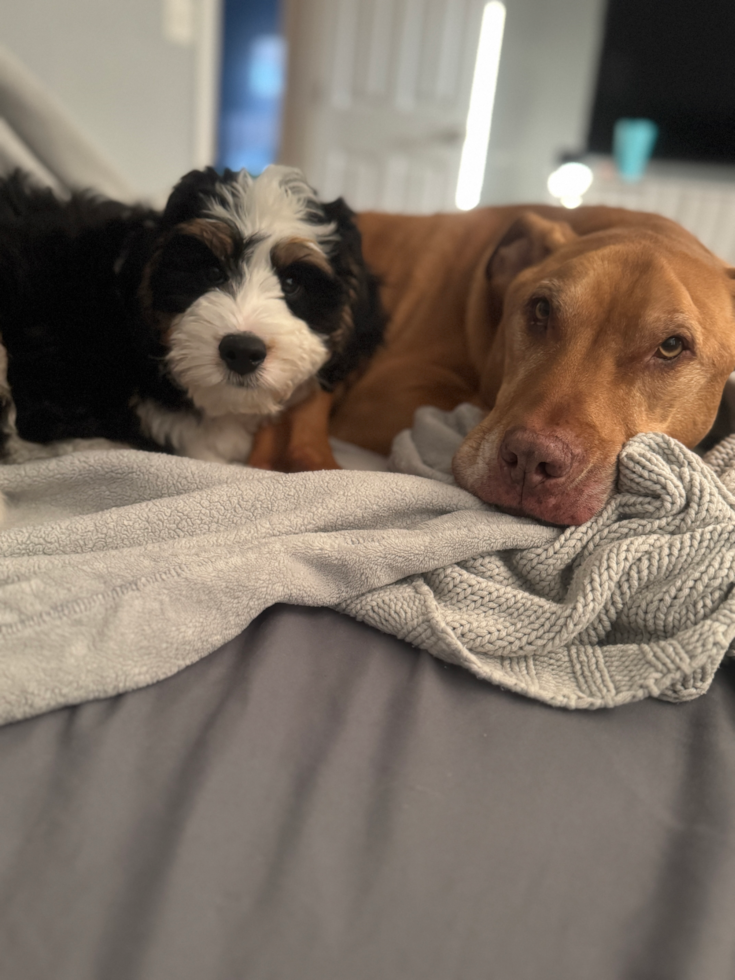
Mini Bernedoodles generally combine affection, playfulness, intelligence, and a steady social style. Bernese influence can create a dog that enjoys activity without remaining switched on to every opportunity for exercise.
They tend to value family involvement highly. A Mini Bernedoodle may enjoy a morning walk, spend time playing with the children, and then settle near the family without needing the rest of the afternoon turned into an enrichment program.
The Poodle side still adds plenty of learning ability and enthusiasm. This is not a slow or uninterested dog, but many develop a comfortable balance between activity and rest.
Mini Bernedoodle Intelligence and Training
Mini Bernedoodles are strong training candidates because both parent breeds are intelligent and accustomed to cooperating with people.
The Poodle can add quick learning, while Bernese influence may create a more patient or deliberate style. Some individuals respond immediately to a new exercise, while others prefer a moment to understand what is being asked.
Positive reinforcement suits the cross especially well. Bernese Mountain Dogs can be sensitive to harsh handling, so pressure is unnecessary when rewards and consistency work better.
Most family training does not need to become complicated. Recall, loose-leash walking, calm greetings, handling, settling, and reliable household manners give the dog's intelligence a practical purpose.
Mini Bernedoodle Energy Level
The Mini Bernedoodle generally has moderate energy. It can enjoy hiking, swimming, outdoor exploration, fetch, and longer walks, but many adults do not require intense physical exercise every day.
The larger body also makes moderation important during growth. Puppies need opportunities to move and play without being pushed into repetitive strenuous exercise before their structure has matured.
As adults, many develop a good off switch. They can participate enthusiastically when the family is active and settle comfortably when the day becomes quieter.
This flexibility is one of the reasons the cross can fit such a broad range of family routines.
Mini Bernedoodle Affection and Family Attachment
Mini Bernedoodles can become deeply attached to their families. Bernese Mountain Dogs have a strong history as farm companions that lived closely with people, and Poodles form similarly strong human bonds.
Many enjoy physical affection and choose to remain near family members throughout the day. A larger Mini Bernedoodle may express that closeness by leaning against someone or occupying considerably more sofa than its owner originally planned.
The affectionate temperament can make independence practice important. A puppy that never learns to rest alone may struggle when ordinary life eventually requires separation.
Short, calm periods apart help build confidence without changing the dog's naturally close relationship with people.
Mini Bernedoodles With Children
Mini Bernedoodles can make excellent family companions. Bernese influence may add patience and a gentle social style, while the Poodle contributes playfulness and trainability.
Their larger size can make them physically sturdy around children, but it also creates a different risk. A 40-pound adolescent can knock over a small child without intending any harm.
Teaching calm greetings and appropriate play from puppyhood therefore matters. Children should also learn to respect the dog's space rather than relying on a gentle temperament to excuse rough behavior.
Older children may enjoy training, walking, and outdoor activity with the dog, while younger children can benefit from the cross's potentially steadier rhythm.
Mini Bernedoodles With Other Dogs and Pets
Mini Bernedoodles commonly have good potential with other dogs and household pets. Their parent breeds do not contribute strong modern prey or herding instincts that dominate family life.
Another dog can make an excellent playmate when size and energy levels are compatible. A large Mini Bernedoodle may play too physically for a very tiny companion even when everyone is friendly.
Cats can also fit comfortably into the household, especially when introductions happen early and calmly.
Normal puppy chasing can still occur, so good boundaries remain useful rather than assuming friendly ancestry makes training unnecessary.
Mini Bernedoodle Barking and Watchfulness
Mini Bernedoodles can notice visitors and unusual activity around the home. The Bernese Mountain Dog historically had a watchdog role on farms, so some alert behavior is natural.
The response is usually not as activity-driven as it can be in highly vigilant herding or sporting dogs. Many will announce something unusual and then settle once the family makes it clear that everything is fine.
Individual dogs vary, and learned behavior matters greatly. Barking that earns attention repeatedly can become a habit regardless of ancestry.
Teaching a calm response to visitors and outside sounds gives that natural awareness useful boundaries.
Mini Portidoodle Temperament
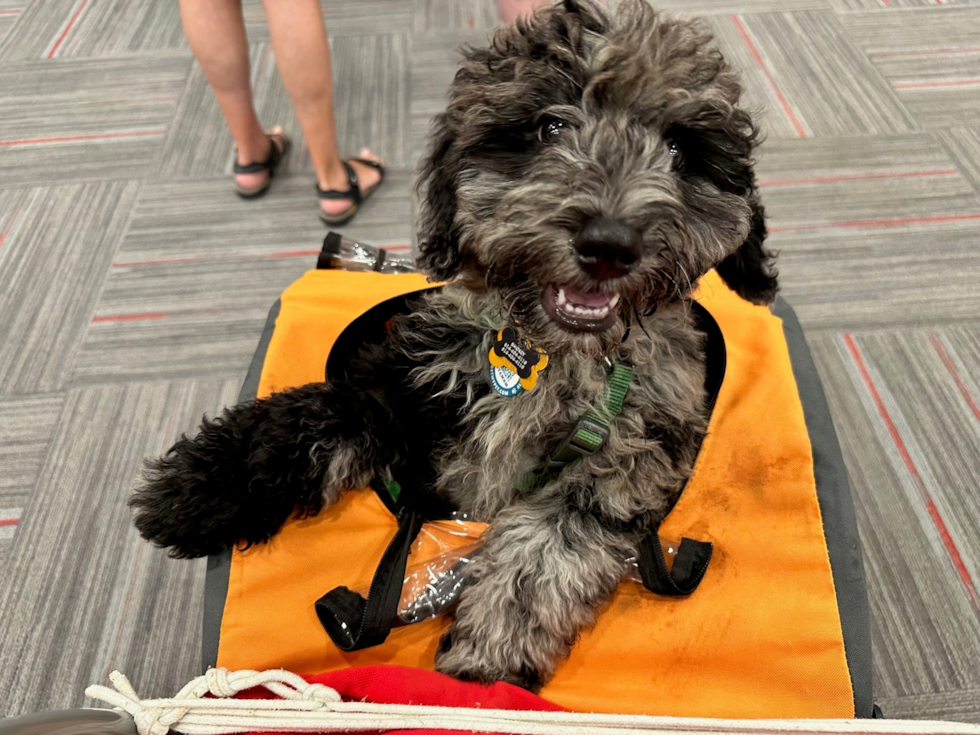
The Mini Portidoodle tends to be affectionate, clever, energetic, and highly interactive. Both parent breeds bring a history of working closely with people, so the cross can be exceptionally responsive to training and eager to participate in family activities.
The Portuguese Water Dog also contributes a spirited quality. These dogs were expected to work through demanding conditions rather than simply accompany fishermen passively, so confidence and persistence were useful traits.
A Mini Portidoodle may therefore feel more active and purposeful than its size suggests. It can settle indoors, but the road to that relaxed evening may include more walking, training, retrieving, or swimming than a Mini Bernedoodle needs.
Mini Portidoodle Intelligence and Training
Training is one of the Mini Portidoodle's strongest qualities because both parent breeds have exceptional histories of learning and working with people.
Portuguese Water Dogs needed to respond to fishermen while also making decisions in a difficult environment. Poodles bring another highly trainable working background, so the finished cross can pick up behaviors quickly.
This makes advanced training especially rewarding. Retrieving, scent work, agility, obedience, water games, trick training, and other activities can give the dog productive outlets for its intelligence.
Quick learning can also work against inconsistent households. A dog capable of learning five useful behaviors quickly can learn five equally inconvenient household habits just as efficiently.
Mini Portidoodle Energy Level
The Mini Portidoodle usually has the higher energy level in this comparison. Portuguese Water Dogs are active athletes that need meaningful daily exercise, and Miniature Poodles also enjoy regular physical and mental activity.
A short bathroom walk around the block is not likely to satisfy a healthy adult as its entire routine. Brisk walks, games, training, exploration, and opportunities to move freely provide a much more realistic foundation.
Exercise should still be balanced rather than endless. Mental work can tire a clever dog in ways that simply adding another mile does not.
Owners who enjoy an active lifestyle may find this cross particularly satisfying because the dog has both the body and the brain to participate.
Mini Portidoodles and Water
Water interest is one of the most distinctive parts of the Mini Portidoodle comparison. Portuguese Water Dogs were specifically developed for aquatic work, and Poodles themselves have water-retriever ancestry.
This gives the Mini Portidoodle unusually strong potential to enjoy swimming and retrieving in water. Individual dogs still vary, and no puppy should simply be thrown into water because of its family tree.
Gradual, positive introductions allow the dog to build confidence safely. A Mini Portidoodle that enjoys swimming may eventually become an enthusiastic companion for lakeside trips, dock activities, beach outings, or simply retrieving toys from a safe pool.
The attraction can be wonderfully convenient for water-loving families and somewhat less convenient when the dog discovers every muddy pond deserves investigation.
Mini Portidoodle Affection and Family Attachment
Mini Portidoodles tend to be strongly people-oriented. Portuguese Water Dogs historically worked in close partnership with fishermen, while Poodles also thrive on interaction with their humans.
The attachment often feels active. These dogs may want to join walks, games, training, trips, and household activity rather than simply remain nearby.
Many are affectionate once the day slows down and can be excellent cuddle companions after their activity needs have been met.
Teaching calm independence remains useful because an intensely involved dog still needs to cope comfortably when family members leave.
Mini Portidoodles With Children
Mini Portidoodles can make excellent family dogs, particularly in households with children who enjoy active play and interaction.
Their smaller average size makes them physically manageable, while the Portuguese Water Dog side contributes a sturdy body rather than an especially delicate frame.
Enthusiasm is the bigger consideration. Portuguese Water Dogs can be exuberant, and a lively Mini Portidoodle may jump, bounce, or play with more intensity than very young children appreciate.
Early manners around greetings and play help channel that enthusiasm into a family-friendly form. Older children may particularly enjoy training, retrieving games, and water activities with the dog.
Mini Portidoodles With Other Dogs and Pets
Mini Portidoodles generally have good potential with other dogs when socialized well. Their playful, energetic style can make them enjoyable companions for another dog that appreciates similar activity.
A quieter senior dog may find a lively young Mini Portidoodle exhausting, which makes play-style matching important.
Cats can also live successfully with the cross. Retrieving and movement interest can create chasing during puppyhood, but the breed does not bring a strong terrier-style vermin background into the home.
Clear boundaries and rewards for calm behavior give other household pets a better chance of enjoying the new companion.
Mini Portidoodle Barking and Alertness
Mini Portidoodles can be alert and vocal, though barking varies by individual. Portuguese Water Dogs are attentive working dogs, and Poodles also notice changes around them quickly.
Activity outside a window, visitors, or excitement may trigger barking. In some dogs, vocal behavior is less about guarding and more about enthusiasm or frustration.
Training becomes easier when the dog has enough exercise and mental stimulation. A bored, intelligent dog can find plenty of reasons to react to its environment.
Rewarding calm observation and teaching a reliable quiet cue help keep that natural alertness manageable.
Mini Bernedoodle vs Mini Portidoodle Temperament Comparison: What Is the Real Difference?
The clearest temperament difference is steady family companionship versus athletic working engagement.
The Mini Bernedoodle generally brings more Bernese steadiness. It can learn quickly, enjoy exercise, and participate in family adventures without necessarily needing challenging activity woven through every day.
The Mini Portidoodle usually brings more sustained drive for action and interaction. Portuguese Water Dog and Poodle ancestry combine two intelligent, athletic water-working traditions, which can create a dog that actively looks forward to training, retrieving, swimming, and varied exercise.
This difference is not the same thing as saying the Mini Bernedoodle is lazy or the Mini Portidoodle cannot settle. Both descriptions would miss the point. A Mini Bernedoodle can hike for hours, while a properly exercised Mini Portidoodle can spend a relaxed evening beside the family.
The important question is what happens on the ordinary days between those adventures. The Mini Bernedoodle usually adapts more easily to a moderate routine, while the Mini Portidoodle is more likely to notice when several quiet days in a row have become a pattern.
Mini Bernedoodle vs Mini Portidoodle: Which One Should You Choose?
The Mini Bernedoodle and Mini Portidoodle both offer intelligence, affection, trainability, and strong family bonds, but they are unlikely to feel identical once they settle into adult life. Their shared Poodle explains many of the similarities. Their other parent explains why one may fit your daily routine much better than the other.
The Mini Bernedoodle generally offers greater physical substance and a calmer overall pace. The Mini Portidoodle generally offers a smaller athletic body and more sustained enthusiasm for activity, training, and water-based fun.
Choose a Mini Bernedoodle if You Want a Steadier Family Companion
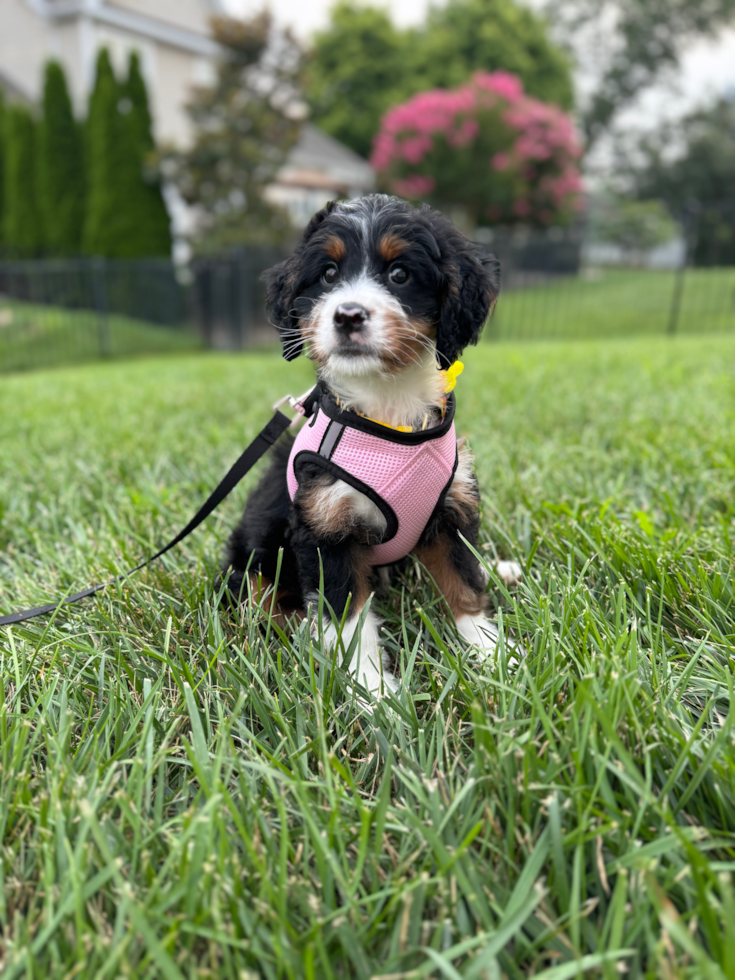
A Mini Bernedoodle may suit you better if you want an intelligent dog that enjoys exercise but can also fit naturally into a moderate family routine.
The Bernese side can add a calm, gentle quality that becomes especially appealing once puppyhood is over. Many Mini Bernedoodles enjoy walking, hiking, playing, and training without expecting every part of the day to provide another challenge.
Their larger body may also appeal to families that want a substantial dog rather than a compact athletic companion. Even an F1B Mini Bernedoodle around 25 pounds can feel heavier and broader than a similarly tall Mini Portidoodle.
The tradeoff is greater size variation and potentially greater shedding. Anyone specifically seeking a small, consistently low-shedding dog should look closely at generation and parent coats rather than relying on the Mini Bernedoodle name alone.
Choose a Mini Portidoodle if You Want a Sporty, Highly Interactive Dog
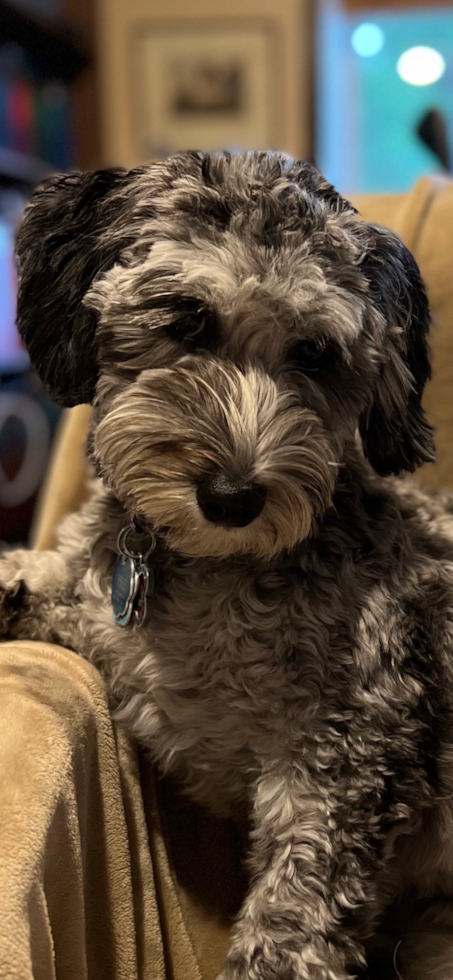
A Mini Portidoodle may suit you better if walks, training, outdoor adventures, swimming, and games are already part of the lifestyle you want to share with your dog.
The Portuguese Water Dog and Poodle give this cross two highly athletic, intelligent working parents. That can produce a dog with impressive stamina for its size and a genuine enthusiasm for learning.
The smaller adult range can make the cross easier to transport and manage physically than many Mini Bernedoodles without sacrificing athletic ability. This can be particularly appealing for people who want a capable adventure dog but do not want a 40-pound companion.
The Mini Portidoodle asks for more active participation in return. Its intelligence is an advantage when owners enjoy engaging it and a challenge when several days of boredom are allowed to accumulate.
Which Is Bigger: Mini Bernedoodle or Mini Portidoodle?
The Mini Bernedoodle is usually larger and heavier. First-generation Mini Bernedoodles commonly fall around 30 to 50 pounds, while F1B dogs are frequently closer to 20 to 30 pounds.
Mini Portidoodles commonly stay around 15 to 30 pounds, although individual parent size and generation can move dogs outside that range. Their Portuguese Water Dog parent is medium-sized rather than very large, which makes the parent-size gap less extreme.
A small F1B Mini Bernedoodle can certainly overlap with a larger Mini Portidoodle. The biggest difference is that the Mini Bernedoodle has much greater potential to mature into a surprisingly substantial adult.
For owners with firm size limits, actual parent weights and previous mature offspring should be part of the decision.
Which Is Calmer: Mini Bernedoodle or Mini Portidoodle?
The Mini Bernedoodle usually has the calmer adult profile. Bernese Mountain Dogs are powerful working dogs, but they are known for a placid, good-natured temperament and do not require the same sustained activity as Portuguese Water Dogs.
Mini Portidoodles tend to remain more interested in movement, games, training, and exploration. Their parents both come from working backgrounds that rewarded physical stamina and mental engagement.
Puppyhood can temporarily blur the distinction because young Mini Bernedoodles can be rambunctious too. The calmer Bernese influence generally becomes more useful as the dog matures.
If a good off switch is a high priority, the Mini Bernedoodle has the stronger average advantage.
Which Is More Energetic?
The Mini Portidoodle is usually more energetic. Portuguese Water Dogs are athletic dogs that require vigorous daily exercise, and Miniature Poodles add further activity rather than reducing it.
Mini Bernedoodles enjoy exercise too and can become excellent hiking or outdoor companions. Many simply do not need the same amount of sustained activity to remain content.
The difference can be particularly obvious over several consecutive days. A Mini Bernedoodle may tolerate a quieter day after a busy weekend more readily, while a young Mini Portidoodle may still expect its normal walk, training, and play.
For consistently active owners, this extra enthusiasm can be a major advantage rather than a burden.
Which Needs More Mental Stimulation?
The Mini Portidoodle generally needs more regular mental engagement because both parent breeds were developed for complex work requiring problem-solving and close cooperation with humans.
Training exercises, retrieving, scent games, puzzle feeders, swimming activities, and varied walking routes can all give the dog useful outlets.
Mini Bernedoodles also benefit from mental stimulation and can learn an impressive amount. They are simply more likely to be content when training is one enjoyable part of life rather than something that needs to appear every day in several forms.
A dog does not need a complicated puzzle collection to stay mentally healthy. Short training sessions and meaningful interaction can accomplish a great deal when they are used consistently.
Which Is Easier to Train?
Both are highly trainable, but the Mini Portidoodle may have the edge for enthusiasm and advanced learning.
Portuguese Water Dogs and Poodles both have histories built around responding to people while performing difficult tasks. A Mini Portidoodle may learn new exercises quickly and remain enthusiastic when training becomes more complex.
Mini Bernedoodles are very capable learners too. Their Bernese side may create a somewhat more deliberate style, and some dogs respond best when training remains positive rather than repetitive.
For basic household manners, either can excel. For someone who wants to pursue advanced obedience, retrieving games, agility, or water work, the Mini Portidoodle may offer more natural drive.
Which Is Better for First-Time Dog Owners?
The Mini Bernedoodle may have a slight advantage for many first-time owners because its adult energy and mental needs can be more forgiving.
This does not make it effortless. Size, grooming, leash manners, socialization, and independence training still need consistent attention, particularly when the dog may mature to 40 pounds or more.
A Mini Portidoodle can also be a wonderful first dog for an owner who actively wants the training and exercise experience. Its responsiveness can make learning together highly rewarding.
The less suitable first-time match would be someone attracted to the Mini Portidoodle's size but expecting it to behave like a low-energy small companion.
Which Is Better With Young Children?
The Mini Bernedoodle may have a slight advantage for households with younger children because Bernese influence can contribute a gentler, steadier pace.
Its greater physical size creates an important counterpoint, though. A large adolescent Mini Bernedoodle can knock a child over during excited play, so manners still matter.
Mini Portidoodles can be excellent with children too, especially families that enjoy active interaction. Their enthusiasm may require more work around jumping, bouncing, and overly energetic greetings.
For older children interested in training, swimming, fetching, and outdoor activities, the Mini Portidoodle can become a particularly entertaining companion.
Which Is Better With Other Dogs?
Both can live very successfully with other dogs.
Mini Bernedoodles may suit quieter canine companions because many develop a relatively easygoing adult play style. A well-socialized dog can enjoy company without turning every interaction into a high-energy event.
Mini Portidoodles may be especially fun with another active dog. Their athleticism and enthusiasm can create lively play, particularly during youth.
The best match depends on individual energy and play style. A calm senior may appreciate the Bernedoodle's pace more than an exuberant young Portidoodle, regardless of how friendly both dogs are.
Which Is Better With Cats?
Both can live comfortably with cats when introductions and early boundaries are handled well.
Neither cross has a strong terrier-style vermin background. The Portuguese Water Dog does bring retrieving and working instincts, so some Mini Portidoodles may be particularly interested in movement during puppyhood.
Mini Bernedoodles may have a slight advantage for particularly quiet cats because their overall adult temperament can be calmer.
The cat's personality matters too. A confident cat that has safe places to retreat usually adjusts much more easily than one that runs whenever the puppy approaches.
Which Sheds Less: Mini Bernedoodle or Mini Portidoodle?
The Mini Portidoodle generally has the advantage for low visible shedding because both parent breeds naturally have low-shedding coats.
Mini Bernedoodles have a heavily shedding Bernese Mountain Dog on one side and a low-shedding Poodle on the other. Their finished coats can therefore range from very low shedding to noticeably more hair around the home.
Mini Portidoodles still vary in coat texture, but their genetic starting point makes heavy shedding less characteristic.
Neither should be guaranteed completely non-shedding or allergy-proof. Those are different claims from saying the cross generally leaves little visible hair around the home.
Which Needs More Grooming?
Both can require significant grooming, but the workload is different.
A Mini Bernedoodle may have more total coat to maintain because of its larger body, and straighter individuals can require substantial undercoat brushing. Curlier coats need regular combing and professional trims to prevent matting.
The Mini Portidoodle is usually smaller but may have dense waves or curls that require consistent brushing. Regular swimmers add rinsing, drying, detangling, and ear care to the routine.
Neither is a low-maintenance grooming choice. The better option depends more on whether you prefer managing a larger mixed-texture coat or a smaller but consistently textured one.
Which Is Better for Allergies?
The Mini Portidoodle may offer the stronger low-shedding profile, but neither cross can be guaranteed suitable for someone with allergies.
Portuguese Water Dogs and Poodles both release relatively little visible hair. Mini Bernedoodles can inherit substantially more shedding from the Bernese side.
Allergic reactions involve proteins found in dander and saliva as well as hair, so low shedding does not make an individual dog allergen-free.
Anyone with meaningful dog allergies should evaluate their response to the actual dog rather than relying solely on breed ancestry.
Which Is Better for Apartment Living?
The answer depends on whether physical size or activity level creates the bigger challenge.
The Mini Portidoodle is usually smaller and takes up less room, but it needs more deliberate exercise and mental activity. A bored athletic dog can struggle in a spacious house just as easily as in an apartment.
The Mini Bernedoodle tends to be calmer but may mature into a 40- or 50-pound dog. That physical size can matter in very compact living spaces even when the temperament is easygoing.
Either can live successfully in an apartment when its daily routine is appropriate. A predictable exercise schedule, quiet training, and comfortable alone-time skills matter much more than access to a backyard.
Which Is Better for an Active Lifestyle?
The Mini Portidoodle has the clearer advantage for consistently active households.
Portuguese Water Dog and Poodle ancestry combine stamina, athletic ability, trainability, and a natural enthusiasm for movement. Hiking, long walks, retrieving, swimming, agility-style activities, and travel can all suit the cross extremely well.
Mini Bernedoodles can enjoy the same adventures and should not be underestimated physically. Their advantage is flexibility rather than maximum activity.
If you want a dog that can join adventures but also accept several quieter days without complaint, the Mini Bernedoodle may fit better. If activity is already woven into most days of your week, the Mini Portidoodle may feel like the more natural partner.
Which Is Better for Swimming and Water Activities?
The Mini Portidoodle is the clear favorite for water-oriented households.
Portuguese Water Dogs were developed specifically for work in and around water, and Poodles also have water-retriever ancestry. Few Doodle crosses bring that kind of aquatic heritage from both sides.
Individual dogs still need safe, gradual introductions. Natural ancestry does not mean every puppy immediately understands deep water or enjoys swimming.
For a dog that does love it, water can become both physical exercise and mental enrichment. Swimming, retrieving floating toys, dock activities, and supervised lake outings can become a meaningful part of the relationship.
Which Handles Cold Weather Better?
The Mini Bernedoodle usually has the advantage in cold weather because the Bernese Mountain Dog developed in Switzerland with a thick double coat suited to cool, snowy conditions.
Portuguese Water Dogs have weather-resistant coats and were expected to work in coastal conditions, so Mini Portidoodles are not particularly fragile in cool weather either.
Individual coat type changes the equation. A strongly Poodle-influenced Mini Bernedoodle in a short clip does not have the same insulation as a full-coated Bernese Mountain Dog.
For normal winter walks, both can do well. The Mini Bernedoodle simply has the stronger cold-weather heritage.
Which Handles Warm Weather Better?
The Mini Portidoodle usually has the better profile for active life in warmer weather, although sensible heat precautions still matter.
Portuguese Water Dogs are athletic dogs with moderate body mass, while Mini Portidoodles are also usually lighter than Mini Bernedoodles. That can make heat dissipation somewhat easier during activity.
Bernese Mountain Dogs developed for a cool Alpine environment and carry heavy bodies and thick coats. A Mini Bernedoodle is much smaller, but strong Bernese traits can still make hot conditions less comfortable.
Neither dog should exercise hard in extreme heat or humidity. Shade, water, cool indoor space, and activity during cooler parts of the day remain important.
Which Is More Independent?
The Mini Portidoodle may show a slightly stronger independent working streak, but that does not make it a dog that prefers being away from people.
Portuguese Water Dogs had to make decisions while working in complex environments, which can create confidence and self-direction. The Poodle adds another intelligent parent capable of independent problem-solving.
Mini Bernedoodles can be more emotionally dependent on family company, particularly when the Bernese side is strong. Many prefer staying close to their people throughout the day.
Both should still learn comfortable alone time from puppyhood rather than having independence left to chance.
Which Is More Affectionate?
Both can be extremely affectionate, but the style may differ.
The Mini Bernedoodle often brings a softer, steadier form of closeness. It may lean against family members, settle beside them, follow them through the home, and value quiet physical contact.
The Mini Portidoodle may express attachment more actively. It can seek games, training, outings, fetching, swimming, and shared activity before happily settling down afterward.
Neither form reflects a stronger bond. One tends to feel calmer and more physically affectionate, while the other can feel more participatory.
Which Is More Likely to Bark?
Either can alert bark, but neither should automatically be considered highly vocal.
Bernese Mountain Dogs historically watched farms and could alert families to unfamiliar visitors. Portuguese Water Dogs are similarly attentive working dogs and may vocalize through excitement, frustration, or awareness of environmental changes.
The Mini Portidoodle's higher overall activity and engagement can sometimes make it feel more expressive, while the Mini Bernedoodle may be somewhat slower to react.
Training and environment influence the outcome greatly. A dog that rehearses barking at a busy front window every day will usually become better at it regardless of ancestry.
Which Is More Predictable in Size?
The Mini Portidoodle generally has the advantage for size predictability because the difference between a Portuguese Water Dog and Miniature Poodle is smaller than the enormous gap between a Bernese Mountain Dog and Miniature Poodle.
Portuguese Water Dogs commonly weigh around 35 to 60 pounds, while Bernese Mountain Dogs may range from roughly 70 to well over 100 pounds. That makes first-generation Mini Bernedoodle size particularly variable.
Later-generation Mini Bernedoodles can become easier to estimate when both parents are already within smaller Bernedoodle or Poodle ranges.
For either cross, actual parent measurements remain more useful than averages. The word “mini” describes the intended smaller version of the cross, not one standardized adult size.
Mini Bernedoodle vs Mini Portidoodle: The Final Comparison
Choosing between a Mini Bernedoodle vs Mini Portidoodle becomes much easier when you look beyond the shared Poodle and ask what kind of working background fits your life.
The Mini Bernedoodle adds the Bernese Mountain Dog, a powerful Swiss farm companion valued for strength, steadiness, draft work, watchfulness, and close family relationships. That influence tends to create the larger and calmer dog in this comparison, with a substantial body and a temperament that can adapt nicely when busy days alternate with quieter ones.
The Mini Portidoodle adds the Portuguese Water Dog, an agile coastal worker that once swam beside fishing boats, retrieved gear, helped with nets, and carried messages over water. Combined with the Poodle's own retrieving background, this creates a particularly athletic and trainable little dog with strong potential for swimming, advanced learning, and an active lifestyle.
Their coats also tell part of the story. Mini Portidoodles have low-shedding coat genetics from both sides, which generally makes visible shedding more predictable. Mini Bernedoodles combine the Poodle with a heavily shedding double-coated breed, so coat behavior can vary much more.
Size is another practical divide. The Mini Portidoodle commonly stays around 15 to 30 pounds, while an F1 Mini Bernedoodle can reach 30 to 50 pounds and sometimes feels much more like a medium-sized dog than a traditionally small companion.
The better choice comes down to the ordinary days rather than the occasional adventure.
If you want an affectionate, intelligent dog that can hike, play, train, and join family activities but generally settles comfortably into a more moderate routine, the Mini Bernedoodle may be the better fit.
If you want a smaller athletic companion and genuinely enjoy regular exercise, training, retrieving, water activities, and keeping a clever dog mentally engaged, the Mini Portidoodle may be the more rewarding match.
Neither is simply a fluffy Poodle mix with a different color pattern. Their parent histories still matter, and those histories shape what each dog may ask from the person living on the other end of the leash.
Look closely at the parents, generation, expected adult size, coat, and temperament before choosing. The right cross is the one whose normal daily needs fit comfortably into the life you actually plan to share with it.
Frequently Asked Questions
What is the main difference between a Mini Bernedoodle and Mini Portidoodle? Both share Miniature Poodle ancestry, but the Mini Bernedoodle also has Bernese Mountain Dog ancestry while the Mini Portidoodle has Portuguese Water Dog ancestry. The Bernese side generally adds greater size, physical substance, and a calmer temperament, while the Portuguese Water Dog adds more athleticism, water instinct, stamina, and sustained interest in activity. Both can be highly intelligent and affectionate. The biggest difference is whether you prefer a steadier family companion or a more active sporting and water-oriented dog.
Which is bigger, a Mini Bernedoodle or Mini Portidoodle? The Mini Bernedoodle is usually larger. F1 Mini Bernedoodles commonly mature around 30 to 50 pounds, while F1B dogs are frequently closer to 20 to 30 pounds. Mini Portidoodles commonly fall around 15 to 30 pounds. Individual dogs overlap, but the Mini Bernedoodle has much greater potential to mature into a substantial medium-sized adult.
Which is calmer, a Mini Bernedoodle or Mini Portidoodle? The Mini Bernedoodle usually has the calmer adult temperament. Bernese Mountain Dogs are strong working dogs but are known for a steady, good-natured style and moderate exercise requirements. Mini Portidoodles generally need more activity because Portuguese Water Dogs and Poodles both bring athletic working backgrounds. A well-exercised Mini Portidoodle can still develop an excellent off switch indoors.
Which is easier to train, a Mini Bernedoodle or Mini Portidoodle? Both are highly trainable. The Mini Portidoodle may have a slight advantage for advanced training because both parent breeds are exceptionally responsive, athletic dogs with histories of complex water work and retrieving. Mini Bernedoodles are strong learners too and may feel easier for basic family manners because their overall temperament can be less intense. Positive, consistent training works well for both.
Which sheds less, a Mini Bernedoodle or Mini Portidoodle? The Mini Portidoodle generally has the advantage for consistently low shedding. Both the Portuguese Water Dog and Poodle have coats that release relatively little visible hair. Mini Bernedoodles can vary much more because the Bernese Mountain Dog has a heavy shedding double coat. Curlier Mini Bernedoodles may shed very little, while straighter individuals can leave noticeably more hair around the home.
Which needs more grooming, a Mini Bernedoodle or Mini Portidoodle? Both need regular grooming. Mini Bernedoodles may have more total coat to maintain because they are commonly larger, while Mini Portidoodles can develop dense curls or waves that mat when brushing is skipped. Swimming adds extra maintenance for Mini Portidoodles that spend a lot of time in water. Rinsing, thorough drying, detangling, and ear checks should become part of the routine for dogs that swim frequently.
Is a Mini Bernedoodle or Mini Portidoodle better with children? Both can be excellent family dogs. Mini Bernedoodles may have a slight advantage with very young children because Bernese influence can add a calmer, gentler rhythm, although their larger bodies can accidentally knock a toddler over. Mini Portidoodles may be especially enjoyable for active older children who want to play fetch, train tricks, swim, or participate in outdoor activities. Early manners are important because young Portidoodles can be enthusiastic.
Is a Mini Bernedoodle or Mini Portidoodle better for apartment living? Either can live successfully in an apartment when its needs are met. Mini Portidoodles are usually physically smaller, but their higher energy level requires a committed daily exercise and enrichment routine. Mini Bernedoodles tend to be calmer but can grow considerably larger. Apartment suitability therefore depends less on the breed name and more on whether you can comfortably meet the adult dog's size, exercise, barking, and alone-time needs.
Which is better for swimming, a Mini Bernedoodle or Mini Portidoodle? The Mini Portidoodle has the clear advantage for natural water potential. Portuguese Water Dogs were developed specifically to work with fishermen in and around water, while Poodles also descend from water retrievers. Mini Bernedoodles can enjoy swimming too, but aquatic work is not central to the Bernese Mountain Dog's history. Individual confidence still matters, and every dog should be introduced to water gradually and safely.
Should I choose a Mini Bernedoodle or Mini Portidoodle? Choose a Mini Bernedoodle if you want an intelligent, affectionate, substantial family dog with moderate energy and a steadier everyday rhythm. It is a strong match for someone who enjoys walks and adventures but also wants a dog comfortable with quieter days. Choose a Mini Portidoodle if you want a smaller, highly trainable athlete with more energy, excellent water potential, and a real enthusiasm for exercise and mental challenges. Both can be wonderful companions, but the better choice depends on whether Bernese steadiness or Portuguese Water Dog athleticism fits the life you actually lead.