





Published Wednesday, October 14, 2026 by Pilesgrove Pups
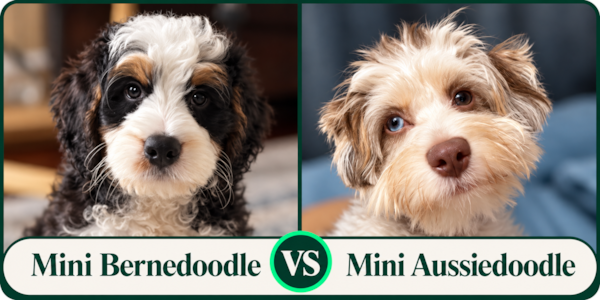
The Mini Bernedoodle vs Mini Aussiedoodle comparison puts two intelligent Poodle mixes side by side, but the similarities can hide just how different these dogs may feel to live with. Both can have soft wavy or curly coats, affectionate personalities, excellent trainability, and a strong desire to stay involved with their families. Both can also become active adventure companions when given the opportunity.
The real difference appears when you look past the shared Poodle. A Mini Bernedoodle combines the Miniature Poodle with the Bernese Mountain Dog, a large Swiss working breed developed for jobs such as pulling carts, driving cattle, watching farms, and living closely with farming families. A Mini Aussiedoodle combines the Miniature Poodle with the Mini Aussie, a compact herding dog known for agility, intelligence, responsiveness, and strong awareness of movement.
Those histories create two very different styles of clever dog. The Mini Bernedoodle is more likely to bring physical substance, patience, a calmer social style, and a somewhat easier off switch. The Mini Aussiedoodle tends to be lighter on its feet, quicker to react, more interested in movement, and more likely to seek mental work even after its physical exercise is finished.
Size also deserves more attention than the word “mini” suggests. Mini Bernedoodles can still become surprisingly substantial dogs because one parent is the Bernese Mountain Dog, which may weigh well over 70 pounds. Many Mini Bernedoodles fall somewhere around 20 to 50 pounds depending on generation and parents. Mini Aussiedoodles are usually lighter, with many adults somewhere around 15 to 35 pounds.
Neither is simply the calmer or smarter choice. Mini Bernedoodles can be energetic and remarkably trainable, while Mini Aussiedoodles can develop excellent indoor manners and relax beautifully after activity. The useful distinction is one of working style: the Mini Bernedoodle generally brings more Bernese steadiness, while the Mini Aussiedoodle brings more Mini Aussie responsiveness and herding intensity.
Table of Contents
- Mini Bernedoodle vs Mini Aussiedoodle at a Glance
- Mini Bernedoodle and Mini Aussiedoodle Overview and History
- Mini Bernedoodle vs Mini Aussiedoodle Appearance
- Mini Bernedoodle vs Mini Aussiedoodle Temperament
- Mini Bernedoodle vs Mini Aussiedoodle: Which One Should You Choose?
- Choose a Mini Bernedoodle if You Want a Gentler, More Relaxed Doodle
- Choose a Mini Aussiedoodle if You Want a Highly Interactive Training Partner
- Which Is Bigger: Mini Bernedoodle or Mini Aussiedoodle?
- Which Is Calmer: Mini Bernedoodle or Mini Aussiedoodle?
- Which Is More Energetic?
- Which Needs More Mental Stimulation?
- Which Is Easier to Train?
- Which Is Better for First-Time Dog Owners?
- Which Is Better With Young Children?
- Which Is Better With Other Dogs?
- Which Is Better With Cats?
- Which Has Stronger Herding Instincts?
- Which Sheds Less: Mini Bernedoodle or Mini Aussiedoodle?
- Which Needs More Grooming?
- Which Is Better for Apartment Living?
- Which Is Better for Seniors?
- Which Is Better for an Active Lifestyle?
- Which Handles Cold Weather Better?
- Which Handles Warm Weather Better?
- Which Is More Affectionate?
- Which Is More Social With Strangers?
- Which Is More Likely to Bark?
- Which Is More Predictable in Size?
- Mini Bernedoodle vs Mini Aussiedoodle: The Final Comparison
Mini Bernedoodle vs Mini Aussiedoodle at a Glance
| Trait | Mini Bernedoodle | Mini Aussiedoodle |
| Parent breeds | Bernese Mountain Dog × Miniature Poodle | Mini Aussie × Miniature Poodle |
| General size | Small-medium to medium | Small-medium |
| Common adult weight | About 20–50 pounds, generation-dependent | About 15–35 pounds |
| Common adult height | Roughly 13–22 inches | Roughly 12–18 inches |
| Build | Sturdy, substantial, often broader | Athletic, agile, often lighter |
| Coat | Straight, wavy, or curly | Straight, wavy, or curly |
| Shedding | Low to moderate, coat-dependent | Low to moderate, coat-dependent |
| Grooming | Moderate to high | Moderate to high |
| Color range | Tricolor, black and white, brown and white, sable, merle and more | Black, red, blue merle, red merle, cream, brown, white and combinations |
| Eye colors | Usually brown; blue or mixed colors may occur in some lines | Brown, blue, amber, hazel, mixed or parti-colored |
| Energy | Moderate | Moderate to high |
| Mental stimulation | Moderate to high | High |
| Trainability | High | Very high |
| Herding behavior | Usually limited | Possible and sometimes noticeable |
| Social style | Affectionate, gentle, family-focused | Loyal, alert, interactive, responsive |
| Best fit | Families wanting a calmer, substantial Doodle | Active owners who enjoy training and engagement |
These ranges are useful guides rather than fixed standards. Generation matters particularly in Mini Bernedoodles because an F1 puppy from a Bernese Mountain Dog and Miniature Poodle can mature much larger than a later-generation or Poodle-backcrossed dog. Mini Aussiedoodles vary too, but the size gap between their parent breeds is usually less dramatic.
Mini Bernedoodle and Mini Aussiedoodle Overview and History
The Mini Bernedoodle and Mini Aussiedoodle both combine a Poodle with a working breed, which is one reason both can be intelligent, trainable, and capable of much more than casual lapdog life. The type of work behind the non-Poodle parent is completely different, though.
The Bernese Mountain Dog was a versatile Swiss farm dog. It pulled carts, drove cattle, watched farm property, and worked alongside people who needed strength, dependability, and a steady temperament. The Mini Aussie comes from a herding tradition where fast responses, close attention to livestock, agility, endurance, and the ability to react instantly to movement mattered.
The Poodle adds another layer of working intelligence to both crosses. Despite its elegant appearance, the Poodle developed as a water retriever and remains an athletic, highly trainable dog with strong problem-solving ability.
The result is two Doodles with intelligence coming from both sides, but intelligence expressed differently. Mini Bernedoodles may bring a more deliberate working style. Mini Aussiedoodles tend to bring faster reactions and greater environmental awareness.
Mini Bernedoodle History and Background
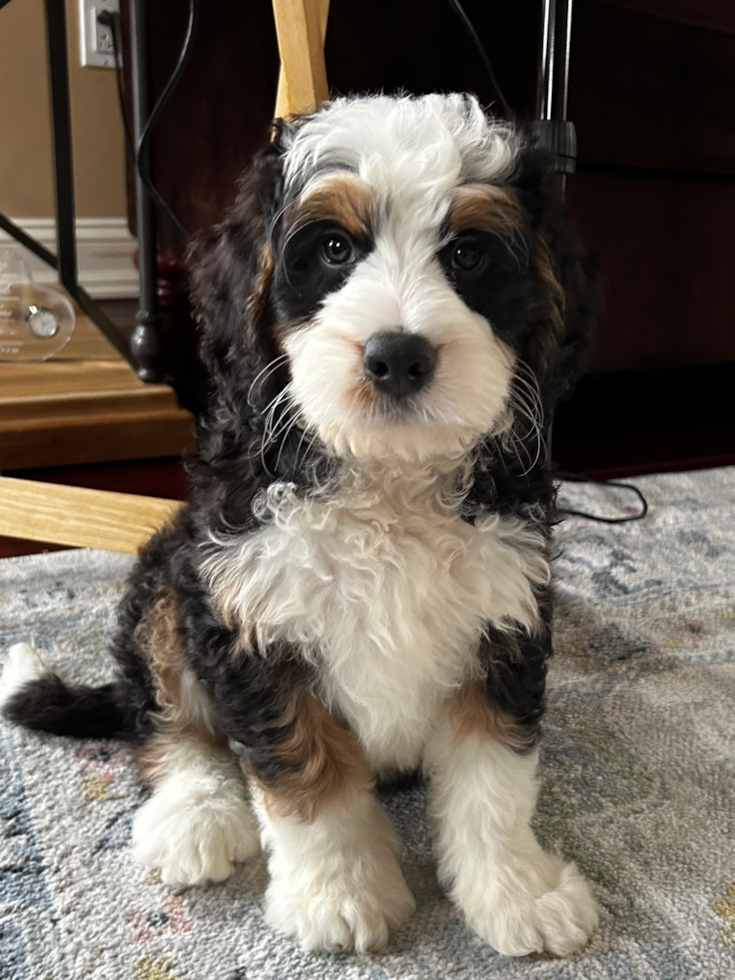
The Mini Bernedoodle combines a Bernese Mountain Dog with a Miniature Poodle, although later generations can include different proportions of Bernese and Poodle ancestry. The modern cross became increasingly familiar after Bernedoodles grew in popularity during the early 2000s.
The Bernese Mountain Dog comes from the Swiss canton of Bern, where the breed worked on farms in an agricultural region known for dairy production. Berners were expected to perform several useful jobs rather than specialize in one task. They drove cattle, pulled carts loaded with milk or goods, watched the farm, and served as close companions to farming families.
This history helps explain the modern Berner's combination of strength and gentleness. It is a large, sturdy dog with enough power for draft work but a temperament traditionally described as confident, good-natured, and strongly attached to family.
The Miniature Poodle changes both size and coat possibilities. Poodles were developed as water retrievers and needed the intelligence, athletic ability, and cooperation required to work closely with hunters. Miniature Poodles preserve those qualities in a much smaller body.
Bringing the two together creates considerable variation because the parent breeds are so different in size. A first-generation Mini Bernedoodle has one very large parent and one much smaller parent, which is why adult size can be harder to predict than many people expect.
The temperament tends to blend more smoothly than the size. Both parents are intelligent, human-focused dogs that respond well to training. The Bernese side can add steadiness and patience, while the Poodle can increase agility, learning speed, and interest in structured activity.
Mini Aussiedoodle History and Background
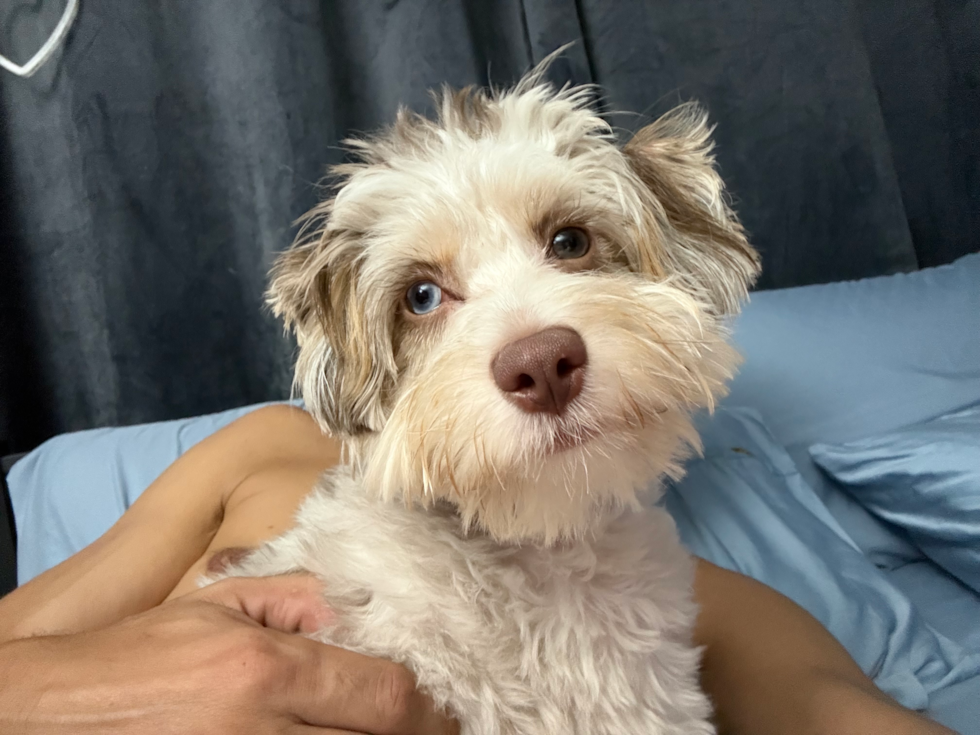
The Mini Aussiedoodle, also known as the Mini Aussiepoo or Mini Aussiepoodle, combines a Mini Aussie with a Miniature Poodle. Like many modern Poodle crosses, there is no single universally accepted breeder or exact date that defines the beginning of every Mini Aussiedoodle line.
The Mini Aussie contributes true herding ancestry. Small Australian Shepherds became increasingly popular in the United States during the twentieth century, particularly among people in the horse world who appreciated having a compact dog that retained the intelligence, stamina, and herding ability of larger Aussies.
A Mini Aussie may be compact, but its instincts are not miniature versions of companion-dog behavior. Herding work rewards close observation, fast reactions, persistence, responsiveness to handlers, and the ability to control moving animals.
The Miniature Poodle adds another intelligent and athletic parent. This means the Mini Aussiedoodle receives problem-solving ability and physical versatility from both sides of its family tree.
That pairing can produce a remarkably capable dog. Mini Aussiedoodles may learn very quickly, excel at games and dog sports, and become highly tuned in to their owners. They may also need more mental engagement than someone expects from a fluffy dog of modest size.
The cross is therefore best understood as an active companion rather than a smaller version of a relaxed Doodle. A Mini Aussiedoodle may cuddle beautifully at night, but its daytime brain usually appreciates having something worthwhile to do.
Mini Bernedoodle vs Mini Aussiedoodle Appearance
The Mini Bernedoodle and Mini Aussiedoodle both have enormous variation in appearance because each cross combines different coat types, colors, and body structures. Grooming adds another layer because a rounded teddy bear cut can make two dogs with very different underlying anatomy look surprisingly similar.
The Mini Bernedoodle generally has greater potential for body mass and a broader outline. Bernese Mountain Dogs are large, heavily built working dogs with substantial bone. The Mini Aussiedoodle tends to be lighter, more agile, and somewhat more athletic in outline because Mini Aussies and Miniature Poodles are both built for fast, efficient movement.
Color can be equally striking in both, but the patterns differ. Bernese influence brings the famous black, white, and rust tricolor look, while Mini Aussie influence introduces merle, copper points, white markings, and much greater eye-color variation.
Mini Bernedoodle Appearance
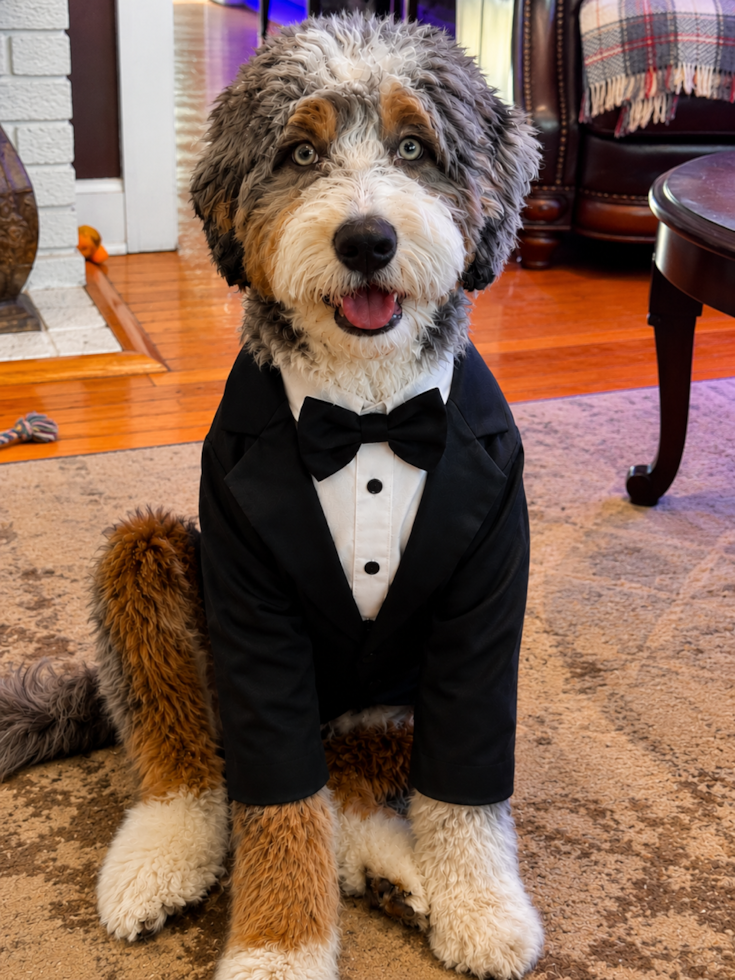
Mini Bernedoodles vary enormously in size. First-generation dogs may weigh around 30 to 50 pounds, while Poodle-backcrossed Mini Bernedoodles can remain closer to 20 to 30 pounds. Height can range roughly from the low teens to around 20 inches or somewhat more.
The large size difference between the Bernese Mountain Dog and Miniature Poodle explains much of this variation. An adult Mini Bernedoodle can therefore look like a compact medium dog rather than what some people picture when they hear “mini.”
The body tends to be sturdy and well proportioned. Bernese influence can add a broader chest, heavier bone, and a substantial feel that remains noticeable even when the Poodle reduces the overall size.
Mini Bernedoodle Coat Type and Texture
Mini Bernedoodle coats may be straight, wavy, or curly. Bernese Mountain Dogs have moderately long double coats that can be straight or slightly wavy, while Poodles contribute dense curl.
The classic Mini Bernedoodle coat is often a loose, shaggy wave that creates the teddy bear appearance people associate with the cross. Curlier dogs may look more Poodle-like and can retain loose hair more effectively inside the coat.
Straight-coated Mini Bernedoodles may resemble smaller, shaggy Bernese Mountain Dogs and can shed more visibly, especially if they inherit more undercoat.
Generation plays an important role. A Poodle-backcrossed dog may have greater odds of curl and furnishings than a first-generation puppy, though individual genetics still prevent guarantees.
Mini Bernedoodle Colors and Markings
The most recognizable Mini Bernedoodle color is tricolor: black, white, and warm tan or rust. The pattern reflects the classic Bernese appearance, though the exact placement of markings can vary considerably.
Mini Bernedoodles can also appear in black and white, brown and white, sable, phantom, parti, merle, and other combinations depending on the Poodle side and the genetics present in the breeding line.
Tricolor markings are not always perfectly symmetrical. One dog may have a narrow white blaze and neat copper eyebrows, while another carries much more white across the face and chest.
Coat color may also change with maturity. Poodle-related fading can soften darker shades, while growing coat length can make the pattern appear different even when the underlying pigment has not changed.
Mini Bernedoodle Eyes and Facial Features
Mini Bernedoodles usually have brown eyes with a soft, expressive appearance. Bernese Mountain Dogs have dark brown eyes and a gentle expression, while the Poodle can add a slightly more refined shape to the head.
Some Mini Bernedoodle lines can produce blue or partially colored eyes when genes such as merle are present. These are not traditional Bernese traits, so eye color depends heavily on the genetics brought through the Poodle side or other ancestry within the line.
Floppy ears and abundant facial furnishings create the familiar teddy bear appearance. A rounded trim can make the muzzle appear shorter and the face much broader than it actually is.
Their expression commonly looks softer and less intensely watchful than the Mini Aussiedoodle's, although grooming plays a large role in that visual impression.
Mini Bernedoodle Build and Size
The Mini Bernedoodle is usually the heavier and more substantial dog in this comparison. Even a relatively short individual may carry more bone and body mass because of the Bernese Mountain Dog parent.
This can make the cross feel more physically robust in family life. A 30-pound Mini Bernedoodle has very different presence around children or larger dogs than a 15-pound Mini Aussiedoodle.
The larger body also affects maturity. Dogs toward the upper end of the Mini Bernedoodle range may take longer to finish filling out physically than smaller companion crosses.
The word “mini” should therefore be understood relative to the standard Bernedoodle rather than as a guarantee of a tiny adult.
Mini Bernedoodle Shedding
Mini Bernedoodle shedding can vary considerably. The Bernese Mountain Dog is a true double-coated shedding breed, while the Poodle releases very little visible hair.
A curly Mini Bernedoodle may shed very little because loose hairs remain caught within the coat. A straight or lightly waved dog with more Bernese undercoat may leave noticeably more hair around the home.
Generation can influence the odds, but it does not guarantee one exact result. Even littermates can develop different shedding levels.
Anyone choosing the cross primarily for low shedding should pay close attention to the coats of the parents and mature relatives rather than assuming every Mini Bernedoodle behaves like a Poodle.
Mini Bernedoodle Grooming Needs
Mini Bernedoodles need regular coat maintenance regardless of shedding level. Wavy and curly coats can mat behind the ears, beneath the legs, around the collar, and anywhere hair rubs together.
Straighter coats may need more undercoat removal, particularly during seasonal coat changes. They may require less clipping but more brushing to manage loose hair.
Professional grooming is common for furnished coats. A shorter trim makes home care much easier and can be particularly practical for active dogs that spend time outdoors.
The tradeoff remains familiar: the less hair that reaches the floor, the more likely it is that loose hair needs to be deliberately removed from the dog.
Mini Aussiedoodle Appearance

Mini Aussiedoodles are usually lighter and more athletic than Mini Bernedoodles. Many adults fall around 15 to 35 pounds and stand roughly 12 to 18 inches, though parent size and generation can move an individual outside those typical ranges.
The body tends to have moderate bone and excellent agility. Both the Mini Aussie and Miniature Poodle are built to move efficiently, so even a heavily coated dog can reveal a lean, athletic frame after grooming.
Mini Aussie ancestry also produces one of the broadest visual ranges in the Doodle world because coat patterns and eye colors can vary dramatically.
Mini Aussiedoodle Coat Type and Texture
Mini Aussiedoodle coats can be straight, wavy, or curly. The Mini Aussie contributes a medium-length double coat that may be straight or softly waved, while the Poodle adds dense curl.
Loose waves are common and can create a fleece-like texture. Stronger Poodle influence may produce a denser curl, while straighter dogs may retain more Mini Aussie undercoat.
Coat type affects far more than appearance. Straighter dogs may shed more noticeably, while curlier coats can mat more aggressively because loose hair remains caught inside.
Adult texture may also differ from puppy texture. A soft puppy with mild waves can become considerably curlier or denser during maturation.
Mini Aussiedoodle Colors and Markings
Mini Aussiedoodles have an enormous range of colors. Mini Aussie ancestry contributes black, red, blue merle, red merle, white markings, and copper or tan points, while the Poodle broadens the palette further.
The result can include blue merle, red merle, black, red, brown, chocolate, cream, apricot, white, gray, parti, phantom, and numerous multicolor combinations.
Merle creates irregular marbling rather than one fixed pattern, so two blue merle Mini Aussiedoodles can look completely different.
Color is one of the breed's most eye-catching features, but it has no useful relationship with temperament, intelligence, or grooming difficulty. Those traits need to be evaluated separately.
Mini Aussiedoodle Eyes and Expression
Mini Aussiedoodles can have brown, blue, amber, hazel, or mixed-colored eyes. One blue and one brown eye can occur, as can flecks or partial color within a single iris.
This variety comes largely from the Mini Aussie side. The eyes contribute to the alert, attentive expression that many Mini Aussiedoodles carry even when their faces are covered in soft furnishings.
Their head shape may lean more toward the Mini Aussie or Poodle. Some have broader shepherd-like faces, while others develop narrower muzzles and more refined Poodle proportions.
The overall expression is commonly bright and watchful, which matches the dog's tendency to notice movement and changes around it.
Mini Aussiedoodle Build and Size
The Mini Aussiedoodle generally has the more agile body. Both parent breeds bring coordination, athleticism, and enough stamina for substantial activity.
Many Mini Aussiedoodles are capable hiking companions, enthusiastic swimmers, quick retrievers, and natural candidates for agility or other dog sports. Their moderate size makes that athletic ability relatively easy to manage physically.
The lighter build also makes them quicker in movement than many Mini Bernedoodles. They can change direction rapidly and may feel especially nimble during play.
This athleticism does not require a marathon-running owner, but it does make the cross particularly rewarding for people who enjoy doing things with their dog.
Mini Aussiedoodle Shedding
Mini Aussiedoodle shedding also depends heavily on coat inheritance. The Mini Aussie has a shedding double coat, while the Poodle contributes low visible shedding.
A curlier Mini Aussiedoodle may leave very little hair around the home. A straighter dog with more obvious undercoat may release considerably more, particularly during seasonal changes.
There is no reliable reason to promise that every Mini Aussiedoodle will be non-shedding. Coat genetics are more complicated than simply being half Poodle.
The parents and adult relatives remain the most useful clues when shedding is a major concern.
Mini Aussiedoodle Grooming Needs
Curly and wavy Mini Aussiedoodles need frequent brushing and combing because mats can develop beneath the fluffy outer coat. The areas behind the ears, under the legs, along the collar, and around the tail deserve particular attention.
Straighter dogs may need more undercoat work and somewhat less professional trimming. Seasonal shedding can increase brushing requirements considerably.
Many owners choose short pet trims because they make an active lifestyle easier. Mud, seeds, burrs, and outdoor debris are much simpler to remove from a practical coat than from several inches of fluff.
The right grooming routine depends on what the dog actually inherited rather than what the cross is supposed to look like.
Mini Bernedoodle vs Mini Aussiedoodle Appearance Comparison: What Is the Difference?
The clearest physical difference is substance versus agility. Mini Bernedoodles generally carry more body weight, heavier bone, and a broader outline because of the Bernese Mountain Dog. Mini Aussiedoodles are usually lighter and more athletic because both parents are compact, agile dogs.
Size can overlap, but the upper end is different. A Mini Bernedoodle may reach 40 or 50 pounds and still fall comfortably within common expectations for the cross. Mini Aussiedoodles more commonly stay in the teens or twenties, with many adults topping out around the low-to-mid thirties.
Color creates another distinction. Mini Bernedoodles are famous for tricolor coats inspired by the Bernese Mountain Dog, while Mini Aussiedoodles are especially known for merle patterns and unusual eye colors. Both can have broader palettes than these signature looks suggest.
Coat texture overlaps almost completely. Straight, wavy, and curly coats can appear in either cross, so the amount of curl should never be used as the main way to identify one.
If you prefer a larger teddy bear look with a broad, substantial frame, the Mini Bernedoodle may appeal more. If you prefer a lighter, agile dog with striking merle possibilities and a more athletic outline, the Mini Aussiedoodle may be closer to what you picture.
Mini Bernedoodle vs Mini Aussiedoodle Temperament
The temperament difference between these two dogs becomes much easier to understand through the original work of their non-Poodle parent.
Bernese Mountain Dogs needed to be strong, steady farm workers. They pulled carts, drove cattle, watched property, and spent long periods close to their people. Mini Aussies needed to monitor livestock movement, react quickly, follow direction, and keep working as the environment changed.
Both jobs required intelligence, but not the same kind of intensity.
The Mini Bernedoodle commonly brings a calmer, more deliberate social style. The Mini Aussiedoodle tends to be faster to notice, faster to react, and more likely to seek continued mental engagement.
Mini Bernedoodle Temperament
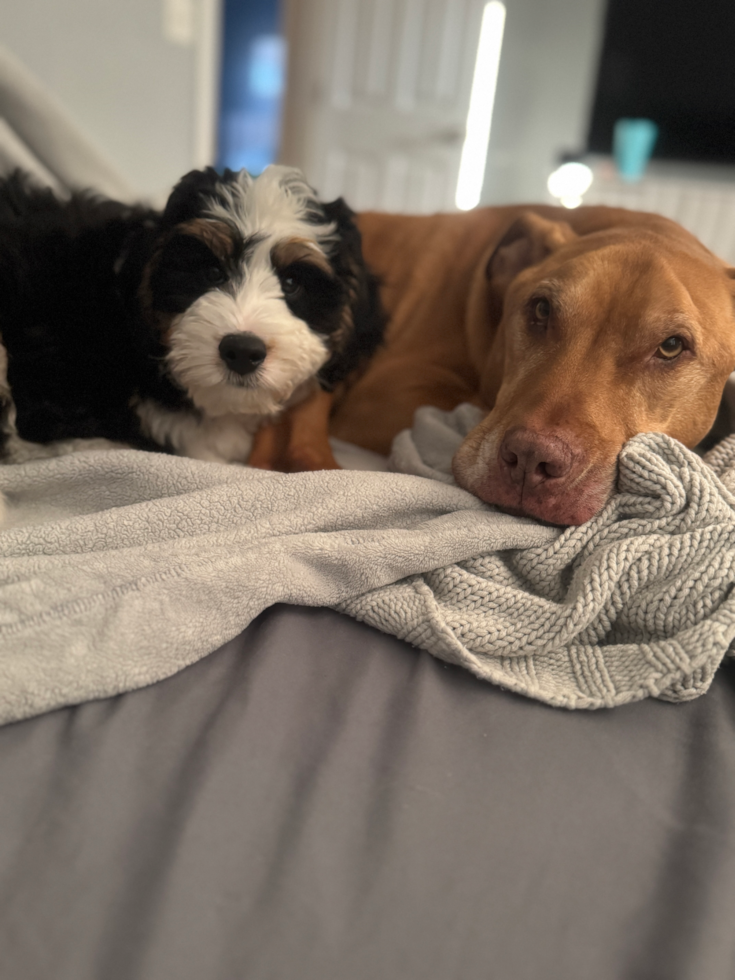
Mini Bernedoodles tend to be affectionate, gentle, playful dogs with strong family attachment. The Bernese Mountain Dog contributes a reputation for good nature and steadiness, while the Poodle adds responsiveness, intelligence, and a little more liveliness.
Many Mini Bernedoodles enjoy activity without needing every day to become an athletic project. A good walk, family play, some training, and time with their people can create a satisfying routine.
Their temperament can feel substantial in the same way their bodies do. Rather than reacting instantly to everything around them, many seem more inclined to observe first and engage once the situation makes sense.
Mini Bernedoodle Intelligence and Training
Mini Bernedoodles are highly trainable because both parent breeds are intelligent and accustomed to working alongside people.
The Poodle can add faster problem-solving, while Bernese influence contributes willingness to cooperate. Many respond extremely well to positive reinforcement, especially when training remains encouraging and social.
Some individuals may be slower or more deliberate than Mini Aussiedoodles. They may understand perfectly well without responding with the same rapid-fire enthusiasm.
That is not a lack of intelligence. The difference is closer to temperament and working style. A Mini Bernedoodle may prefer a confident invitation over constant pressure to perform.
Mini Bernedoodle Energy Level
Mini Bernedoodles usually have moderate energy. They can enjoy long walks, hikes, swimming, fetching, and active family outings, but many develop a good off switch once their needs have been met.
The Bernese Mountain Dog contributes working ability without the same constant movement awareness seen in herding breeds. This can make the cross easier for households that enjoy activity but do not want a dog searching for another task all evening.
Puppies and adolescents can still be energetic. A 30-pound adolescent racing around the living room should not be mistaken for evidence that the adult will always require intense exercise.
As the dog matures, the Bernese side may become more visible in the form of a steadier, more relaxed adult temperament.
Mini Bernedoodle Affection and Family Attachment
Mini Bernedoodles commonly form strong bonds with their families. Bernese Mountain Dogs are deeply people-oriented, and Poodles also thrive on close human relationships.
Many want to be involved without necessarily directing every moment of the day. They may follow family members around the house, settle nearby during work, and happily join whatever outing is planned.
The closeness can make independence training important. A dog that is included constantly may have difficulty when normal life suddenly requires several hours alone.
Short calm separations during puppyhood help build confidence without changing the affectionate nature people value in the cross.
Mini Bernedoodles With Children
Mini Bernedoodles can be excellent family companions, particularly because Bernese influence can contribute patience and gentleness.
Their greater size creates both an advantage and a caution. A substantial Mini Bernedoodle may feel less physically fragile around children than a small Mini Aussiedoodle, but a 40-pound adolescent can also knock over a toddler during enthusiastic play.
The temperament usually fits family life well when socialization and manners begin early. Calm greetings, polite play, and learning not to jump are more important than relying on a naturally sweet personality.
Older children can participate in walks and training, while younger children benefit from the dog's potentially steadier companion style.
Mini Bernedoodles With Other Dogs and Pets
Mini Bernedoodles usually have good potential in multi-pet homes. Bernese Mountain Dogs historically worked around livestock and other farm animals, while Poodles are generally adaptable social dogs.
They do not typically bring strong herding behavior into the household, which can make relationships with cats or quieter dogs somewhat simpler than with a movement-focused cross.
Puppies can still chase and play roughly, especially when excited. Size deserves attention because a larger Mini Bernedoodle can overwhelm a very small pet unintentionally.
Good introductions and boundaries matter more than assuming a friendly cross will automatically know how to behave around every animal.
Mini Bernedoodle Barking and Watchfulness
Mini Bernedoodles can be alert to visitors and unusual activity. Bernese Mountain Dogs historically watched farms, so some awareness of the environment is natural.
The response tends to be less movement-focused than the Mini Aussiedoodle's. A Mini Bernedoodle may announce a visitor without feeling responsible for monitoring everything that passes outside the window.
Individual dogs vary, and barking can become habitual when it repeatedly earns attention.
Early reinforcement for calm behavior can keep normal watchfulness within reasonable limits.
Mini Aussiedoodle Temperament

Mini Aussiedoodles tend to be highly intelligent, responsive, energetic dogs that become closely tuned in to their people. The Mini Aussie contributes strong herding instincts and environmental awareness, while the Poodle adds another trainable, athletic mind.
The result can feel exceptionally interactive. A Mini Aussiedoodle may notice where everyone is, anticipate routines, watch moving objects closely, and respond immediately when something changes.
This is wonderful for people who enjoy a dog that participates actively in life. It can feel like too much dog for someone who mainly wants a quiet companion.
Mini Aussiedoodle Intelligence and Training
Mini Aussiedoodles are among the stronger training candidates in the small-to-medium Doodle group because both parent breeds bring serious learning ability.
They can pick up basic cues quickly and may enjoy progressing into tricks, advanced obedience, scent games, agility, retrieving, or other activities that require problem-solving.
Repetition for its own sake can become boring. Once a Mini Aussiedoodle understands a behavior, adding distance, distractions, or a new context may hold attention better than repeating the same cue twenty more times.
Owners who enjoy training may find this tremendously rewarding. The dog is not merely capable of learning; many actively seem to enjoy the process.
Mini Aussiedoodle Energy Level
The Mini Aussiedoodle usually has the higher energy level in this comparison. Both the Mini Aussie and Poodle are athletic breeds, and the herding side adds a particular interest in movement.
A normal routine should include more than a quick walk around the block. Sniffing, training, free play, retrieving, exploration, and varied outings can all help create a satisfying day.
Trying to solve every problem with more running is not ideal. A Mini Aussiedoodle can become physically fitter while remaining mentally under-stimulated.
The best routine balances exercise with tasks that require thought and then deliberately teaches the dog how to relax afterward.
Herding Behavior in Mini Aussiedoodles
Herding behavior is one of the most important differences in this comparison. The Mini Aussie parent may contribute circling, chasing, following movement closely, blocking paths, or occasionally focusing on heels and ankles during excited play.
Running children can be particularly interesting. So can bicycles, joggers, cats, and dogs moving quickly through the home or yard.
These behaviors should be redirected rather than punished harshly. Recall, impulse control, place training, toys, and structured games give the dog more appropriate ways to use its attention.
Not every Mini Aussiedoodle will herd obviously, but the possibility is real enough that prospective owners should understand it before choosing the cross.
Mini Aussiedoodle Affection and Family Attachment
Mini Aussiedoodles can be intensely loyal and affectionate. Mini Aussies form close bonds with their people, while Poodles are also highly human-focused.
Their attachment may feel less like passive cuddling and more like participation. A Mini Aussiedoodle frequently wants to know what the family is doing and whether it is invited.
Some may be more reserved around strangers than a very social Mini Bernedoodle. Early socialization can build confidence while respecting the dog's natural tendency to evaluate unfamiliar people.
At home, many become extremely cuddly once activity is finished. High intelligence and affection are not opposites; this dog can spend an hour training and still want the closest available spot on the sofa afterward.
Mini Aussiedoodles With Children
Mini Aussiedoodles can make excellent companions for active families, particularly with older children who enjoy outdoor activity, games, and training.
The main consideration is herding. Running and squealing children can trigger chasing or attempts to control movement, particularly during puppyhood and adolescence.
Adults should redirect those behaviors immediately rather than allowing them to become part of family play. The dog can learn that children moving quickly are not livestock requiring assistance.
Older children can become excellent training partners because the cross enjoys interaction and learns quickly. That shared activity can build a particularly strong relationship.
Mini Aussiedoodles With Other Dogs and Pets
Mini Aussiedoodles can live very well with other dogs, especially when the other dog's play style matches their energy.
Herding behavior can create friction with pets that dislike being watched, followed, or controlled. One dog may consider circling playful while the other finds it deeply annoying.
Cats can also live successfully with the cross, though movement can trigger chasing. Early introductions and rewards for calm behavior are particularly useful.
The goal is not to suppress every instinct. It is to teach the dog that household animals are companions whose movement does not need to be managed.
Mini Aussiedoodle Barking and Alertness
Mini Aussiedoodles can be highly alert. The Mini Aussie notices environmental changes, and Poodles are attentive dogs in their own right.
Some dogs may bark at visitors, outdoor movement, vehicles, or unexpected sounds. Others remain relatively quiet but watch everything closely.
The difference from the Mini Bernedoodle is often the amount of monitoring rather than sheer volume. A Mini Aussiedoodle may notice ten things that the Mini Bernedoodle simply decides are none of its business.
Training a reliable quiet cue and rewarding calm observation can make that awareness much easier to live with.
Mini Bernedoodle vs Mini Aussiedoodle Temperament Comparison: What Is the Real Difference?
The most useful temperament distinction is steadiness versus responsiveness.
The Mini Bernedoodle generally brings more Bernese-style steadiness. It can be intelligent, active, playful, and eager to learn while still having a somewhat calmer relationship with its environment. Many enjoy family activity without needing to monitor every movement around them.
The Mini Aussiedoodle generally brings more Mini Aussie responsiveness. It is quicker to notice movement, more likely to anticipate what happens next, and more inclined to seek another mental or physical task once the first one is complete.
Both share the Poodle, so neither lacks intelligence or trainability. The difference is how that intelligence behaves during an ordinary day.
A Mini Bernedoodle may finish a walk, enjoy a few minutes of play, and settle near the family. A Mini Aussiedoodle may finish the same walk and still be ready for a short training session because its legs are satisfied but its brain has more questions.
That distinction is what prospective owners should take seriously. The right answer is not which dog is more impressive. It is which style fits naturally into the life you already live.
Mini Bernedoodle vs Mini Aussiedoodle: Which One Should You Choose?
The Mini Bernedoodle and Mini Aussiedoodle can both be affectionate, intelligent family dogs, but they tend to suit different daily rhythms. Their shared Poodle gives both strong training potential and plenty of personality. The Bernese Mountain Dog and Mini Aussie determine where the biggest lifestyle differences appear.
The Mini Bernedoodle usually offers more physical substance and a calmer temperament. The Mini Aussiedoodle usually offers greater agility and a stronger appetite for activity and mental engagement.
Choose a Mini Bernedoodle if You Want a Gentler, More Relaxed Doodle
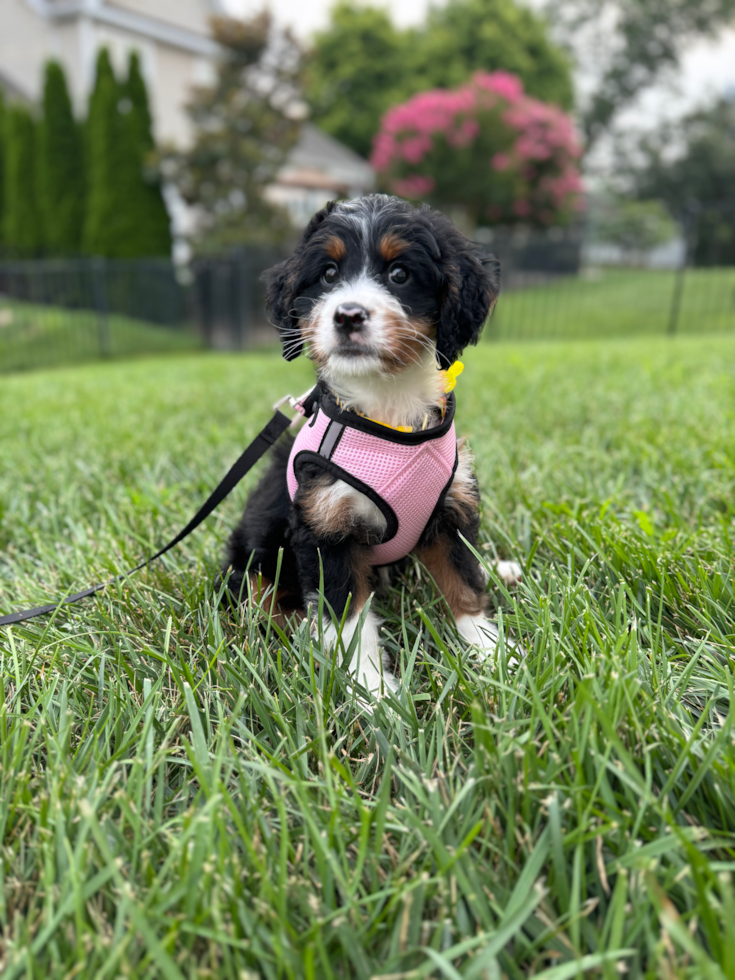
A Mini Bernedoodle puppy may suit you better if you want an intelligent dog that enjoys activity but does not necessarily expect every day to contain a new challenge.
Bernese influence can add patience, steadiness, and an affectionate family focus. Many Mini Bernedoodles can enjoy a hike on Saturday and be perfectly content with a moderate walk and family time on a quieter weekday.
The cross may also appeal to people who prefer a more substantial dog. Even the smaller Mini Bernedoodles tend to feel sturdier and heavier than many Mini Aussiedoodles.
This makes them especially attractive to families wanting a Doodle that can participate in normal activity while still developing a comfortable, relaxed presence in the home.
Choose a Mini Aussiedoodle if You Want a Highly Interactive Training Partner
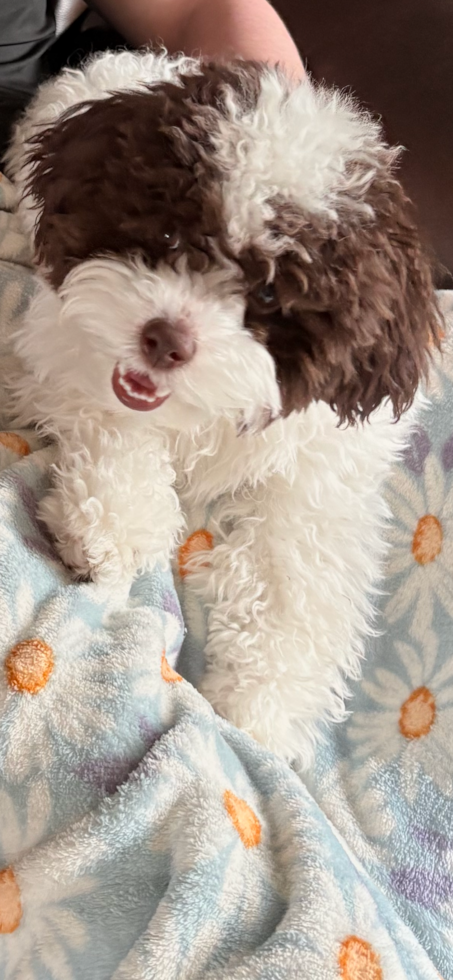
A Mini Aussiedoodle puppy may suit you better if training, outdoor activity, and mental enrichment are genuinely enjoyable parts of dog ownership for you.
Mini Aussie and Poodle intelligence combine to create a dog capable of learning an impressive amount. That same ability means the dog is likely to notice inconsistency, invent its own entertainment, and look for something meaningful to do when the day becomes too repetitive.
For active owners, this can be exactly the appeal. Hiking, advanced tricks, scent games, agility, retrieving, and varied outings can turn the relationship into an ongoing partnership.
The Mini Aussiedoodle does not need constant entertainment, but it benefits from an owner who likes engaging the dog's brain rather than hoping a long walk will solve everything.
Which Is Bigger: Mini Bernedoodle or Mini Aussiedoodle?
The Mini Bernedoodle is usually the larger and heavier dog. Many adults fall between about 20 and 50 pounds, depending heavily on generation and parent size.
Mini Aussiedoodles more commonly fall around 15 to 35 pounds and generally have lighter frames. Even at similar heights, the Mini Bernedoodle may feel substantially heavier because Bernese ancestry contributes more bone and body mass.
There is still overlap. A small later-generation Mini Bernedoodle may weigh less than a large Mini Aussiedoodle.
For either cross, actual parent measurements and previous adult puppies from similar pairings provide the best estimate.
Which Is Calmer: Mini Bernedoodle or Mini Aussiedoodle?
The Mini Bernedoodle usually has the calmer overall profile.
Bernese Mountain Dogs are working dogs, but their work historically required strength and steadiness rather than the rapid movement control associated with herding breeds. Many Mini Bernedoodles therefore enjoy activity without remaining mentally switched on to every environmental change.
Mini Aussiedoodles tend to notice more and may seek more interaction throughout the day. Their Mini Aussie side can keep them attentive even after physical exercise is finished.
A well-trained Mini Aussiedoodle can still have an excellent off switch. It simply may require more deliberate work to develop.
Which Is More Energetic?
The Mini Aussiedoodle is usually more energetic, especially in the sense of sustained engagement.
Mini Aussies are agile herding dogs, and Poodles contribute additional athletic ability. The combination can create substantial stamina and a real enthusiasm for movement.
Mini Bernedoodles are not lazy. They can hike, swim, run, fetch, and participate in active family life. The difference is that many need less of that activity to feel satisfied.
If your week already contains long walks, frequent outings, training, or outdoor hobbies, the Mini Aussiedoodle is more likely to fit naturally into that rhythm.
Which Needs More Mental Stimulation?
The Mini Aussiedoodle generally needs more deliberate mental stimulation.
Both parent breeds are strong problem-solvers, and the Mini Aussie adds the attention and decision-making skills associated with herding work. Training, puzzles, scent work, retrieving, and varied environments give that intelligence useful outlets.
Mini Bernedoodles enjoy mental enrichment too, especially through training and interactive games. They may simply be more content when those activities are a smaller part of the day.
This difference matters for busy households. A dog can have enough physical exercise and still be bored if its brain has nothing interesting to process.
Which Is Easier to Train?
Both are highly trainable, but they can feel easier in different ways.
The Mini Aussiedoodle may learn new behaviors faster and often excels when training becomes more complex. It can be wonderfully responsive to an owner who enjoys teaching.
The Mini Bernedoodle may feel easier for basic family training because the dog can be less intense and may accept repetition without constantly looking for the next challenge. Some individuals may also bring a slightly more deliberate or stubborn streak, so motivation still matters.
Neither responds well to unnecessary harshness. Clear, positive, consistent training suits both.
Which Is Better for First-Time Dog Owners?
The Mini Bernedoodle generally has the easier profile for many first-time owners because its exercise and mental needs can be more forgiving.
That does not make the dog effortless. A large adolescent Mini Bernedoodle still needs leash training, manners, socialization, grooming, and independence skills.
A Mini Aussiedoodle can also be an excellent first dog for someone who is enthusiastic about training and willing to learn. Its intelligence may make progress fast, but it also notices inconsistent rules quickly.
The better question for a beginner is not experience alone. It is how much time and interest the person wants to devote to active training.
Which Is Better With Young Children?
The Mini Bernedoodle may have a slight advantage with younger children because Bernese influence can contribute a steadier, gentler social style and there is less likelihood of herding behavior.
Its larger body can also make it physically sturdier, although that size can create accidental knocking during puppyhood. Good manners around jumping and excited greetings remain important.
Mini Aussiedoodles can be wonderful family dogs, but running children may trigger chasing, circling, or heel-focused behavior. Those habits should be redirected early.
For older active children, the Mini Aussiedoodle can become an outstanding partner for games, hiking, tricks, and training.
Which Is Better With Other Dogs?
Both can do very well with other dogs.
Mini Bernedoodles may bring a relatively easygoing play style and can fit comfortably into multi-dog homes when introductions are handled well.
Mini Aussiedoodles can be highly social too, but the herding side may lead some dogs to stare, circle, chase, or attempt to control another dog's movement. A compatible energetic dog may enjoy this interaction, while a quieter dog may not.
Matching personalities and play styles matters more than assuming one cross will automatically be easier.
Which Is Better With Cats?
The Mini Bernedoodle may have a slight advantage with cats because it is less likely to bring strong herding behavior into the relationship.
Mini Aussiedoodles can absolutely live successfully with cats, especially when raised with them. The main concern is that a running cat can trigger chasing or attempts to control movement.
Good introductions, escape areas for the cat, and reinforcement for calm behavior can make either pairing successful.
The individual puppy's behavior around movement is more informative than the cross name alone.
Which Has Stronger Herding Instincts?
The Mini Aussiedoodle clearly has the greater potential for herding behavior because of the Mini Aussie parent.
Circling, chasing moving people or animals, staring, blocking movement, and heel-focused play can all appear. The behavior ranges from barely noticeable in some dogs to very obvious in others.
Mini Bernedoodles do not have the same herding foundation, although Bernese Mountain Dogs historically helped drive cattle on farms. Their work was broader and their modern temperament generally lacks the same intense movement control associated with Mini Aussies.
Families with running children or multiple pets should take this difference seriously when choosing between the two.
Which Sheds Less: Mini Bernedoodle or Mini Aussiedoodle?
There is no reliable universal winner because both crosses have one shedding double-coated parent and one low-shedding Poodle parent.
A curly individual of either cross may release very little visible hair. Straighter dogs may inherit more undercoat and shed noticeably during seasonal changes.
Generation also affects the possibilities. Dogs with greater Poodle ancestry may have better odds of low visible shedding, but coat genetics still vary.
If shedding is an important deciding factor, look at the actual parents and mature relatives rather than assuming one cross is automatically safer.
Which Needs More Grooming?
Both can require substantial grooming, and coat type matters more than the cross.
Curly dogs need thorough brushing and combing because mats can tighten close to the skin. Straighter dogs may require more undercoat removal and seasonal brushing.
Mini Bernedoodles can have more total coat simply because they are larger-bodied dogs, which can make each grooming session longer. Mini Aussiedoodles may collect more outdoor debris if their activity level takes them onto trails and through fields regularly.
Short practical trims reduce the workload significantly for either.
Which Is Better for Apartment Living?
The Mini Bernedoodle may have a slight advantage temperamentally, while the Mini Aussiedoodle usually has the advantage in physical size. That makes apartment suitability more nuanced than simply choosing the smaller dog.
A Mini Bernedoodle may need less mental stimulation but can take up considerably more physical space, especially at 35 or 40 pounds. A Mini Aussiedoodle can fit easily into a smaller home but may need more deliberate outdoor exercise and training.
Either can thrive in an apartment if its needs are met. A yard is not a substitute for engagement with either cross.
Barking, alone-time skills, and daily routine matter far more than whether the home has a large floor plan.
Which Is Better for Seniors?
The Mini Bernedoodle is often the easier choice for a moderately active senior, especially when the expected adult dog is toward the lower end of the size range.
Its calmer temperament and more moderate need for mental work can fit a relaxed daily routine. The main consideration is physical size, because a 45-pound dog may be harder to handle than the word “mini” suggests.
An active senior who walks extensively, enjoys training, or spends plenty of time outdoors may love a Mini Aussiedoodle.
The ideal match depends more on the person's real routine and ability to manage the adult dog than on age itself.
Which Is Better for an Active Lifestyle?
The Mini Aussiedoodle has the clearer advantage for consistently active owners.
Its Mini Aussie and Poodle parents both contribute athleticism, trainability, and stamina. A healthy adult can become an enthusiastic companion for hiking, long walks, swimming, dog sports, travel, and outdoor exploration.
Mini Bernedoodles can enjoy all of those activities too, particularly fit adults. They simply tend to require less sustained activity as part of their everyday routine.
Someone who wants the option of adventure without needing it every day may prefer the Mini Bernedoodle. Someone who already lives an active lifestyle may appreciate how naturally the Mini Aussiedoodle joins in.
Which Handles Cold Weather Better?
The Mini Bernedoodle may have a slight advantage in cold weather because the Bernese Mountain Dog developed in the Swiss Alps with a thick weather-resistant coat.
Mini Aussies also have protective double coats and can handle cool conditions well. Their smaller, lighter bodies may simply lose heat somewhat faster than a substantial Mini Bernedoodle.
Coat inheritance complicates the comparison. A Poodle-influenced curly coat differs considerably from the natural double coat of either non-Poodle parent.
Both can enjoy winter activity when healthy, conditioned, and appropriately monitored.
Which Handles Warm Weather Better?
The Mini Aussiedoodle may have a modest advantage for activity in warmer weather because it is usually lighter and less heavily built.
Bernese Mountain Dogs were developed for a cool Alpine climate, and their large bodies and thick coats make them less suited to heat. A Mini Bernedoodle inherits only part of that structure, but dogs that strongly favor the Bernese side may still become uncomfortable more quickly in hot conditions.
Mini Aussies also have double coats, so the Mini Aussiedoodle is not a heat-specialist dog. Exercise during hot, humid weather still needs common sense.
Early morning or evening activity, shade, water, and indoor cooling are important for both.
Which Is More Affectionate?
Both are deeply affectionate, but their style of attachment can differ.
The Mini Bernedoodle may lean toward softer, calmer physical companionship. Bernese influence can create a dog that enjoys staying close, leaning against family members, resting nearby, and taking part in household life without needing constant activity.
The Mini Aussiedoodle may express affection through involvement. It may bring toys, follow routines, participate in training, and remain highly aware of what its favorite people are doing.
Neither style reflects a stronger bond. One feels steadier and more relaxed, while the other may feel more interactive.
Which Is More Social With Strangers?
The Mini Bernedoodle may have a slight advantage for easygoing social interaction, although Bernese Mountain Dogs themselves can show some reserve with unfamiliar people.
Mini Aussies can also be reserved during initial meetings. Their herding background encourages awareness and evaluation rather than automatic enthusiasm for every stranger.
Poodle influence can increase sociability in either cross, and early socialization matters enormously.
A socially successful adult does not have to greet everyone like a lifelong friend. Calm confidence around unfamiliar people is a perfectly good outcome.
Which Is More Likely to Bark?
The Mini Aussiedoodle may be somewhat more likely to alert bark because Mini Aussies are highly aware of changes around them and can have watchdog tendencies.
Mini Bernedoodles can announce visitors too, particularly when Bernese watchfulness comes through. Their overall response may simply be less persistent.
Environment has a major influence. Dogs with constant access to busy front windows or apartment hallways can practice barking far more than dogs living in quieter settings.
Teaching a calm response early is useful with either cross.
Which Is More Predictable in Size?
The Mini Aussiedoodle generally has the advantage for size predictability because the gap between Mini Aussie and Miniature Poodle size is much smaller than the gap between Bernese Mountain Dog and Miniature Poodle size.
A first-generation Mini Bernedoodle combines a parent that may weigh well over 70 pounds with one that is a fraction of that size. Adult puppies can therefore land across a fairly broad range.
Later-generation Mini Bernedoodles may become easier to estimate when both parents are already smaller Bernedoodle or Poodle-type dogs.
If adult size is a major concern, the specific pairing matters more than any breed average.
Mini Bernedoodle vs Mini Aussiedoodle: The Final Comparison
Choosing between a Mini Bernedoodle vs Mini Aussiedoodle is not really a choice between an intelligent dog and an athletic one, because both can be both. The better question is what kind of intelligence and activity you want to live with.
The Mini Bernedoodle adds Bernese Mountain Dog influence to the Poodle. That can create a larger, more substantial Doodle with a gentle family focus, moderate energy, strong trainability, and a more relaxed relationship with the world around it. Many can enjoy long walks and outdoor adventures while still being perfectly satisfied with quieter days.
The Mini Aussiedoodle adds the Mini Aussie. That creates a lighter, quicker, more responsive dog with a stronger tendency toward herding behavior, environmental awareness, sustained mental engagement, and athletic activity. It is especially well suited to owners who enjoy training and want a dog actively involved in their hobbies.
The physical difference is important too. Mini Bernedoodles may reach 40 or 50 pounds, while Mini Aussiedoodles more commonly stay within a lighter 15-to-35-pound range. Anyone choosing based on the word “mini” alone can end up with far more dog than expected.
Children and pets create another useful divide. The Mini Bernedoodle may offer the easier profile for young children or quieter household pets because it is less likely to bring strong herding behavior. The Mini Aussiedoodle can be an exceptional companion for active older children, but chasing, circling, and heel-focused play need early boundaries when they appear.
Neither is an easy-care coat. Both can shed very little or noticeably depending on inheritance, and both need grooming suited to the individual texture.
The decision becomes much clearer when you picture an ordinary week rather than the best possible Saturday.
If you want a substantial, affectionate dog that can join family adventures but is usually content when life slows down, the Mini Bernedoodle may be the more natural fit.
If you want a clever, agile dog that notices everything, learns quickly, and genuinely enjoys having training, games, and activity woven into the week, the Mini Aussiedoodle may suit you better.
The Mini Bernedoodle and Mini Aussiedoodle are both impressive dogs. The better one is the dog whose normal needs feel comfortable in your normal life.
Frequently Asked Questions
What is the main difference between a Mini Bernedoodle and Mini Aussiedoodle? Both share a Miniature Poodle parent, but the Mini Bernedoodle also has Bernese Mountain Dog ancestry while the Mini Aussiedoodle has Mini Aussie ancestry. The Bernese side generally adds more physical substance, steadiness, and moderate energy, while the Mini Aussie adds greater agility, herding instincts, alertness, and appetite for mental engagement. This creates two highly intelligent dogs with different working styles. The Mini Bernedoodle tends to be the calmer family companion, while the Mini Aussiedoodle usually needs more structured activity and mental stimulation.
Which is bigger, a Mini Bernedoodle or Mini Aussiedoodle? The Mini Bernedoodle is usually bigger. Many adults fall around 20 to 50 pounds, while Mini Aussiedoodles commonly fall around 15 to 35 pounds. Generation matters greatly for Mini Bernedoodles because the Bernese Mountain Dog is dramatically larger than the Miniature Poodle. A later-generation Mini Bernedoodle may be much smaller than a first-generation dog, so parent size should always be considered.
Which is calmer, a Mini Bernedoodle or Mini Aussiedoodle? The Mini Bernedoodle usually has the calmer temperament. Bernese Mountain Dog influence can add steadiness and a good off switch, while Mini Aussie ancestry tends to keep the Mini Aussiedoodle more aware of movement and interested in activity. A well-trained Mini Aussiedoodle can still relax beautifully after its needs are met. It may simply need more deliberate physical and mental engagement before reaching that point.
Which is easier to train, a Mini Bernedoodle or Mini Aussiedoodle? Both are highly trainable. Mini Aussiedoodles may learn complex behaviors particularly quickly because both parent breeds bring strong working intelligence and responsiveness. Mini Bernedoodles also learn readily and may feel slightly easier for ordinary family manners because they can be less intense. Some may have a more deliberate pace, so patient positive reinforcement tends to work better than pressure.
Does a Mini Aussiedoodle have more herding instinct than a Mini Bernedoodle? Yes. The Mini Aussie is a true herding dog, so Mini Aussiedoodles have a greater chance of showing behaviors such as chasing movement, circling, staring, blocking paths, or focusing on heels during excited play. Mini Bernedoodles do not have the same strong herding foundation. Early impulse-control training is therefore especially useful with Mini Aussiedoodles in homes with running children or other pets.
Which sheds less, a Mini Bernedoodle or Mini Aussiedoodle? There is no guaranteed winner. Both combine a low-shedding Poodle with a double-coated breed that naturally sheds. Curly dogs of either cross may release very little visible hair, while straighter dogs with more undercoat can shed noticeably. Generation, furnishings, curl, and the specific parent coats provide better clues than the breed name.
Is a Mini Bernedoodle or Mini Aussiedoodle better with children? Both can be wonderful family dogs. The Mini Bernedoodle may be especially appealing for younger children because of its steadier temperament and lower likelihood of herding behavior, although its larger body can still knock over a toddler during excited play. Mini Aussiedoodles can be excellent with active older children who enjoy games, hiking, and training. Running children may trigger herding behaviors, so chasing and circling should be redirected early.
Is a Mini Bernedoodle or Mini Aussiedoodle better for apartment living? Both can live successfully in apartments when their needs are met. The Mini Bernedoodle may need less mental activity, but larger individuals take up considerably more physical space. The Mini Aussiedoodle is often smaller but usually requires more deliberate exercise, training, and mental enrichment. For either cross, routine matters far more than whether the home has a yard.
Which is better for an active lifestyle, Mini Bernedoodle or Mini Aussiedoodle? The Mini Aussiedoodle usually has the advantage for consistently active owners. Mini Aussie and Poodle ancestry combine athleticism, stamina, agility, and strong interest in shared activity. Mini Bernedoodles can still be excellent walking, hiking, swimming, and travel companions. They are simply more likely to be satisfied when active days alternate with quieter ones.
Should I choose a Mini Bernedoodle or Mini Aussiedoodle? Choose a Mini Bernedoodle if you want an intelligent, affectionate, substantial Doodle with moderate energy, a steadier temperament, and strong potential as a family companion. Choose a Mini Aussiedoodle if you want a lighter, athletic dog with high trainability, greater mental drive, and a real enthusiasm for activity. Both can become wonderful companions, but the better choice depends on whether Bernese steadiness or Mini Aussie responsiveness fits your daily life better.