





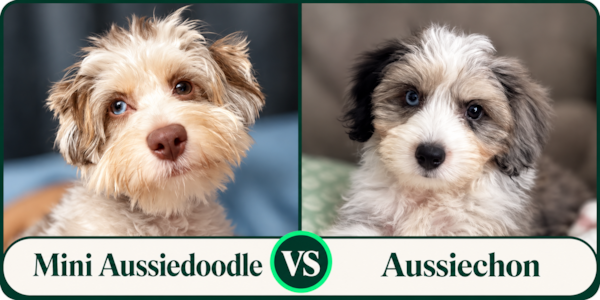
Published Wednesday, October 14, 2026 by Pilesgrove Pups
The Mini Aussiedoodle vs Aussiechon comparison starts with an important advantage: we can hold one parent steady. Both dogs have a Mini Aussie parent, so both can inherit the intelligence, loyalty, athleticism, alertness, and herding instincts associated with the Mini Aussie. The real difference is what happens when that same foundation is paired with a Miniature Poodle in the Mini Aussiedoodle or a Bichon Frise in the Aussiechon.
That second parent changes the dog in meaningful ways. The Poodle can add more athleticism, stronger problem-solving ability, tighter curl, and a greater appetite for structured training. The Bichon Frise adds its own intelligence, but it comes from a more companion-focused background and brings a cheerful social temperament, a sturdy small frame, and a plush coat that can soften some of the Mini Aussie's working-dog intensity.
This makes the comparison much more useful than asking which one is smarter. Both are clever. Both can learn quickly. Both may watch movement, become closely tuned in to their family, and show traces of the Mini Aussie's herding behavior. The difference is how much mental and physical work each dog is likely to want and what kind of relationship develops around that intelligence.
The Mini Aussiedoodle usually leans toward the more active, task-oriented side. It can be an excellent match for someone who genuinely enjoys training, hiking, games, dog sports, and giving a clever dog new things to figure out. The Aussiechon is still lively and capable, but the Bichon influence may create a more socially easygoing companion that is satisfied with a somewhat less demanding activity schedule.
Neither should be mistaken for a decorative little fluff ball. The shared Mini Aussie matters too much for that. The better choice is whether you want to amplify the Mini Aussie's athletic and problem-solving qualities with the Poodle or balance them with the Bichon's cheerful companion temperament.
Table of Contents
- Mini Aussiedoodle vs Aussiechon at a Glance
- Mini Aussiedoodle and Aussiechon Overview and History
- Mini Aussiedoodle vs Aussiechon Appearance
- Mini Aussiedoodle vs Aussiechon Temperament
- Mini Aussiedoodle vs Aussiechon: Which One Should You Choose?
- Choose a Mini Aussiedoodle if You Want an Active Training Partner
- Choose an Aussiechon if You Want Intelligence With a Softer Companion Rhythm
- Which Is Bigger: Mini Aussiedoodle or Aussiechon?
- Which Is Calmer: Mini Aussiedoodle or Aussiechon?
- Which Is More Energetic?
- Which Is Easier to Train?
- Which Is Better for First-Time Dog Owners?
- Which Is Better With Children?
- Which Is Better With Other Dogs?
- Which Is Better With Cats?
- Which Has Stronger Herding Instincts?
- Which Sheds Less: Mini Aussiedoodle or Aussiechon?
- Which Needs More Grooming?
- Which Is Better for Allergies?
- Which Is More Affectionate?
- Which Is More Likely to Bark?
- Which Is Better for Apartment Living?
- Which Is Better for an Active Lifestyle?
- Which Is Better for Seniors?
- Which Is More Social With Strangers?
- Which Is More Predictable in Size and Appearance?
- Mini Aussiedoodle vs Aussiechon: The Final Comparison
Mini Aussiedoodle vs Aussiechon at a Glance
| Trait | Mini Aussiedoodle | Aussiechon |
| Parent breeds | Mini Aussie × Miniature Poodle | Mini Aussie × Bichon Frise |
| General size | Small to medium-small | Small to medium-small |
| Common adult weight | Often around 12–30 pounds, depending on parents and generation | Often around 8–20 pounds |
| Common height | Roughly 12–18 inches | Roughly 10–18 inches |
| Build | Athletic, agile, sometimes leggier | Compact, sturdy, agile |
| Coat | Straight, wavy, or curly | Straight, wavy, or curly, often plush |
| Shedding | Low to moderate, coat-dependent | Usually low, coat-dependent |
| Grooming | Moderate to high | Moderate to high |
| Color range | Very broad, including merle | Broad, including merle |
| Eye colors | Brown, blue, amber, hazel, mixed or parti-colored | Brown, blue, amber, hazel, or mixed |
| Energy | Moderate to high | Moderate |
| Mental stimulation | High | Moderate to high |
| Trainability | Very high | High |
| Herding behavior | Possible and sometimes noticeable | Possible, usually somewhat softened |
| Social style | Loyal, interactive, alert, active | Cheerful, affectionate, social, playful |
| Best fit | Active owners who enjoy training and engagement | Families wanting Mini Aussie intelligence in a more companion-oriented package |
These ranges are useful guides rather than standards for either cross. Mini Aussiedoodles and Aussiechons can vary considerably according to the actual Mini Aussie parent, the other parent, generation, and the size history within the breeding program.
Mini Aussiedoodle and Aussiechon Overview and History
The Mini Aussiedoodle and Aussiechon are modern crosses, but the parent breeds behind them have very different working histories. The Mini Aussie gives both dogs the same basic core: a compact herding dog with high intelligence, athletic ability, responsiveness to people, and a natural awareness of movement.
That shared ancestry is important because neither the Poodle nor Bichon completely erases it. An Aussiechon may be softer and more companion-oriented than a Mini Aussiedoodle, but it can still circle, chase, watch children closely, or become fascinated by movement. Likewise, a Mini Aussiedoodle does not inherit every trait at maximum intensity simply because both sides are intelligent.
The difference is best understood through what the second parent was historically bred to do. The Miniature Poodle brings another active, highly trainable dog with working ancestry. The Bichon Frise brings a small but sturdy companion whose history rewarded sociability, adaptability, tricks, and an ability to charm people.
Mini Aussiedoodle History and Background
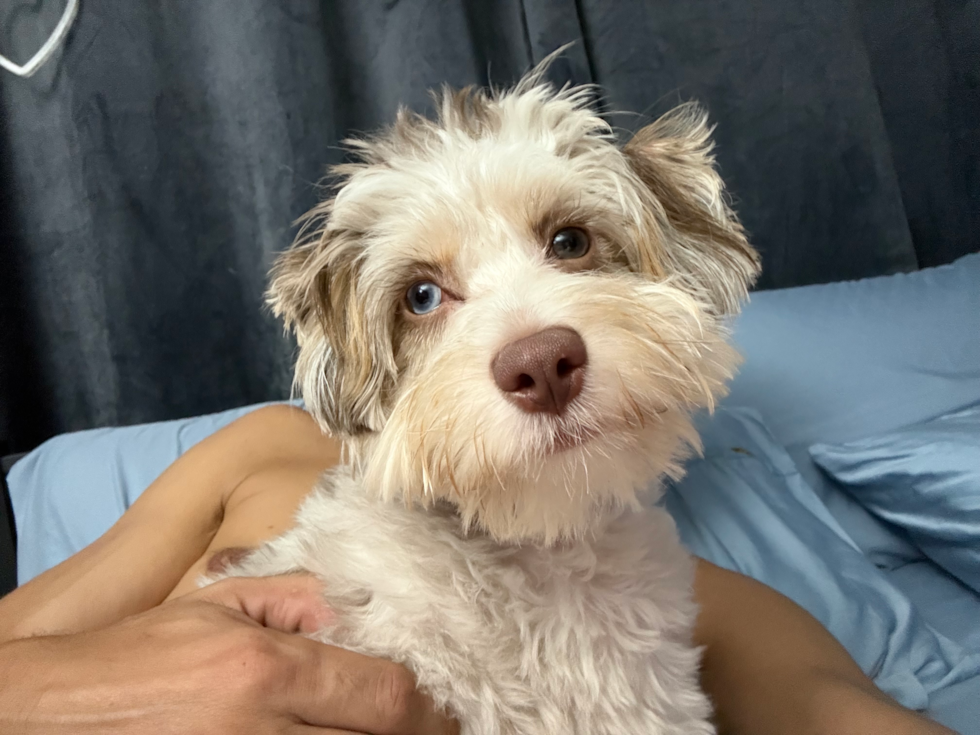
The Mini Aussiedoodle, also called the Mini Aussiepoo or Mini Aussiepoodle, combines a Mini Aussie with a Miniature Poodle. Intentional pairings became more visible during the rise of Poodle crosses in the late twentieth century, although there is no universally documented first breeder whose program can be called the origin of every modern Mini Aussiedoodle.
The Mini Aussie side contributes genuine herding ancestry. Mini Aussies were developed from smaller Australian Shepherd lines while retaining the intelligence, agility, loyalty, and working ability that made Aussies valuable around livestock. Adults commonly stand somewhere around 13 to 18 inches and often weigh about 20 to 40 pounds, though individual breeding lines can differ.
The word “mini” can therefore be misleading if someone expects a toy-sized lapdog. A Mini Aussie may be compact compared with a standard Australian Shepherd, but it is still an athletic herding dog with considerable stamina and a brain designed to notice patterns, movement, and human direction.
The Miniature Poodle adds another sophisticated working background. Poodles were developed as water retrievers and needed enough intelligence, coordination, and responsiveness to work closely with people. Miniature Poodles retain that trainability and athleticism in a smaller body.
That pairing is the reason Mini Aussiedoodles can be such capable dogs. The Mini Aussie adds herding awareness and working drive, while the Poodle adds another layer of problem-solving ability and physical versatility. For owners who enjoy training, that combination can be tremendously rewarding.
It can also mean the dog needs more than a walk and a food bowl. A clever Mini Aussiedoodle with too little to do may decide to create its own entertainment, and human preferences are not always part of that creative process.
Aussiechon History and Background
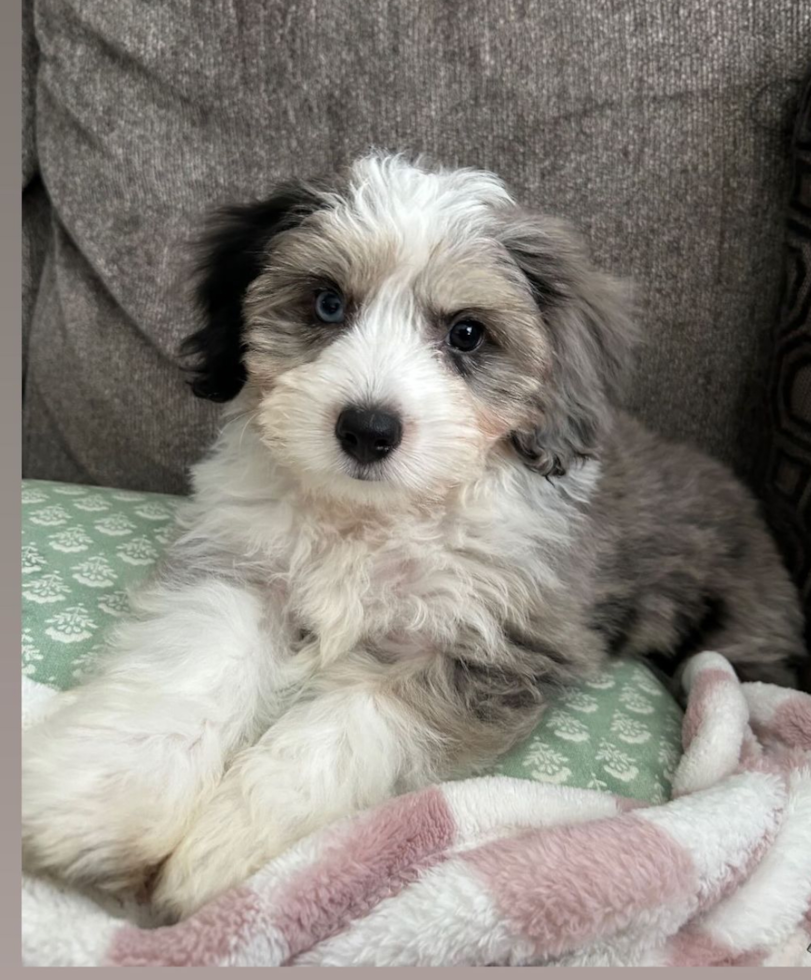
The Aussiechon, sometimes called the Mini Aussie Bichon, combines a Mini Aussie with a Bichon Frise. Like the Mini Aussiedoodle, it is a modern cross without one universally accepted creation date or documented founding breeder.
The Mini Aussie contributes the same herding foundation here, which is why the Aussiechon should not be understood as simply a fluffy Bichon mix. Intelligence, alertness, athletic ability, movement awareness, and potential herding behavior remain part of the genetic picture.
The Bichon Frise moves the cross in another direction. Bichons belong to an old family of small Mediterranean companion dogs and became fashionable in European royal households. Later periods of their history saw them working alongside street performers and in circuses, where friendliness, adaptability, tricks, and an ability to engage an audience became genuine advantages.
That history produced a dog that is intelligent without being primarily work-driven. Bichons are playful, cheerful, sturdy, social dogs that enjoy learning but also excel at something much simpler: living with people.
When combined with the Mini Aussie, those traits can create a dog with plenty of intelligence and athletic ability but a stronger companion emphasis than the Mini Aussiedoodle. The Aussiechon may still love hikes, training, games, and outdoor adventures, yet the Bichon side can make ordinary family interaction especially rewarding.
That is the main reason the Aussiechon has its own place rather than functioning as a substitute for a Mini Aussiedoodle. Both share the same herding foundation, but the Bichon changes the balance.
Mini Aussiedoodle vs Aussiechon Appearance
Mini Aussiedoodles and Aussiechons can look surprisingly similar because the Mini Aussie contributes such distinctive colors and markings to both. Blue merle, red merle, black, red, white markings, tan points, and striking eye colors can all create dogs that look strongly related.
Coat texture is where the second parent becomes more obvious. Miniature Poodles can contribute dense curls and a somewhat refined athletic outline, while Bichons add a plush curly double coat and a compact, rounded body. Either cross can still inherit a straighter Mini Aussie-style coat.
The result is a broad spectrum rather than two fixed appearances. One Mini Aussiedoodle may look unmistakably Doodle-like, while another retains enough Mini Aussie coat and structure to make the ancestry obvious. The same is true of Aussiechons.
Mini Aussiedoodle Appearance
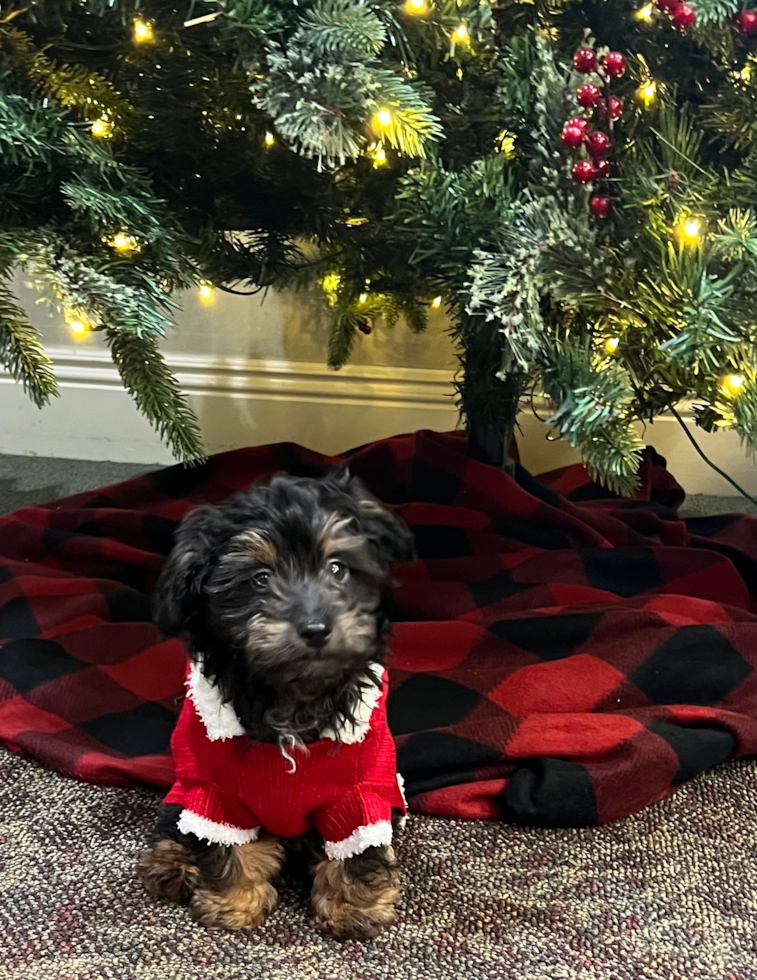
Mini Aussiedoodles commonly fall somewhere around 12 to 18 inches at the shoulder, with adult weight frequently landing in the teens or twenties. Some remain smaller, while others approach 30 pounds or more depending on the Mini Aussie parent, Poodle size, generation, and breeding line.
The body is generally athletic. Both parent breeds are built to move, which gives many Mini Aussiedoodles good leg length, coordination, and a surprisingly capable frame beneath the coat.
A short haircut often reveals this structure much more clearly. The dog that looked like a fluffy teddy bear before grooming may suddenly look like a compact little athlete afterward.
Mini Aussiedoodle Coat Type and Texture
Mini Aussiedoodle coats can be straight, wavy, or curly. The Mini Aussie contributes a medium-length double coat that may be straight or slightly wavy, while the Poodle brings dense curl.
Many Mini Aussiedoodles develop a fleece-like wave somewhere between the two parents. Others grow stronger curls, particularly when Poodle influence is high or when later-generation breeding increases the proportion of Poodle ancestry.
Straighter dogs may retain more undercoat and can shed more visibly. Curlier dogs may leave less hair around the home but develop mats more readily because loose hair stays trapped inside the coat.
Puppy texture can also change. A soft loose coat at ten weeks does not guarantee that the adult dog will remain equally loose once mature hair and undercoat develop.
Mini Aussiedoodle Colors and Patterns
Color is one of the Mini Aussiedoodle's most eye-catching features. The Mini Aussie contributes black, red, blue merle, red merle, white markings, and tan points, while the Poodle adds its own substantial palette.
Mini Aussiedoodles may therefore be black, red, brown, chocolate, cream, apricot, gray, blue merle, red merle, parti-colored, or multicolored. The exact combinations depend on the genes present in both parents.
Merle patterns can make two puppies look completely different even when they share the same basic colors. The irregular marbling creates individual patterns rather than a standardized placement of patches.
Color should remain secondary to temperament, health, and structure when choosing a dog. A striking merle coat may be beautiful, but it tells you very little about whether the adult's activity needs will fit your household.
Mini Aussiedoodle Eyes and Expression
Mini Aussiedoodles can have considerably more eye-color variation than many companion crosses. Brown, blue, amber, hazel, mixed-color, and partially colored eyes may occur through Mini Aussie ancestry.
Some dogs have one blue and one brown eye, while others have flecks or marbling within a single iris. These features can appear alongside merle coats but are not limited to one exact appearance.
Poodle influence can narrow the face and lengthen the muzzle slightly, while stronger Mini Aussie traits may create a broader, more shepherd-like head.
The overall expression tends to be alert. Even a very fluffy Mini Aussiedoodle often looks as though it is paying close attention to whatever is happening around it.
Mini Aussiedoodle Build and Size
The Mini Aussiedoodle is usually the larger and more athletic dog in this comparison. The Mini Aussie already carries a compact working build, while the Miniature Poodle adds more athletic structure rather than reducing it to a purely companion frame.
This can result in a dog capable of substantial activity despite its manageable size. Healthy adults may enjoy longer walks, hiking, retrieving, agility-style games, swimming, and other activities that require coordination and stamina.
Individual size deserves attention because the term Mini Aussiedoodle covers more variation than many owners expect. A 15-pound adult and a 30-pound adult create noticeably different experiences even though both carry the same crossbreed name.
The parents give the clearest clue. Their actual height, weight, bone, and body proportions matter more than a generic estimate.
Mini Aussiedoodle Shedding
Mini Aussiedoodles are commonly low shedding compared with a pure Mini Aussie, but coat inheritance matters enormously. The Mini Aussie parent naturally has a shedding double coat, while the Poodle releases very little visible hair.
A strongly Poodle-influenced curly coat can leave little loose hair around the home. A straighter dog with more Mini Aussie undercoat may shed noticeably, especially during seasonal coat changes.
This is one reason the phrase “low shedding” is more accurate than promising that every Mini Aussiedoodle will not shed.
Generation can affect the odds, but it does not create certainty. Looking at the parents and mature dogs from similar pairings gives a more realistic picture.
Mini Aussiedoodle Grooming Needs
Mini Aussiedoodle grooming depends heavily on coat type. Curlier dogs need thorough brushing and combing because mats can form close to the skin, especially behind the ears, beneath the legs, around the collar, and along the tail.
Straighter coats may require less clipping but more attention to undercoat. Seasonal shedding can create dense loose hair that needs to be brushed out rather than allowed to collect against the skin.
Professional grooming is common for furnished wavy and curly dogs. A shorter trim can reduce the workload substantially while keeping the dog comfortable and easy to maintain.
Coat care should be chosen according to the actual dog rather than the Doodle label. Two Mini Aussiedoodles can require noticeably different routines.
Aussiechon Appearance
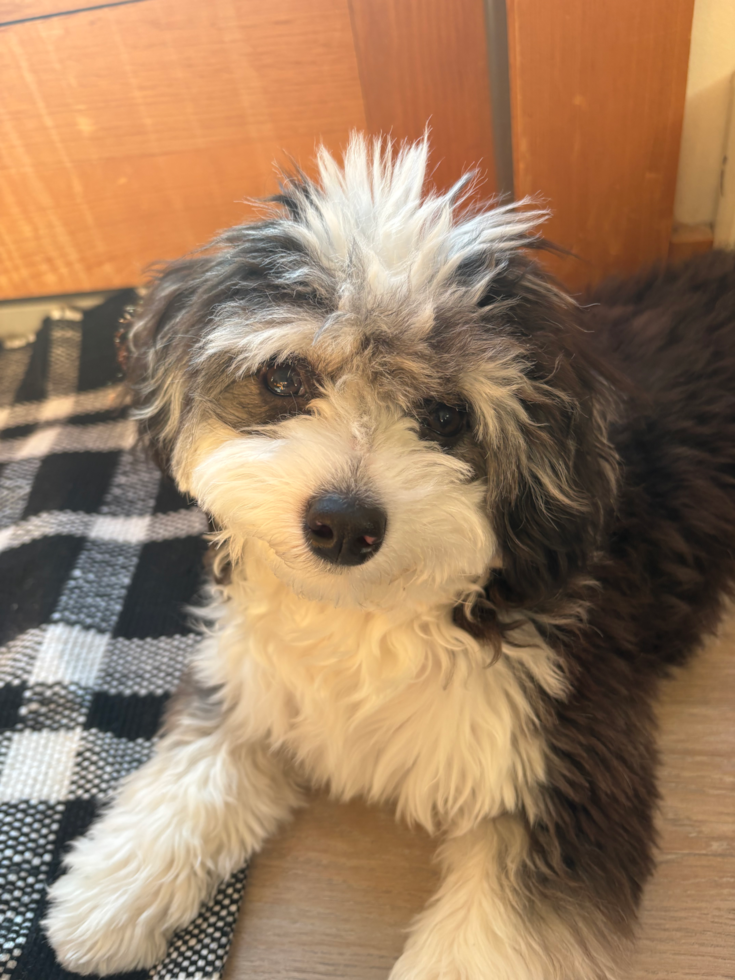
Aussiechons are generally smaller and more compact, with many adults falling around 8 to 20 pounds. Height can vary broadly because the Mini Aussie contributes more stature than the Bichon, but many remain easy-to-handle small companions.
The Bichon adds more body substance than its fluffy appearance suggests. Bichons stand only around 9.5 to 11.5 inches but commonly weigh 12 to 18 pounds, so an Aussiechon can have a solid little frame even when it is considerably smaller than a Mini Aussiedoodle.
The shared Mini Aussie still contributes athletic structure. This is not a delicate lapdog cross despite its soft coat and small size.
Aussiechon Coat Type and Texture
The Aussiechon coat can range from relatively straight to wavy or curly. The Mini Aussie supplies a straight-to-wavy double coat, while the Bichon contributes a dense, soft undercoat and curly outer coat.
Many Aussiechons develop a plush, fluffy texture with more body than a typical Mini Aussie coat. Some form loose waves, while others have enough Bichon influence to develop obvious curls.
Compared with the Mini Aussiedoodle, the curl may feel softer or more cottony rather than forming the same dense Poodle-style texture. There is still substantial overlap, especially after both dogs receive similar haircuts.
The Bichon also makes low shedding more likely than it would be in a pure Mini Aussie. That advantage comes with significant grooming responsibilities.
Aussiechon Colors and Patterns
Aussiechons can inherit much of the Mini Aussie's dramatic color range. Blue merle, red merle, black, red, tan, and white markings can all appear, while the Bichon contributes white, cream, buff, and apricot-related shades.
This can produce especially striking combinations. A merle Aussiechon with a predominantly white coat may look very different from a darker dog that strongly favors the Mini Aussie side.
The Bichon's light coloring can make white and cream areas especially prominent in many puppies. Other dogs retain much stronger shepherd-like color placement.
As with the Mini Aussiedoodle, appearance can change as the puppy matures. Coat length, density, and some shades become clearer once adult hair replaces the puppy coat.
Aussiechon Eyes and Expression
Aussiechons can inherit the same interesting eye-color possibilities from their Mini Aussie parent. Brown, blue, amber, hazel, mismatched, and partially colored eyes may all occur.
The Bichon side can make the face look rounder and softer, especially when the coat is groomed into a teddy bear style. Dark pigmentation around the eyes and nose can create strong contrast in lighter-coated dogs.
The muzzle remains moderate rather than short. Both parent breeds have conventional facial proportions, which gives the Aussiechon a balanced head underneath the fluffy furnishings.
Their expression can combine Mini Aussie alertness with the Bichon's cheerful openness. That mixture is part of what makes the cross visually distinctive.
Aussiechon Build and Size
The Aussiechon is usually the more compact dog. Bichon influence can reduce overall size while adding sturdiness, so the finished dog may feel solid without becoming tall or heavy.
This makes the cross attractive to people who like Mini Aussie intelligence but want a smaller physical package. An Aussiechon can still be agile and fast without taking up much room.
The Mini Aussie parent means the dog should not be treated as physically incapable simply because the Bichon reduced the size. Many enjoy brisk walks, play, obstacle games, and family adventures.
The difference from the Mini Aussiedoodle is usually one of capacity and intensity. The Aussiechon can do plenty, but it may not need quite as much sustained physical activity to feel satisfied.
Aussiechon Shedding
Aussiechons usually shed lightly, particularly when the Bichon coat comes through strongly. Bichons release little visible hair because loose strands remain trapped within the curly coat.
The Mini Aussie still contributes a shedding double coat, so some individuals may release more hair than others. A straighter Aussiechon with more undercoat can show noticeable seasonal shedding.
A plush or curly dog may leave very little hair on furniture but require more brushing to remove what remains caught inside the coat.
As with the Mini Aussiedoodle, coat genetics matter more than the crossbreed name alone.
Aussiechon Grooming Needs
Aussiechon grooming can be substantial because plush Bichon-influenced coats tangle easily. Soft hair can form mats behind the ears, beneath the legs, around the neck, and anywhere friction occurs.
Dogs with straighter Mini Aussie coats may require more undercoat removal rather than constant trimming. Their needs can therefore shift according to what they inherit.
Professional grooming is common for dogs with fuller furnishings. A short teddy bear trim keeps the classic soft appearance while reducing the amount of brushing required at home.
The Bichon's powder-puff look comes with maintenance. An Aussiechon that sheds very little is not automatically an easy-care dog.
Mini Aussiedoodle vs Aussiechon Appearance Comparison: What Is the Difference?
The strongest visual difference is usually athletic refinement versus compact plushness. Mini Aussiedoodles tend to have greater potential for height, leg length, and a more obviously athletic frame because both parents are active working breeds.
Aussiechons can still look athletic, especially when Mini Aussie structure dominates, but the Bichon usually reduces body size and adds more compact substance. Many have a rounder, softer appearance once the coat grows out.
Coat texture overlaps considerably. Mini Aussiedoodles can have anything from straight Mini Aussie-style hair to strong Poodle curls, while Aussiechons range from straight or wavy coats to plush Bichon-influenced curls. The Poodle generally creates the greater potential for tight, defined curl, while the Bichon often adds volume and softness.
Both crosses can inherit merle coloring, unusual eye colors, and classic Mini Aussie markings. Those similarities make color a poor way to decide between them because the same striking appearance can sit on two dogs with different activity needs.
If you want a slightly larger, more athletic-looking dog with stronger curl potential, the Mini Aussiedoodle may appeal more. If you want a smaller, sturdier dog with a plush teddy bear quality, the Aussiechon has the advantage.
Mini Aussiedoodle vs Aussiechon Temperament
Temperament is where the shared Mini Aussie matters most. Both dogs have a herding parent, so both can be alert, loyal, quick to learn, sensitive to household patterns, and interested in movement.
This also means the Aussiechon should not be treated as though the Bichon turns it into a completely conventional lapdog. Running children, other pets, bicycles, and fast-moving activity can still bring out chasing or herding behavior in either cross.
The real distinction comes from the second parent's contribution. The Poodle reinforces athleticism, working intelligence, and problem-solving. The Bichon adds a cheerful, highly social temperament with less demand for sustained work.
Mini Aussiedoodle Temperament
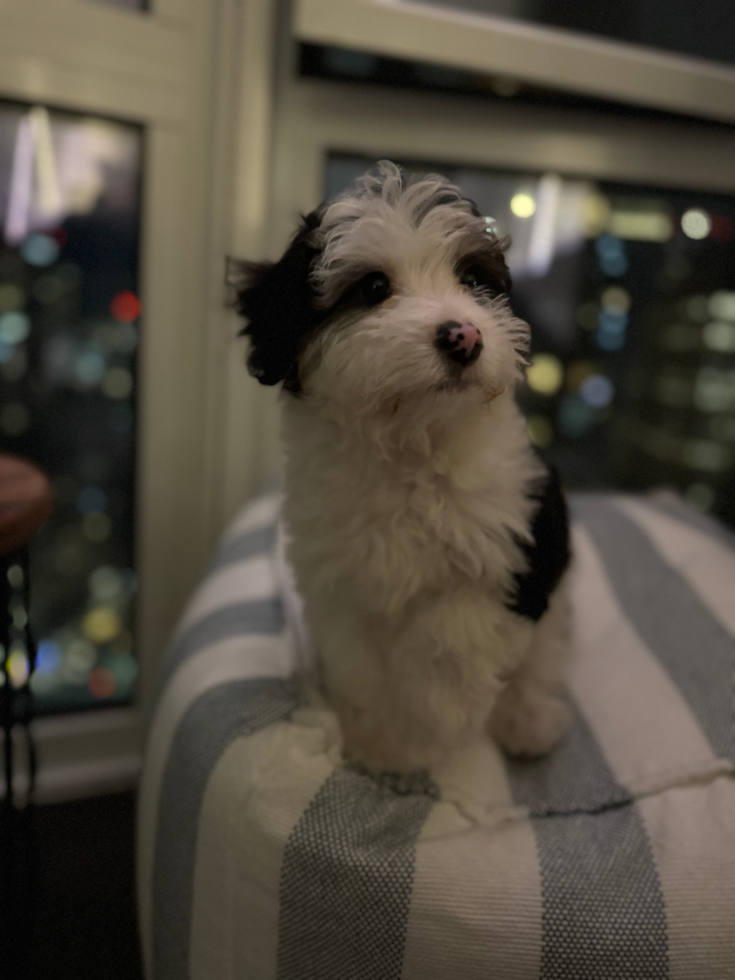
Mini Aussiedoodles tend to be bright, attentive, active dogs that form close relationships with their families. Both parent breeds are highly trainable and physically capable, which can create a dog that seems to learn household routines almost before anyone realizes it is paying attention.
Their intelligence is not simply about knowing commands. Many Mini Aussiedoodles notice patterns, anticipate what happens next, and become very aware of where their people and other animals are in the environment.
This level of engagement can be wonderful in the right household. It also means the dog benefits from owners who enjoy interaction rather than expecting intelligence to make ownership effortless.
Mini Aussiedoodle Intelligence and Training
Training is one of the Mini Aussiedoodle's strongest qualities. Both the Mini Aussie and Poodle have backgrounds that rewarded cooperation with people, problem-solving, and the ability to learn complex behaviors.
Basic cues may come quickly, but these dogs can usually handle much more. Tricks, scent work, retrieving, agility foundations, advanced obedience, and other structured games give the brain useful work.
The challenge is keeping training interesting. A Mini Aussiedoodle that already understands a behavior may become less enthusiastic about repeating it twenty times simply because the human wants twenty perfect repetitions.
Variety and progression work better. Once the dog understands a skill, using it in new locations or combining it with another task can be more satisfying than drilling the same exercise.
Mini Aussiedoodle Energy Level
The Mini Aussiedoodle usually has the higher energy level in this comparison. The Mini Aussie contributes the stamina and alertness of a herding dog, while the Miniature Poodle adds another athletic parent.
That energy should not be managed solely by trying to exhaust the dog physically. Endless running can create a very fit Mini Aussiedoodle whose brain is still looking for work.
A balanced routine combines walks, sniffing, training, play, exploration, and periods of deliberate calm. Teaching the dog how to settle is just as useful as teaching another trick.
For an active owner, this balance can be extremely enjoyable. The dog can participate in real outings and still become a comfortable indoor companion once its needs are met.
Herding Behavior in Mini Aussiedoodles
Herding behavior is a genuine possibility because of the Mini Aussie parent. It may appear as circling, following moving people closely, chasing runners, blocking movement, or focusing intensely on another pet.
Some puppies may also show interest in heels or ankles when excited. This does not mean the dog is aggressive, but allowing the behavior to become a game can make it much harder to manage later.
Recall, impulse control, place training, and redirection toward toys or structured games give the dog better options. Owners should take the behavior seriously without treating normal herding instinct as a character flaw.
The Poodle does not necessarily weaken this drive. Because the Poodle brings plenty of intelligence and athleticism of its own, some Mini Aussiedoodles can be highly capable, intense learners.
Mini Aussiedoodle Affection and Family Attachment
Mini Aussiedoodles can be deeply affectionate and loyal. Mini Aussies tend to form close working relationships with their people, while Poodles are also highly human-focused.
The attachment may feel very interactive. These dogs frequently want to know what the family is doing and whether there is a role for them in it.
That can make them excellent companions for someone who enjoys including a dog in daily life. A Mini Aussiedoodle may be perfectly happy beside you on the sofa, but it is also likely to become interested the moment you stand up and head toward the door.
Independence still deserves practice. A clever dog that accompanies its owner everywhere can become unprepared for the inevitable times when it needs to remain home alone.
Mini Aussiedoodles With Children
Mini Aussiedoodles can be excellent family dogs, particularly in active households where children are old enough to participate in walks, games, and training.
Their physical sturdiness can be useful around family activity, but herding behavior deserves attention. Running children can become extremely interesting to a dog whose Mini Aussie ancestry says moving things should be monitored and perhaps organized.
Chasing, circling, or heel-focused behavior should be redirected early. These habits are much easier to shape when the puppy is small than after an athletic adolescent has practiced them for months.
Older children can develop an excellent partnership with the dog through tricks, fetch, scent games, and supervised training. This gives the dog's intelligence somewhere useful to go.
Mini Aussiedoodles With Other Dogs and Pets
Mini Aussiedoodles can live happily with other dogs, especially when energy levels and play styles are compatible. Their intelligence and social attachment do not prevent them from enjoying canine companionship.
The herding side can complicate relationships with quieter animals. One dog may find being followed, stared at, or repeatedly circled irritating even if the Mini Aussiedoodle means no harm.
Cats can also live successfully with the cross. Early boundaries become important because running can trigger chasing or herding behavior.
A respectful relationship develops more easily when the puppy learns from the beginning that other household animals are companions rather than something to manage.
Mini Aussiedoodle Barking and Alertness
Mini Aussiedoodles can be alert dogs. Mini Aussies naturally monitor their surroundings, while Poodles are attentive and quick to notice changes.
Visitors, activity outside, or unfamiliar sounds may trigger barking. Some dogs are more vocal than others, but environmental awareness is part of the temperament rather than something surprising.
Training can keep the behavior reasonable. Teaching the dog that an initial alert is enough prevents watchfulness from turning into a full-time job.
Mental enrichment helps too. A dog with meaningful activities is less likely to spend the day inventing responsibilities around every sound beyond the window.
Aussiechon Temperament
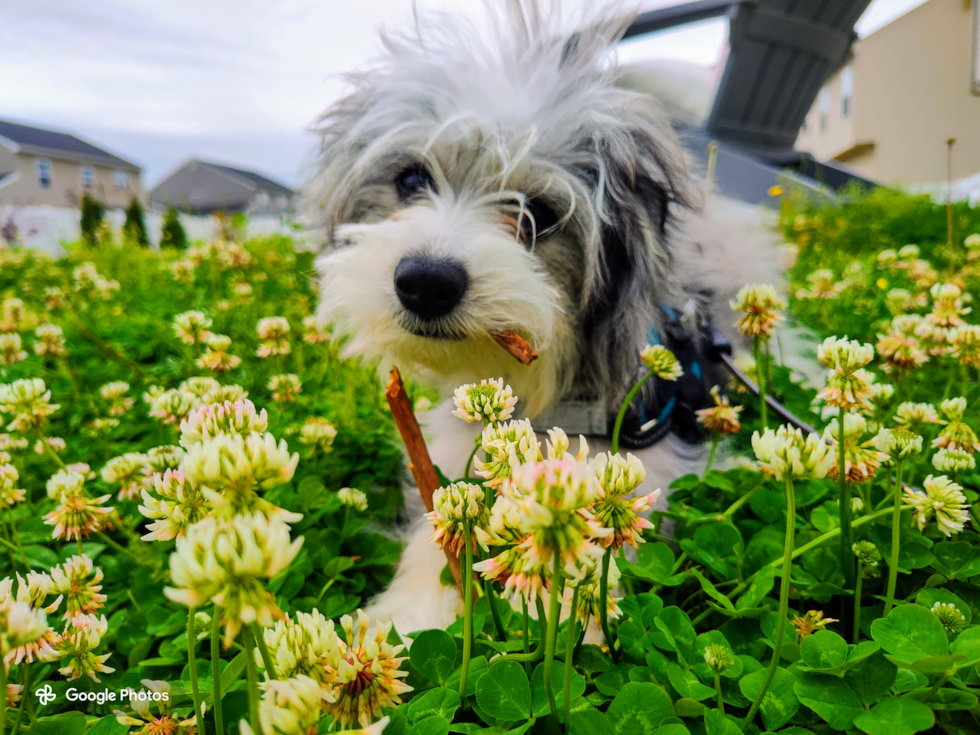
The Aussiechon shares the Mini Aussie's intelligence, loyalty, and movement awareness but adds the Bichon's cheerful social temperament. This can create a dog that feels slightly softer and more openly companion-oriented without losing the cleverness that comes from its herding side.
Bichons are playful dogs that enjoy interaction, tricks, and attention. They are intelligent enough to perform and compete in dog activities, but their everyday temperament is built around adaptability and social connection rather than sustained work.
That combination can make the Aussiechon easier to fit into households that love Mini Aussie intelligence but do not necessarily want the intensity of two highly active working backgrounds.
Aussiechon Intelligence and Training
Aussiechons can be excellent learners. The Mini Aussie contributes strong working intelligence, while the Bichon has a long history of learning tricks and performing for people.
The training experience may feel slightly different from the Mini Aussiedoodle. An Aussiechon can learn very quickly but may be satisfied with a less ambitious training program once household manners are established.
That does not limit what the dog can learn. It simply means training may function more as enjoyable interaction than as an outlet for a powerful need to solve new problems every day.
Positive reinforcement fits both parent breeds well. Food, toys, praise, and play can turn training into something the dog actively looks forward to.
Aussiechon Energy Level
The Aussiechon generally has moderate energy, though individuals with strong Mini Aussie traits can be noticeably active. Daily walks, play, training, and exploration remain important.
The Bichon may soften the need for sustained activity. Bichons can be wonderfully playful and surprisingly fast, but their energy commonly arrives in lively bursts followed by comfortable periods of rest.
This can produce an appealing balance. An Aussiechon may enjoy an active morning outing and still be content with a quieter afternoon at home.
It should still receive more engagement than a conventional low-energy lapdog. The shared Mini Aussie remains part of the equation and gives the cross both physical ability and mental awareness.
Herding Behavior in Aussiechons
Aussiechons can show herding behavior because they have the same Mini Aussie parentage as Mini Aussiedoodles. The Bichon does not erase that instinct.
A puppy may chase running children, monitor another dog, circle during play, or become interested in ankles and movement. Some dogs show very little of this, while others make their herding ancestry obvious.
The difference is that Bichon influence may reduce the overall intensity in some individuals. An Aussiechon can still be movement-aware without feeling as relentlessly task-focused as a highly driven Mini Aussiedoodle.
Early redirection remains important. Herding behaviors become much easier to live with when the puppy learns appropriate games and boundaries rather than practicing them freely.
Aussiechon Affection and Sociability
The Aussiechon may have the advantage for broad sociability. Mini Aussies can be intensely loyal and somewhat discerning, while Bichons are famous for a cheerful assumption that unfamiliar people may simply be friends they have not met yet.
That combination can create a dog that is strongly attached to family but also comfortable with visitors, outings, and social environments.
Individual Mini Aussie influence still matters. Some Aussiechons may observe strangers carefully before warming up rather than greeting everyone immediately.
Good socialization helps the dog develop confidence without forcing interaction. Exposure should teach the puppy that unfamiliar people and places are safe, not that it must greet everyone it encounters.
Aussiechons With Children
Aussiechons can make wonderful family dogs because the Bichon contributes a sturdy small body and a playful, people-friendly temperament.
The same herding caution applies as it does with Mini Aussiedoodles. Running children can trigger chasing or circling when the Mini Aussie side is strong.
The difference may be one of intensity rather than presence. Many Aussiechons fit easily into family routines once boundaries around chasing and excited play are established.
Their smaller size can also be practical for families that want Mini Aussie traits without a larger dog. Children still need to understand respectful handling because even a sturdy 15-pound dog can be injured by rough treatment.
Aussiechons With Other Dogs and Pets
The Aussiechon has excellent potential in multi-dog households. Bichons are notably social with other dogs, while Mini Aussies can build strong relationships with familiar canine companions.
Aussiechons may be playful and enthusiastic with other dogs while remaining small enough for many companion-dog households.
Herding behavior can still appear during play. Repeated circling or controlling another dog's movement should be interrupted if the other dog seems uncomfortable.
Cats can also fit well when early introductions are calm. As with the Mini Aussiedoodle, preventing chasing before it becomes rewarding gives the relationship a much better start.
Aussiechon Barking and Alertness
Aussiechons can be alert to activity around the home because of their Mini Aussie side. They may announce visitors, outdoor movement, or sounds they consider unusual.
The Bichon is also an alert little companion, although its watchdog style is generally social rather than defensive. This can create a dog that notices things quickly but recovers readily once the situation is understood.
Barking habits depend heavily on learning. A puppy that receives attention every time it reacts to the window may turn alerting into a reliable way to summon the family.
Calm reinforcement and enough daily activity help keep normal awareness from becoming excessive noise.
Mini Aussiedoodle vs Aussiechon Temperament Comparison: What Is the Real Difference?
Because both dogs share the Mini Aussie, the main temperament difference is not whether herding instinct or intelligence exists. Both can have plenty of each. The better comparison is what the second parent does with that herding foundation.
The Mini Aussiedoodle generally intensifies the working side of the equation. Poodle ancestry adds another athletic, highly trainable, problem-solving dog. The result can have more appetite for challenging training, sustained activity, and structured engagement.
The Aussiechon generally shifts the balance toward companionship and sociability. Bichon ancestry adds a dog that loves tricks and play but also has a strong history of adapting to human social life. The finished cross may still be clever and active while asking for somewhat less deliberate mental work.
This difference matters most during an ordinary week. Both dogs might happily hike on Saturday, but the Mini Aussiedoodle is more likely to appreciate several challenging activities between Monday and Friday as well. The Aussiechon may be satisfied with walks, play, a little training, and plenty of involvement in family life.
Neither temperament is objectively better. One rewards an owner who enjoys creating things for a dog to do, while the other may fit more naturally into a household where the dog participates enthusiastically without becoming a major daily project.
Mini Aussiedoodle vs Aussiechon: Which One Should You Choose?
The Mini Aussiedoodle and Aussiechon share enough Mini Aussie traits that either can appeal to someone drawn to intelligent, loyal, active little dogs. Both can learn quickly, participate in family activities, and develop strong relationships with their people.
The choice becomes clearer when you consider how much intensity you actually want around that intelligence. The Poodle tends to push the Mini Aussiedoodle toward greater mental and athletic engagement. The Bichon tends to move the Aussiechon toward social adaptability and a somewhat easier companion rhythm.
Choose a Mini Aussiedoodle if You Want an Active Training Partner
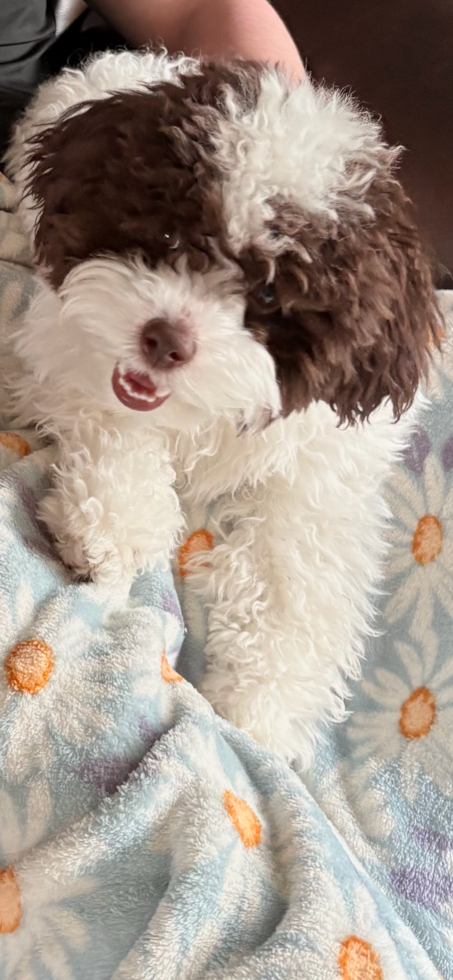
A Mini Aussiedoodle puppy may suit you better if working with your dog sounds like one of the enjoyable parts of ownership rather than another task on the schedule. These dogs can thrive with owners who like teaching tricks, practicing obedience, exploring trails, playing retrieving games, or finding new ways to challenge a clever mind.
The cross can also suit active outdoor households. Both parents bring real athletic ability, so a healthy adult may have plenty of enthusiasm for hiking, longer walks, swimming, and dog sports.
That extra capacity comes with responsibility. A Mini Aussiedoodle that receives very little mental engagement can become restless even when its basic physical exercise has technically been completed.
For the right person, this is not a drawback. It is the reason the dog is so rewarding.
Choose an Aussiechon if You Want Intelligence With a Softer Companion Rhythm
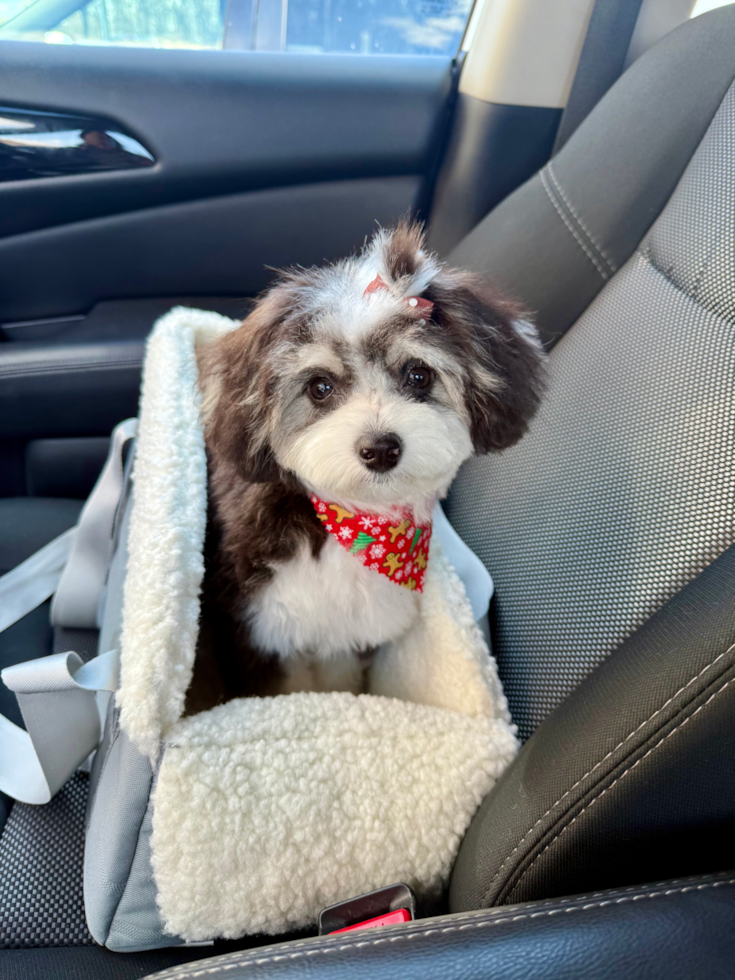
An Aussiechon puppy may suit you better if you love the Mini Aussie's intelligence and distinctive appearance but want the second parent to pull more strongly toward companion life.
The Bichon contributes cheerfulness, social confidence, playfulness, and a somewhat lower need for sustained physical work. This can create a dog that learns quickly and enjoys activity without requiring quite as much deliberate mental programming.
Aussiechons may be especially appealing to social households. Their Bichon side can add openness toward visitors and other dogs, while the Mini Aussie keeps the dog closely connected to the family.
The result is still not a couch ornament. An Aussiechon needs walks, play, training, and good outlets for any herding behavior that appears. The difference is that its needs may fit more naturally into a broad range of everyday family routines.
Which Is Bigger: Mini Aussiedoodle or Aussiechon?
The Mini Aussiedoodle is usually the larger dog, although the ranges overlap. Mini Aussiedoodles commonly reach the teens or twenties in weight and may approach 30 pounds depending on the parents, while many Aussiechons stay closer to the 8-to-20-pound range.
Height can overlap considerably because both have a Mini Aussie parent. The Bichon's smaller stature generally pulls the Aussiechon toward a lighter adult body.
Generation and parent measurements can change the result. A particularly small Mini Aussiedoodle may be lighter than a larger Aussiechon.
If exact adult size matters, measurements of the parents and mature puppies from previous similar pairings are much more useful than relying on the word “mini.”
Which Is Calmer: Mini Aussiedoodle or Aussiechon?
The Aussiechon generally has the calmer everyday profile, although neither should be considered a low-energy dog.
The Mini Aussiedoodle combines the Mini Aussie with another athletic, highly intelligent breed. That can create a dog that remains interested in activity and mental challenges for longer periods.
The Aussiechon adds the Bichon's pattern of playful bursts followed by comfortable rest. Once its walking, play, and social needs have been met, it may reach the relaxation stage sooner.
Individual parent temperament still matters. A highly driven Mini Aussie can produce an active Aussiechon, while a moderate Mini Aussiedoodle can be very easy to live with.
Which Is More Energetic?
The Mini Aussiedoodle usually has the advantage for sustained energy and activity. Both parent breeds have athletic working histories, so the cross can be capable of longer outings and more demanding physical activity.
The Aussiechon remains playful and agile. It may happily hike, run, play fetch, and join family adventures, but many individuals need less sustained exercise to feel satisfied.
The difference is also mental. A Mini Aussiedoodle may finish a walk and still appreciate a training exercise, while an Aussiechon may be ready to settle after the same outing and a little play.
For people whose lifestyle is genuinely active throughout the week, the Mini Aussiedoodle is usually the stronger match.
Which Is Easier to Train?
Both are highly trainable, so the answer depends on what “easier” means.
The Mini Aussiedoodle may have the advantage for complex training. Mini Aussie and Poodle intelligence combine well for advanced tricks, dog sports, scent games, and behaviors that require several steps.
The Aussiechon may feel easier for ordinary companion training because the Bichon adds an eager social style and may reduce some of the Mini Aussie's need for constant mental challenge. It can learn quickly without necessarily demanding that training remain one of the household's main hobbies.
For either dog, positive reinforcement, variety, and consistency work better than repetitive drilling.
Which Is Better for First-Time Dog Owners?
The Aussiechon may have a slight advantage for many first-time owners, provided they understand that the Mini Aussie side can still bring herding behavior and a real need for activity.
Its Bichon influence can create a somewhat easier balance between intelligence, playfulness, and relaxation. Many households can satisfy the dog with regular walks, games, social interaction, and basic training.
A Mini Aussiedoodle can also be a fantastic first dog for someone who actively wants the training experience. A motivated beginner who enjoys learning about enrichment, recall, impulse control, and dog sports may find the cross extremely rewarding.
The wrong assumption would be that either dog is automatically easy because it is fluffy and relatively small. Intelligence reduces neither the need for training nor the consequences of boredom.
Which Is Better With Children?
Both can be excellent family dogs, but there are slightly different considerations.
The Mini Aussiedoodle may suit active older children who enjoy training, fetch, outdoor activities, and other structured interaction. Its larger average size can also make it physically robust during normal family life.
The Aussiechon can be particularly appealing for families wanting a somewhat smaller dog with an outgoing companion temperament. Bichon influence can add a playful social quality that fits naturally around children.
Herding behavior remains relevant to both. Running children may trigger chasing or circling because both dogs share the Mini Aussie, so early boundaries matter regardless of which cross comes home.
Which Is Better With Other Dogs?
The Aussiechon may have a slight advantage for broad canine sociability because Bichons are notably friendly companion dogs.
Mini Aussiedoodles can also thrive with other dogs, but stronger herding tendencies may occasionally create a more controlling play style. Staring, circling, or repeatedly directing another dog's movement can irritate a quieter companion.
Aussiechons can display the same behavior because the Mini Aussie is shared, but Bichon influence may soften the interaction in some dogs.
Individual play style is still more important than the cross. Two compatible dogs can live beautifully together regardless of which one appears on the pedigree.
Which Is Better With Cats?
There is no dramatic winner because both crosses carry Mini Aussie herding ancestry.
Either may become interested in a cat that runs. The behavior can involve chasing or attempts to control movement rather than traditional hunting, but the cat may not appreciate the distinction.
The Aussiechon may have a slight advantage if Bichon influence creates a softer overall temperament, but this should not be treated as a guarantee.
Early introductions, escape areas for the cat, and rewards for calm behavior around movement are important with both.
Which Has Stronger Herding Instincts?
Both can show noticeable herding behavior because the Mini Aussie is shared.
The Mini Aussiedoodle may display those instincts somewhat more intensely in some lines because the Poodle adds another active, highly responsive working breed rather than a pure companion breed. That does not create more herding genetics, but it can create a dog with greater stamina and engagement around behaviors it finds rewarding.
The Aussiechon still needs the same early attention to chasing, circling, and heel-focused play. A Bichon parent does not guarantee that those behaviors disappear.
The actual Mini Aussie parent is especially important here. A dog from stronger working lines may influence the litter more dramatically than the crossbreed label suggests.
Which Sheds Less: Mini Aussiedoodle or Aussiechon?
The Aussiechon may have a slight advantage for consistently low visible shedding, although individual coats can reverse the result.
The Mini Aussiedoodle combines a shedding Mini Aussie double coat with the low-shedding Poodle. A dog that inherits more Poodle curl may shed very little, while a straighter individual with noticeable undercoat can release more hair.
The Aussiechon also has a Mini Aussie parent, but the Bichon contributes another coat known for retaining loose hair rather than dropping large amounts around the home.
Neither should be guaranteed as completely non-shedding. Looking at the actual coat and similar adult relatives provides better information.
Which Needs More Grooming?
Both require substantial grooming, and the workload depends more on coat inheritance than the breed name.
A curly Mini Aussiedoodle can form tight mats close to the skin. A plush Aussiechon can develop equally frustrating tangles because Bichon-influenced hair may be soft, dense, and prone to catching on itself.
Straighter individuals of either cross may need more undercoat brushing and somewhat less clipping.
Short professional trims make both considerably easier to maintain. People drawn to low shedding should understand that less hair on the furniture usually comes with more attention to the coat on the dog.
Which Is Better for Allergies?
Neither cross can be guaranteed safe for someone with dog allergies.
Poodle and Bichon coats both release relatively little visible hair, which can make either cross appealing to people hoping to reduce loose coat around the home. The Mini Aussie contributes a shedding double coat to both pairings, however, and individual puppies can inherit different coat characteristics.
Allergic reactions also involve proteins in saliva and dander rather than loose hair alone.
Anyone with significant allergies should evaluate the individual dog rather than assuming that either cross will automatically solve the problem.
Which Is More Affectionate?
Both can be deeply affectionate, so declaring one universally more loving would create a difference that does not really exist.
The Mini Aussiedoodle may express attachment through involvement. It may follow its person, participate in training, bring toys, monitor household activity, and then settle close once everything becomes quiet.
The Aussiechon may show affection in a more openly social way. Bichon influence can produce a dog that seeks cuddles and family attention while also enjoying visitors and other friendly people.
The better question is what style of affection you prefer: an intensely interactive partner or a cheerful companion that may spread its social attention a little more broadly.
Which Is More Likely to Bark?
Both can bark because they share an alert herding parent. Mini Aussies notice changes in their surroundings, and either cross may announce visitors, outdoor activity, or unfamiliar sounds.
The Mini Aussiedoodle may have a slight tendency toward more environmental monitoring when working traits are strong. Poodle intelligence can add another attentive mind that quickly recognizes household patterns.
Aussiechons can also make capable little watchdogs, but Bichon influence may create a more socially open response once someone is welcomed into the home.
Training matters enormously with both. Alertness becomes much easier to live with when the dog learns that one notification is sufficient.
Which Is Better for Apartment Living?
Both can live successfully in apartments, but the Aussiechon usually has the easier apartment profile.
Its smaller average size and somewhat lower activity needs can fit naturally into compact homes, provided daily walks, play, and mental stimulation are part of the routine.
Mini Aussiedoodles can also thrive in apartments, but owners need to be more deliberate about providing meaningful activity. A large yard does not automatically satisfy an intelligent dog, so apartment living itself is not the issue.
Barking, boredom, and insufficient mental stimulation are much more important than square footage. An engaged Mini Aussiedoodle in an apartment can be far happier than a neglected one sitting in a large yard.
Which Is Better for an Active Lifestyle?
The Mini Aussiedoodle has the clearer advantage for consistently active owners.
Both parent breeds contribute athleticism, coordination, and trainability. A healthy adult can be an excellent companion for hiking, long walks, outdoor exploration, advanced training, and dog sports.
Aussiechons can participate in many of the same activities, especially fit adults with strong Mini Aussie traits. The difference is that they may not need the same amount of sustained activity as part of ordinary life.
If outdoor adventures are already part of your weekly routine, the Mini Aussiedoodle is likely to embrace them. If those adventures are occasional and you want a dog equally happy with a quieter week, the Aussiechon may be more flexible.
Which Is Better for Seniors?
The Aussiechon is usually the easier choice for seniors seeking a manageable companion, especially when the desired routine includes moderate walks, play, and plenty of time together at home.
Its smaller average size can make physical handling easier, while the Bichon influence may reduce the amount of sustained exercise and mental work needed each day.
An active senior could absolutely prefer the Mini Aussiedoodle. Someone who walks extensively, hikes, enjoys training, or wants a dog involved in regular outdoor activities may appreciate the extra capability.
Age alone does not determine the answer. The owner's actual routine and enthusiasm for training matter far more than the number on a birthday cake.
Which Is More Social With Strangers?
The Aussiechon may have the advantage for easygoing sociability with unfamiliar people because Bichons are especially known for their open, cheerful approach to human company.
Mini Aussies can be devoted and social but may also evaluate unfamiliar people before becoming comfortable. A Mini Aussiedoodle can inherit that slight reserve alongside the Poodle's responsiveness.
Good socialization can make either dog confident in new environments. Confidence does not require the dog to greet everyone enthusiastically, and a polite dog that calmly ignores strangers is just as socially successful as one that wants to meet them.
For households with frequent visitors, the Aussiechon's Bichon influence may make the social side somewhat easier.
Which Is More Predictable in Size and Appearance?
The Aussiechon may have a slight advantage for smaller adult size, while neither cross is truly standardized enough to promise one exact result.
The Bichon parent occupies a narrow 9.5-to-11.5-inch range and generally weighs 12 to 18 pounds. That tends to pull Aussiechon size downward from the Mini Aussie.
Mini Aussiedoodles combine the Mini Aussie with a Miniature Poodle, and there can still be considerable variation depending on the actual sizes and lines behind both parents.
Coat and color remain variable in both crosses. Seeing the parents and mature dogs from similar pairings offers more useful information than any average chart.
Mini Aussiedoodle vs Aussiechon: The Final Comparison
Choosing between a Mini Aussiedoodle vs Aussiechon becomes much easier once you remember that the Mini Aussie is already present in both dogs. Intelligence, loyalty, athletic ability, environmental awareness, distinctive colors, and potential herding behavior can appear on either side.
The real decision is what you want added to that foundation.
The Mini Aussiedoodle adds the Miniature Poodle, another highly intelligent and athletic breed with a genuine working history. That pairing tends to create the more demanding brain and the greater capacity for sustained activity. It can be a fantastic match for people who enjoy training, hiking, dog sports, tricks, games, and a dog that actively participates in the day.
The Aussiechon adds the Bichon Frise, a sturdy little companion famous for cheerful sociability and an ability to adapt to life around people. The Bichon does not remove the Mini Aussie's intelligence or herding instincts, but it can shift the balance toward a smaller, more socially relaxed companion that needs somewhat less deliberate work.
Both can have beautiful merle coats, unusual eye colors, fluffy furnishings, and teddy bear faces. Both can shed lightly. Both can learn an impressive amount. Those surface similarities should not distract from the lifestyle difference underneath them.
The Mini Aussiedoodle is usually the better choice when you want more dog to do things with. Its mind and body can handle a busy life, and it is likely to appreciate an owner who keeps finding new ways to engage both.
The Aussiechon is usually the better choice when you want Mini Aussie intelligence in a more flexible companion package. It can join adventures and learn plenty without making a highly structured activity program quite as important to everyday contentment.
Neither choice eliminates the Mini Aussie. That is perhaps the most important thing to remember in this comparison. An Aussiechon can still herd the children, watch the neighborhood, chase movement, and surprise you with how quickly it learns. A Mini Aussiedoodle can still be wonderfully cuddly and settle beautifully once its needs have been met.
Frequently Asked Questions
What is the main difference between a Mini Aussiedoodle and Aussiechon? Both have a Mini Aussie parent, so both can inherit herding instincts, intelligence, loyalty, athleticism, and strong awareness of movement. The Mini Aussiedoodle's other parent is a Miniature Poodle, while the Aussiechon's other parent is a Bichon Frise. That generally makes the Mini Aussiedoodle more athletic and mentally demanding, with stronger interest in structured training and problem-solving. The Aussiechon remains intelligent and active but may lean more toward cheerful sociability, moderate activity, and companion life through the Bichon side.
Which is bigger, a Mini Aussiedoodle or Aussiechon? The Mini Aussiedoodle is generally larger. Many fall somewhere in the teens or twenties in adult weight, with some growing beyond that depending on the parents and breeding line. Aussiechons commonly remain closer to about 8 to 20 pounds because the Bichon parent is a compact small dog. There is still considerable overlap, so actual parent measurements provide a more reliable estimate than the cross name alone.
Which is calmer, a Mini Aussiedoodle or Aussiechon? The Aussiechon usually has the calmer overall profile. Bichon influence can create a playful dog that enjoys activity but settles readily once its walking, play, and social needs have been met. Mini Aussiedoodles generally need more sustained physical and mental engagement because both sides contribute athletic, highly trainable traits. A well-exercised and well-trained Mini Aussiedoodle can still develop an excellent indoor off switch.
Which is easier to train, a Mini Aussiedoodle or Aussiechon? Both are very trainable. The Mini Aussiedoodle may excel at more complex training because Mini Aussies and Poodles both bring strong working intelligence, while the Aussiechon combines Mini Aussie ability with the Bichon's history as a clever performer. For ordinary family manners, the Aussiechon may actually feel easier because some individuals require less ongoing mental challenge. For someone interested in advanced tricks, sports, or more ambitious training goals, the Mini Aussiedoodle may offer greater depth.
Do Mini Aussiedoodles and Aussiechons both have herding instincts? Yes, they can. Both crosses have a Mini Aussie parent, so chasing movement, circling, monitoring other animals, or trying to organize running children may appear in either dog. The behavior may be stronger in some individuals than others, and the actual Mini Aussie parent matters greatly. Early impulse-control work and appropriate games make these instincts much easier to manage in family life.
Which sheds less, a Mini Aussiedoodle or Aussiechon? Both can shed lightly, but the Aussiechon may have a slight advantage for consistently low visible shedding because the Bichon also releases relatively little loose hair. A curly Mini Aussiedoodle with strong Poodle coat traits may shed extremely little as well. Straighter dogs of either cross can release more hair if they inherit a stronger Mini Aussie undercoat. Coat type and generation therefore matter more than the breed name when shedding is a major concern.
Which is better with children, a Mini Aussiedoodle or Aussiechon? Both can be excellent family dogs. Mini Aussiedoodles may be particularly fun for active older children who enjoy training, games, and outdoor activities, while Aussiechons can offer a smaller body and a cheerful, companion-focused temperament. The Mini Aussie parent means herding behavior is possible in both. Running children may trigger chasing or circling, so adults should redirect those behaviors early rather than waiting for the puppy to outgrow them.
Is a Mini Aussiedoodle or Aussiechon better for apartment living? The Aussiechon usually has the easier apartment profile because it tends to be smaller and may require somewhat less sustained activity. Daily walks, play, training, and social involvement can make it very comfortable in a compact home. Mini Aussiedoodles can also thrive in apartments when owners provide enough physical and mental engagement. A yard is not a substitute for interaction, so a well-exercised apartment dog may be happier than one left alone in a large backyard.
Which is more active, a Mini Aussiedoodle or Aussiechon? The Mini Aussiedoodle is usually more active and more likely to seek additional mental challenges. Mini Aussie and Poodle ancestry combine two intelligent athletic backgrounds, which can create considerable capacity for exercise, training, and dog sports. The Aussiechon remains lively and capable but generally has a more moderate activity profile. It can enjoy hiking and adventures without necessarily requiring that level of activity as frequently.
Should I choose a Mini Aussiedoodle or Aussiechon? Choose a Mini Aussiedoodle if you want an intelligent, athletic companion and genuinely enjoy training, outdoor activity, games, and mental enrichment. It is usually the stronger match for someone who wants a dog that can become an active hobby as well as a family companion. Choose an Aussiechon if you want Mini Aussie intelligence and personality in a smaller, somewhat more companion-oriented dog. It can still be active and display herding behavior, but the Bichon influence often creates a more flexible balance between adventure, social life, play, and quiet time at home.