





Published Tuesday, October 6, 2026 by Pilesgrove Pups
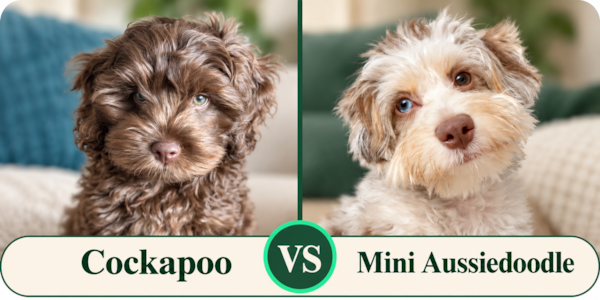
The Cockapoo vs Mini Aussiedoodle comparison brings together two intelligent Poodle mixes that can look surprisingly similar in puppy photos but feel quite different once you live with them. Both can have soft wavy coats, floppy ears, expressive eyes, strong attachments to their families, and enough intelligence to learn quickly. Both also enjoy activity and tend to be far more capable than their fluffy appearance suggests.
The difference lies in what comes alongside the Poodle. A Cockapoo combines the Poodle with a Cocker Spaniel, a sporting dog developed to work closely with hunters, search through cover, and flush game. A Mini Aussiedoodle combines the Poodle with a smaller Australian Shepherd-type dog, which adds herding instincts, close environmental awareness, and a strong drive to watch and control movement.
That creates two different styles of active companion. A Cockapoo may bring enthusiasm for walking, retrieving, sniffing, exploring, and playing while still carrying the cheerful social nature associated with Cocker Spaniels. A Mini Aussiedoodle tends to approach life with more intensity. It may watch people and animals closely, learn routines remarkably fast, and look for opportunities to use both its body and brain.
Neither cross should be dismissed as a cute little Doodle that needs little beyond a walk around the block. They are intelligent dogs with working breeds behind them. The real decision is whether you prefer the Cockapoo's sporting-dog enthusiasm and sociable nature or the Mini Aussiedoodle's herding-dog focus, athleticism, and greater appetite for mental work.
Table of Contents
- Cockapoo vs Mini Aussiedoodle at a Glance
- Cockapoo and Mini Aussiedoodle Overview and History
- Cockapoo vs Mini Aussiedoodle Appearance
- Cockapoo vs Mini Aussiedoodle Temperament
- Cockapoo vs Mini Aussiedoodle: Which One Should You Choose?
- Choose a Cockapoo if You Want an Active but Sociable Companion
- Choose a Mini Aussiedoodle if You Want a Highly Interactive Dog
- Which Is Calmer: Cockapoo or Mini Aussiedoodle?
- Which Is More Energetic?
- Which Is Easier to Train?
- Which Is Better for First-Time Dog Owners?
- Which Is Better With Children?
- Which Is Better With Cats?
- Which Is Better With Other Dogs?
- Which Sheds Less: Cockapoo or Mini Aussiedoodle?
- Which Needs More Grooming?
- Which Is Better for an Active Lifestyle?
- Which Is Better for Apartment Living?
- Which Is More Likely to Bark?
- Which Is More Affectionate?
- Which Is Better for Someone Who Works From Home?
- Which Is Better for Seniors?
- Which Can Handle Longer Walks and Adventures Better?
- Cockapoo vs Mini Aussiedoodle: The Final Comparison
Cockapoo vs Mini Aussiedoodle at a Glance
| Trait | Cockapoo | Mini Aussiedoodle |
| Parent breeds | Cocker Spaniel × Poodle | Mini Aussie × Miniature Poodle |
| General size | Small to medium-small | Small to medium-small |
| Common adult weight | Around 12–25 pounds for many Mini Poodle Cockapoos | Around 15–35 pounds, with smaller dogs possible |
| Common height | Around 10–15 inches | Around 12–18 inches |
| Build | Compact, sturdy, somewhat sporty | Athletic, agile, sturdy |
| Coat | Straight, wavy, or curly | Straight, wavy, or curly |
| Shedding | Usually low, but varies by coat | Low to moderate, depending on coat |
| Grooming | Moderate to high | Moderate to high |
| Common colors | Red, apricot, cream, black, brown, buff, white, parti, roan and other combinations | Black, red, brown, blue merle, red merle, gray, white and multicolor |
| Eye colors | Usually brown or dark brown | Brown, blue, amber, hazel, mixed or mismatched |
| Energy | Moderate to moderately high | Moderate to high |
| Trainability | High | Very high |
| General personality | Cheerful, affectionate, playful, social, active | Intelligent, loyal, energetic, alert, interactive |
| Best fit | Someone wanting an active but sociable companion | Someone wanting a highly engaged and mentally active dog |
For this comparison, the Cockapoo size range refers mainly to dogs produced from a Cocker Spaniel and Miniature Poodle, which commonly reach around 12 to 25 pounds and 10 to 15 inches. Cockapoos can be smaller or larger when breeders use Toy or Standard Poodles, so the exact parentage matters. Mini Aussiedoodles also vary considerably, with many reaching about 15 to 35 pounds and 12 to 18 inches while some lines produce smaller adults.
Cockapoo and Mini Aussiedoodle Overview and History
The Cockapoo and Mini Aussiedoodle share one parent breed, but their histories begin in very different places. The Poodle contributes intelligence, trainability, athletic ability, and a coat that releases relatively little visible hair. The other parent determines whether those traits are paired with a sporting spaniel or a herding dog.
Poodles themselves have a working history that is easy to overlook beneath the carefully groomed coats seen in dog shows. They were developed as water retrievers and remain athletic, responsive dogs capable of learning complex tasks. Toy and Miniature Poodles retain that mental ability despite their smaller size, which helps explain why both the Cockapoo and Mini Aussiedoodle can be such quick students.
The Cocker Spaniel adds a background built around hunting and retrieving. The Mini Aussie side adds livestock work, movement control, and constant awareness of what is happening nearby. Those histories matter because instincts do not disappear simply because the resulting dog has a teddy bear haircut.
Cockapoo History and Popularity
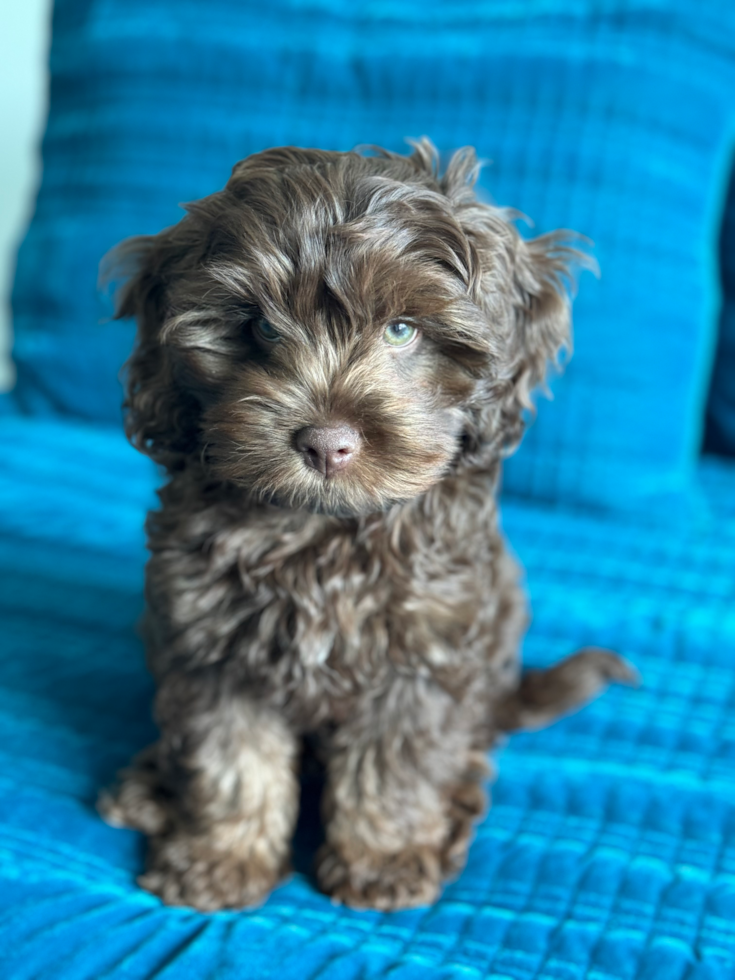
The Cockapoo is one of the oldest widely recognized modern designer crosses. Cocker Spaniel-Poodle mixes have been known in the United States since around the 1950s, and the word “Cockapoo” appeared in print by the early 1960s. That gives this cross several decades more history than many dogs that later became part of the Doodle boom.
Its parent breeds were also enormously popular during that period. Poodles rose to the top of American breed rankings during the 1950s and 1960s, while Cocker Spaniels had already enjoyed long periods as one of America's favorite family dogs. The pairing brought together two familiar breeds with strong trainability, affectionate temperaments, and very different coat types.
The Cocker Spaniel side deserves a little explanation because the term Cockapoo does not always describe exactly the same parentage. In the United States, many Cockapoos descend from American Cocker Spaniels. Other programs use English Cocker Spaniels, including both show and working lines, and breeders may pair them with Toy or Miniature Poodles. The Cockapoo Club of Great Britain recognizes several of these combinations under the broader Cockapoo name.
Those distinctions affect the adult dog. American Cockers generally have a smaller, more compact build and heavier coat, while English Cockers are taller and may retain stronger field instincts. Working English Cocker lines can add even more energy, scent interest, and stamina than a companion-bred American Cocker.
Despite those variations, the Cocker contribution has a recognizable theme. Cockers are affectionate, cheerful dogs that enjoy being around people, but they remain members of the Sporting Group. Their ancestors worked through cover in search of birds, and modern Cockers still enjoy retrieving, exploring, and participating in active family life.
The Poodle adds another highly trainable brain and can reduce visible shedding when its coat traits carry through strongly. That combination has helped the Cockapoo remain popular for decades: it is small enough for many homes, sturdy enough for normal family activity, playful without automatically reaching working-herding intensity, and deeply interested in its people.
Mini Aussiedoodle History and Popularity
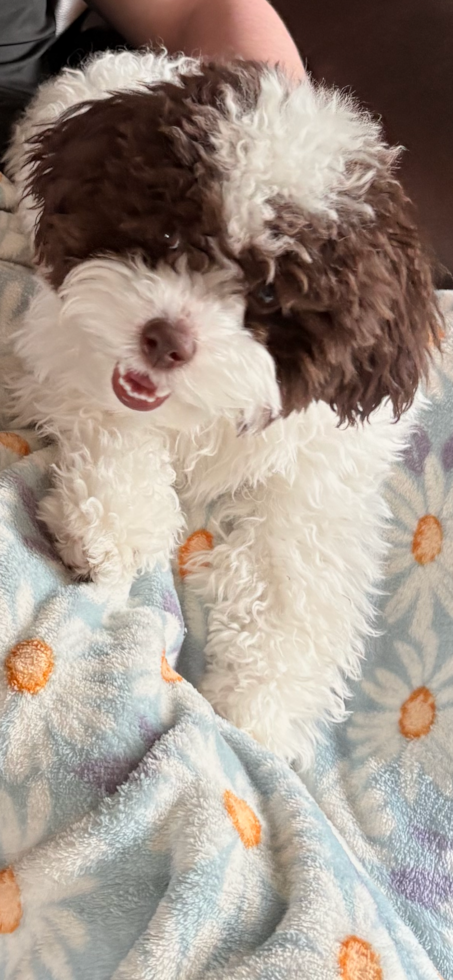
The Mini Aussiedoodle, also called a Mini Aussiepoo or Mini Aussiepoodle, is a much newer cross. Modern Mini Aussiedoodle breeding is strongly associated with the designer-dog expansion of the 1990s, when breeders began combining Miniature Poodles with smaller Australian Shepherd-type dogs to produce compact, highly trainable companions with striking coats.
The history of the Mini Aussie side is more complicated than the name suggests. In the 1960s, breeders in California began selecting smaller Australian Shepherds, and the dogs became especially popular among equestrians who valued their working ability and portable size. Those lines eventually contributed to the development of the Miniature American Shepherd, which the AKC recognized as a separate breed in 2015.
The term Mini Australian Shepherd is still used in many breeding programs outside the AKC's Miniature American Shepherd framework. For anyone researching a Mini Aussiedoodle, this makes the actual parent dogs important. Asking whether the Aussie parent is a Miniature American Shepherd, a Mini Australian Shepherd from other lines, or another small Aussie-type dog gives more useful information than relying on the mix name alone.
Whatever terminology applies, the central traits are similar. These smaller shepherds descend from dogs bred to notice movement, respond to handlers, solve problems, and control livestock. Miniature American Shepherds remain genuine herding dogs and are described by the AKC as bright, self-motivated, loyal, energetic, and capable of succeeding in obedience, agility, tracking, and herding.
Adding a Miniature Poodle does not reduce the intelligence quotient. Poodles bring their own athletic and working background, so the Mini Aussiedoodle has two parents selected for cooperation, responsiveness, and mental ability. That helps explain why the cross can learn so quickly, but it also explains why these dogs benefit from owners who enjoy doing things with them.
Their appearance has helped fuel their popularity as well. Merle coats, copper points, unusual eye colors, soft Doodle texture, and smaller size create a combination that attracts plenty of attention. The important thing is to look past the color and understand the active dog underneath it.
Cockapoo vs Mini Aussiedoodle Appearance
The Cockapoo and Mini Aussiedoodle share some classic Poodle-cross features, especially when both have wavy furnished coats. Floppy ears, shaggy eyebrows, facial hair, and a soft texture can make the two look similar from certain angles. Their non-Poodle parents, however, contribute noticeable differences in body structure, coloring, eye color, and coat behavior.
Cockapoos tend to keep more of a compact spaniel shape. Mini Aussiedoodles can look leaner, more athletic, and slightly taller through the leg, especially when the Aussie parent has a strong working build. Color variety is wide in both, but the specific patterns differ considerably.
Cockapoo Appearance
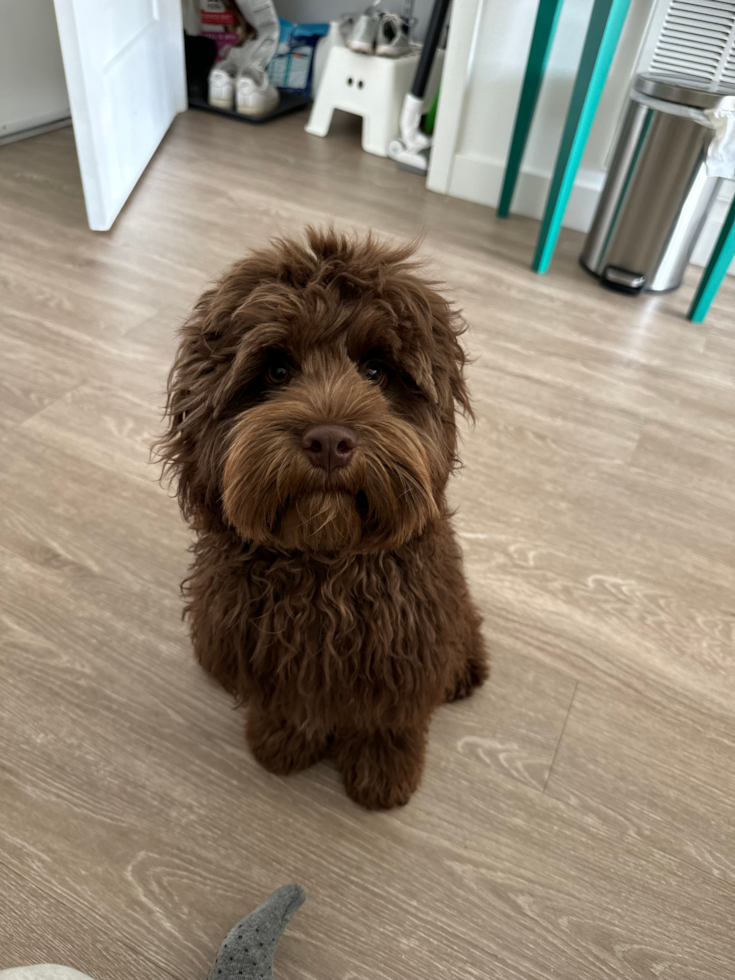
A Miniature-Poodle Cockapoo commonly stands around 10 to 15 inches and weighs about 12 to 25 pounds. The range can shift when Toy or Standard Poodles are used, which is why adult Cockapoo size online can appear inconsistent. For a puppy buyer, the height and weight of the actual parents give a better estimate than a generic Cockapoo chart.
The body is usually sturdy without appearing heavy. Cocker Spaniels have compact sporting frames designed for strength and endurance, while Poodles add a more square, athletic outline. A Cockapoo may therefore appear rounded and fluffy in a long coat but reveal a surprisingly capable body after a short haircut.
The face can lean toward either parent. Cocker influence may produce a broader muzzle, large round eyes, and long dropped ears, while stronger Poodle influence can narrow the muzzle and lengthen the overall head. Most still retain the friendly, open expression for which the cross is known.
Cockapoo Coat Type and Texture
Cockapoo coats can be straight, loosely wavy, or distinctly curly. The Cocker contributes silky hair and feathering, while the Poodle contributes dense curls. Many Cockapoos develop the soft fleece-like wave that has become closely associated with Doodle breeds.
The exact coat can change with generation. An F1 Cockapoo comes directly from a Cocker Spaniel and Poodle, while later generations and backcrosses may contain different proportions of Poodle ancestry. The Cockapoo Club of Great Britain notes that coat variation can be substantial, particularly in later generations, so two puppies from related lines may still mature with noticeably different textures.
Texture affects more than appearance. Curlier coats usually retain more loose hair within the coat and may leave less around the house, but they are also more likely to mat when brushing is inconsistent. Straighter coats may be easier to comb in some areas while releasing more visible hair.
Cockapoo Colors and Patterns
Cockapoos have a particularly broad color range because both Cocker Spaniels and Poodles contribute numerous colors. Red, apricot, cream, buff, chocolate, brown, black, white, and gold-related shades can appear, along with parti and multicolor patterns.
Cocker ancestry can add markings that look quite different from the Mini Aussiedoodle's merle patterns. English Cocker Spaniels, for example, come in black and white, liver and white, orange and white, various roans, solids, tan-point combinations, and several other patterns.
Roan is worth distinguishing from merle because the two are sometimes confused in casual puppy descriptions. Roan creates a fine mixture of colored and white hairs or ticking through parts of the coat, while merle produces irregular marbling and patches caused by a different genetic mechanism.
Some Cockapoo colors also change as the dog matures. Poodle ancestry can contribute fading, so a deep red or chocolate puppy may become considerably lighter during adulthood. Color is therefore better treated as part of the dog's appearance than as something guaranteed to remain exactly the same throughout life.
Cockapoo Eyes, Ears, and Expression
Cockapoos most commonly have brown or dark brown eyes. Depending on coat color and genetics, lighter brown or amber-like shades may occur, but dramatic blue or mismatched eyes are far less characteristic than they are in Mini Aussiedoodles.
The ears are one of the strongest spaniel features. American Cockers have long, heavily coated ears, while English Cockers also carry distinctive dropped ears framed by silky hair. Crossed with the Poodle, those ears can become especially full and fluffy.
That beautiful ear coat needs practical care. Hair and dropped ear leather can reduce airflow around the ear canal, so routine checking, drying after bathing or swimming, and veterinary attention when irritation appears are sensible parts of Cockapoo ownership.
Cockapoo Build and Size
The Cockapoo tends to be compact and sturdy. American Cocker Spaniels stand approximately 13.5 to 15.5 inches and weigh around 20 to 30 pounds, while English Cockers are somewhat taller and commonly weigh 26 to 34 pounds.
A Miniature Poodle can reduce the overall size while adding more leg and a squarer outline. The finished Cockapoo may therefore look compact and spaniel-like, slightly more refined and Poodle-shaped, or somewhere comfortably between the two.
This build works well for people who want a smaller dog without an extremely delicate frame. A 15- to 25-pound Cockapoo can still be easy to handle while having enough substance for active play, longer walks, and normal family adventures.
Cockapoo Shedding
Most Cockapoos are low-shedding compared with the Cocker Spaniel, but the amount varies with coat inheritance. Poodle-like curls can trap loose hair and reduce what reaches furniture and clothing, while a straighter spaniel-influenced coat may shed more visibly.
The Cockapoo Club of Great Britain notes that curlier coat types are less likely to shed and that every coat type still needs regular grooming. That distinction matters because low shedding is sometimes presented as though it automatically makes coat care easy. In reality, the hair that does not land on the sofa can become part of a mat if it stays trapped in the coat.
Low shedding also should not be treated as a guarantee for people with allergies. Dogs produce potential allergens through skin and saliva as well as hair, so individual reactions can vary even among dogs with very curly coats.
Cockapoo Grooming Needs
Cockapoos require consistent coat maintenance, and curlier dogs can become demanding when the coat is kept long. Brushing and combing several times a week helps prevent mats around the ears, legs, chest, tail, and areas where a harness or collar creates friction.
Cocker influence can add extra work around the ears and feathered areas. Purebred American Cockers already require thorough brushing, bathing, and trimming to keep their abundant coats in good condition. A Cockapoo may inherit less coat than a show Cocker, but owners should still expect professional grooming to be a routine expense rather than an occasional luxury.
A shorter puppy or teddy bear trim makes home care much easier. It does not eliminate brushing, but it reduces the amount of hair available to twist into knots and makes it easier to check the skin underneath.
Mini Aussiedoodle Appearance

Mini Aussiedoodles are usually somewhat taller and more athletic-looking than Cockapoos. Many stand around 12 to 18 inches and weigh approximately 15 to 35 pounds, although smaller adults occur depending on the Poodle parent, generation, and breeding line.
The Aussie side can create a stronger, more angular outline beneath the coat. Miniature American Shepherds are compact herding dogs built to move efficiently over difficult ground, so they carry more obvious working structure than a Cocker Spaniel. Poodle influence can add leg length and refinement without removing that athletic quality.
Some Mini Aussiedoodles look unmistakably Doodle-like, while others show strong shepherd features in the eyes, head shape, and markings. A short haircut makes those differences particularly easy to see.
Mini Aussiedoodle Coat Type and Texture
Mini Aussiedoodle coats can range from nearly straight to tightly curled. The Miniature Poodle contributes curl and density, while the Aussie side contributes a medium-length double coat with a longer outer layer and woolly undercoat. Miniature American Shepherds naturally shed a fair amount, especially during seasonal coat changes.
A wavy Mini Aussiedoodle may combine the two textures into a soft fleece coat. Curlier dogs can look much more Poodle-like, while straighter coats may preserve the feathering and movement of the Aussie coat.
The practical difference shows up during grooming. Dense curls can mat close to the skin, while a straighter dog with more undercoat may release more loose hair and need extra brushing during seasonal shedding periods.
Puppy coat is not always a reliable preview of the finished adult coat. Texture, density, and undercoat can become more obvious as the dog matures, so coat expectations should remain flexible during the first year.
Mini Aussiedoodle Colors and Merle Patterns
Color is one of the clearest visual differences between the Cockapoo vs Mini Aussiedoodle. Miniature American Shepherds come in four main colors: black, blue merle, red, and red merle, with white markings and tan points also possible.
The Poodle adds additional solid shades, which leaves Mini Aussiedoodles with a broad range of possible appearances. Black, brown, red, chocolate, gray, cream, white, blue merle, red merle, and multicolor combinations can all appear depending on the parents.
Merle creates irregular patches and marbling across the coat. No two merle patterns need to look alike, so puppies in the same broad color family can still have completely different markings.
The dramatic appearance is part of the breed's appeal, but color should remain secondary to health, structure, and temperament. A striking pattern has no bearing on whether the dog's activity level fits the household.
Mini Aussiedoodle Eye Color
Mini Aussiedoodles have considerably more eye-color variation than Cockapoos. Miniature American Shepherds can have brown, blue, hazel, amber, or differently colored eyes, and a single eye may contain more than one color.
A Mini Aussiedoodle may therefore have two brown eyes, two blue eyes, one of each, or partial blue coloring within a darker eye. These features are particularly noticeable in some merle dogs, although merle coloring does not guarantee blue eyes.
That variety gives the Mini Aussiedoodle a more distinctive and sometimes more intense expression than the softer spaniel-influenced Cockapoo face.
Mini Aussiedoodle Build and Size
The Mini Aussiedoodle usually has the more athletic frame. Miniature American Shepherds stand 13 to 18 inches depending on sex and weigh around 20 to 40 pounds, yet they retain the structure and agility of true herding dogs.
Crossing with a Miniature Poodle usually keeps the finished dog compact while preserving plenty of physical ability. Many Mini Aussiedoodles have enough speed, coordination, and stamina for hiking, agility-style activities, retrieving games, and long exploratory walks.
That does not mean every dog needs intense exercise. It means the body is built for considerably more than a few circles around the living room.
Mini Aussiedoodle Shedding
Mini Aussiedoodles can be low-shedding, but there is more room for variation than the fluffy Doodle appearance sometimes suggests. Poodles release relatively little visible hair, while the Miniature American Shepherd has a double coat that sheds throughout the year and more heavily once or twice annually.
A dog with a strongly Poodle-like coat may leave very little hair around the home. Another with looser waves and more undercoat may shed enough that regular vacuuming becomes part of life.
Generation can influence probability but does not create certainty. Looking at the parents and adult dogs from similar pairings gives a more useful picture than assuming every Mini Aussiedoodle will have the same shedding level.
Mini Aussiedoodle Grooming Needs
Grooming requirements depend heavily on which coat the Mini Aussiedoodle inherits. Wavy and curly coats need thorough brushing because mats can form under the surface where they are difficult to see. Areas around the ears, armpits, collar, legs, and tail deserve particular attention.
Dogs with more Aussie-style coat may require less trimming but more seasonal coat removal. The Miniature American Shepherd's double coat benefits from weekly brushing during normal periods and more frequent brushing when the undercoat sheds heavily.
Furnished Mini Aussiedoodles commonly need professional grooming if owners want to maintain the classic Doodle trim. A shorter haircut reduces tangling, but there is no coat type in this cross that should be treated as completely maintenance-free.
Cockapoo vs Mini Aussiedoodle Appearance Comparison: What Is the Difference?
The Cockapoo usually has the softer spaniel look, with large brown eyes, long floppy ears, a compact frame, and colors that can include red, apricot, buff, chocolate, black, cream, parti, and roan-influenced patterns. The Mini Aussiedoodle tends to look more athletic, with greater potential for striking contrast between markings and a wider range of eye colors.
Size overlaps, but the Mini Aussiedoodle has more potential to become the larger dog. A Cockapoo from a Cocker Spaniel and Miniature Poodle commonly remains in the low-to-mid 20-pound range, while Mini Aussiedoodles can move comfortably above that depending on their parent lines.
The coat question is less straightforward. Both can have curls or waves, and both can shed lightly when Poodle coat traits dominate. The Mini Aussiedoodle has more potential for a true shedding undercoat because of its Aussie parent, while the Cockapoo may inherit a straighter silky coat from the Cocker that also releases visible hair.
Appearance may make the Mini Aussiedoodle seem like the more dramatic choice, especially if merle or unusual eyes appeal to you. The Cockapoo has its own kind of variety, though, particularly through spaniel colors, roan patterns, and the fuller ears that give the breed its classic cheerful expression.
Cockapoo vs Mini Aussiedoodle Temperament
This is where the comparison becomes much more useful than simply asking which dog has the prettier coat. Cockapoos and Mini Aussiedoodles are both intelligent, affectionate, active dogs, yet the instincts beneath those traits come from different working traditions.
The Cockapoo combines a retriever-water-dog background from the Poodle with sporting-spaniel ancestry from the Cocker. The Mini Aussiedoodle combines Poodle intelligence with a dog developed to control livestock. One cross may be more drawn to scents, retrieving, and exploration; the other may be more interested in movement, patterns, environmental changes, and keeping track of everyone nearby.
Both can become wonderful family dogs. The better match depends on what kind of activity and interaction you actually enjoy.
Cockapoo Temperament
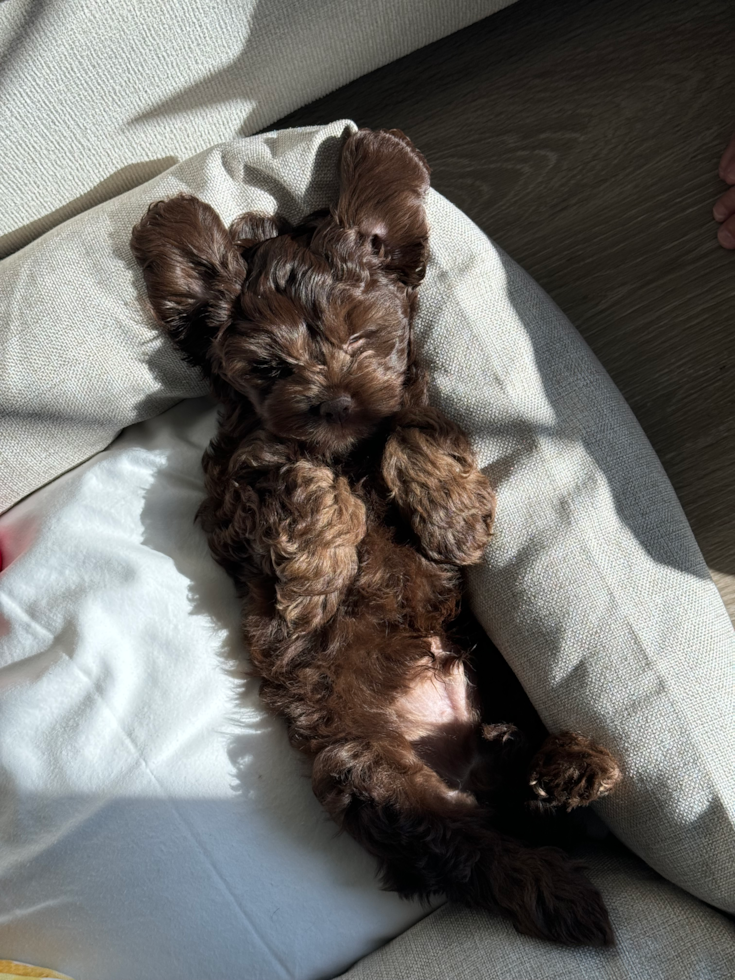
Cockapoos are known for cheerful, affectionate personalities. Cocker Spaniels are famously described as merry dogs, and the Poodle adds intelligence, responsiveness, and a playful streak. The result can be a companion that enjoys meeting people, participating in family life, and turning almost any ordinary activity into something worth getting excited about.
Many Cockapoos combine activity with a useful ability to settle. Their sporting background gives them enough stamina for proper walks, games, and outdoor adventures, but a well-exercised adult can also be very content to spend part of the day relaxing with the family.
The exact temperament depends partly on the Cocker line. A working English Cocker-based Cockapoo may have considerably more drive than one produced from a calmer American show Cocker. That difference is worth asking about because “Cockapoo” alone does not tell you how strongly sporting instincts may appear.
Cockapoo Affection and Social Nature
Cockapoos are deeply people-oriented dogs. Both Cocker Spaniels and Poodles form close relationships with humans, so their cross may follow family members from room to room, seek regular physical affection, and show genuine enthusiasm when someone suggests a walk or game.
That affection can extend beyond the immediate household. Properly socialized Cockapoos are frequently friendly with visitors and comfortable in social settings, especially when the Cocker side carries its characteristic cheerful openness.
Individual dogs can still be cautious with strangers, particularly during adolescence or when early socialization has been limited. Positive exposure to different people and environments gives the puppy a better chance to grow into the sociable adult many families expect.
Cockapoo Energy Level
Cockapoos usually have moderate to moderately high energy. Cocker Spaniels are Sporting Group dogs that enjoy brisk walks, retrieving games, and family activity, while Poodles contribute their own athleticism.
The important distinction is that Cockapoo energy can feel playful and exploratory rather than relentlessly work-focused. Many are happy to walk, sniff, chase a ball, investigate a trail, and then settle once those needs have been met.
A dog with strong working Cocker influence may sit at the higher end of the range. Those Cockapoos may need longer outings and more opportunities to use their nose or retrieve, which makes parent temperament particularly valuable information.
Sporting and Scent Instincts in Cockapoos
Cocker Spaniels were developed to work through vegetation and flush birds for hunters. The name “Cocker” itself is tied to the breed's historic work with woodcock, and the modern breed still retains enough working ability to participate in hunting, obedience, agility, and other sports.
A Cockapoo may inherit an interest in scents, birds, retrieving, or exploring bushes and tall grass. Some carry toys from room to room, love fetch almost immediately, or turn every walk into a careful investigation of whoever passed through the neighborhood six hours earlier.
These behaviors are usually easy to channel. Fetch, scent searches, hidden treats, recall practice, and allowing the dog time to sniff during walks can satisfy instincts without requiring anyone in the household to become a bird hunter.
Reliable recall deserves attention, especially with dogs that become absorbed in scents. An interesting trail can compete surprisingly well with a human calling from the other side of the field.
Cockapoo Intelligence and Training
Cockapoos are highly trainable. Cocker Spaniels are intelligent and eager to please, while Poodles bring even more problem-solving ability. Positive reinforcement suits both parent breeds and works particularly well with a dog that values food, play, praise, and interaction.
Basic training should cover more than sit and down. Recall, loose-leash walking, waiting at doors, handling, grooming cooperation, settling, and independence all make a larger difference to everyday life.
Cockapoos can also enjoy advanced tricks, scent games, retrieving, agility foundations, and obedience work. The dog does not need a complicated training program, but regular mental activity helps prevent a clever puppy from inventing entertainment that the household may appreciate less.
Cockapoos With Children
Cockapoos can be excellent family companions. Cocker Spaniels are affectionate dogs that enjoy playing with children, and the Cockapoo's sturdy small-to-medium frame can be practical in a busy household.
Supervision still matters. A small Cockapoo can be frightened or hurt by rough play, while an excited adolescent dog can accidentally knock into a young child during a burst of enthusiasm.
Older children may find Cockapoos particularly fun because the dog can participate in fetch, walks, trick training, and outdoor games. Giving children appropriate ways to interact with the dog creates a much better relationship than expecting endless cuddling to be the main activity.
Cockapoos With Other Dogs and Pets
Cockapoos usually have strong potential in multi-dog homes. Cocker Spaniels are social dogs that commonly enjoy canine company, while Poodles can also live comfortably with other dogs when well socialized.
Cats can fit into the household too, especially when the puppy grows up around them. The sporting side may produce more interest in fast-moving animals, so calm introductions and early boundaries are still useful.
Smaller pets deserve more caution. A dog with noticeable bird or prey interest may be too curious around free-roaming rabbits, rodents, or pet birds even when its intentions look playful.
Cockapoo Barking and Alone Time
Cockapoos can bark to alert, during excitement, or because they have learned that noise earns attention. Their social nature also means some dislike being left alone for long periods, especially if independence was never practiced during puppyhood.
A healthy routine should include short periods when the dog rests or entertains itself away from the owner. That matters even in work-from-home households because a puppy that has company every minute can struggle when schedules eventually change.
The goal is not to make the Cockapoo less social. It is to teach a social dog that quiet independence is another normal part of the day.
Mini Aussiedoodle Temperament
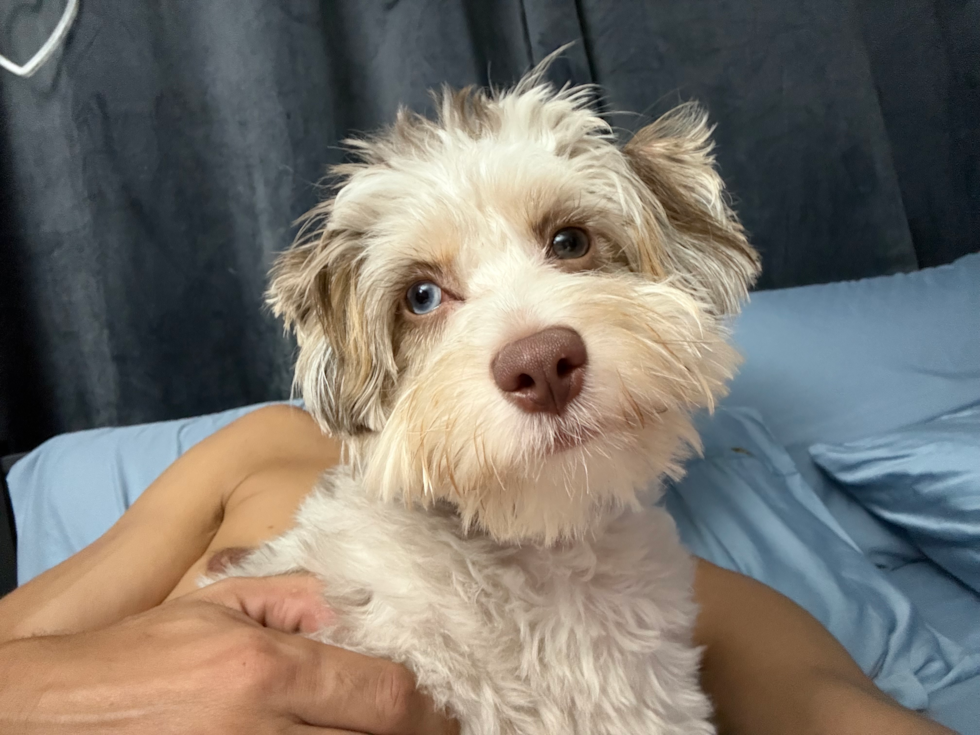
The Mini Aussiedoodle is also affectionate and playful, but it brings more herding-style intensity into the relationship. Miniature American Shepherds are bright, self-motivated workers with strong loyalty to their families, while Poodles add another layer of intelligence and responsiveness.
This can produce a dog that notices everything. A Mini Aussiedoodle may learn the household schedule without formal teaching, recognize which shoes predict a walk, monitor people moving from room to room, and spot a new object in the yard before anyone else has registered that it exists.
That awareness can be delightful for someone who enjoys an interactive dog. It can also create challenges when a highly intelligent puppy has too much free time and too little direction.
Mini Aussiedoodle Intelligence and Training
Mini Aussiedoodles can be exceptionally quick learners. Both parents have histories that required close cooperation with humans, problem-solving, and physical coordination, so training can progress rapidly when rewards and expectations are clear.
Their intelligence should not be confused with automatic obedience. Herding breeds were also selected to make decisions while working, and a Mini Aussiedoodle may become very good at evaluating whether a cue is worth following in the current situation.
Consistency matters. If getting off the sofa is required on Monday but optional on Tuesday, the dog may decide Wednesday's rule needs further negotiation.
Training works best when it stays varied and useful. Obedience, tricks, scent games, retrieval, place training, recall, and simple agility exercises can all give the dog productive ways to use its brain.
Mini Aussiedoodle Energy Level
Mini Aussiedoodles usually have more sustained energy than Cockapoos. Miniature American Shepherds are active, athletic herding dogs that need physical exercise and mental stimulation, and they can excel in obedience, agility, tracking, hiking, and scent work.
The solution is not endless running. Too much repetitive physical exercise can simply create a fitter dog that still has an active mind. A more balanced routine combines walking, sniffing, training, games, exploration, and time to settle.
A satisfied Mini Aussiedoodle can relax very well indoors. The challenge comes when owners expect the off switch to appear without first giving the dog enough meaningful activity.
Herding Behavior in Mini Aussiedoodles
The herding side is the most important temperament difference in this comparison. Miniature American Shepherds were developed to control livestock and retain instincts that direct them toward movement. The AKC even notes that they may attempt to herd children.
In a Mini Aussiedoodle, that may appear as circling, chasing running children, following another dog closely, blocking movement, or paying unusual attention to feet and ankles during excited play. Some puppies show almost none of these behaviors, while others make their ancestry very obvious.
Early training turns these tendencies into something manageable. Recall, impulse control, place work, toy-based games, and clear interruption of heel-focused behavior give the dog alternative responses.
Herding instinct is not aggression. It is a working behavior that needs an appropriate outlet, especially in a family where children or other pets create constant movement.
Mini Aussiedoodle Affection and Family Attachment
Mini Aussiedoodles can be deeply affectionate with their families. Miniature American Shepherds are known for loyalty and strong bonds, while Poodles also form close relationships with their people.
The attachment may feel more focused than the easy sociability seen in many Cockapoos. Some Mini Aussiedoodles are friendly with everyone, while others reserve their strongest enthusiasm for family and take more time to evaluate unfamiliar people.
Early socialization is important for that reason. Positive exposure to visitors, different environments, children, friendly dogs, traffic, grooming, and normal household sounds can help a naturally observant puppy grow into a confident adult.
Once the day's needs are met, these dogs can be very cuddly. The herding background adds drive, not an absence of affection.
Mini Aussiedoodles With Children
Mini Aussiedoodles can be excellent dogs for active families, particularly when children are old enough to take part in walks, games, and training. Their sturdy build can also feel more practical than that of some very small companion crosses.
The extra consideration is movement. Running children can trigger chasing or herding behavior, and an excited young dog may try to control the game rather than simply participate in it.
Adults should intervene early if ankle nipping, circling, or persistent chasing begins. A behavior that seems funny in a ten-week-old puppy becomes much less amusing when the dog is larger, faster, and convinced that the children belong in a neat group.
For older children who enjoy interacting with a dog, the intelligence can be a huge advantage. Trick training, search games, fetch, and simple obstacle courses give both child and dog something constructive to do together.
Mini Aussiedoodles With Other Dogs and Pets
Mini Aussiedoodles can thrive in multi-dog households, especially when the dogs have compatible energy levels. An active canine companion may appreciate a Mini Aussiedoodle's desire to play and explore.
Quieter animals may find the herding style more intrusive. A Mini Aussiedoodle that repeatedly circles, stares at, or blocks another dog may be acting on instinct rather than hostility, but the other dog may still dislike the attention.
Cats can live successfully with this cross when the puppy learns boundaries early. Giving the cat escape areas and rewarding calm behavior around movement reduces the likelihood that chasing becomes a favorite household game.
Mini Aussiedoodle Alertness and Barking
Mini Aussiedoodles are likely to notice changes in their environment quickly. Miniature American Shepherds have natural guardian awareness and may bark to announce strangers or unusual activity.
That alertness can be useful without needing to become excessive. Teaching a dog that one or two barks are enough, then rewarding quiet behavior, works better than allowing the front window to become a full-time observation post.
Mental boredom can make alert behavior worse. A dog with nothing useful to think about may decide that monitoring every passerby, car door, bird, and blowing leaf is an important job.
Cockapoo vs Mini Aussiedoodle Temperament Comparison: The Main Differences
The Cockapoo and Mini Aussiedoodle are both intelligent and active, which makes this comparison more nuanced than simply calling one energetic and the other calm. The difference lies in what drives that activity and how the dog interacts with the world.
The Cockapoo brings sporting instincts. Its attention may be pulled toward scents, retrieving, birds, bushes, water, toys, and whatever interesting trail appears during a walk. The Mini Aussiedoodle brings herding instincts, so its attention may focus more heavily on movement, people, animals, routines, and changes in the surrounding environment.
Social style can differ too. Cockapoos commonly inherit the Cocker's cheerful, open personality and may warm up readily to new people. Mini Aussiedoodles can be just as affectionate but may be more discerning with strangers, particularly when the shepherd side is strong.
The Mini Aussiedoodle also has the greater need for deliberate mental engagement. A Cockapoo benefits from puzzles, training, and scent games, but many are satisfied with a balanced family routine. The Mini Aussiedoodle is more likely to turn the lack of a project into a project of its own.
Cockapoo vs Mini Aussiedoodle: Which One Should You Choose?
The Cockapoo and Mini Aussiedoodle both suit people who want an intelligent dog that participates in family life. Neither is an ideal choice for someone looking for a very independent pet that needs little interaction, and both require more grooming than their low-shedding reputation may suggest. The choice becomes clearer when you consider how you prefer to spend time with your dog.
Cockapoos lean toward cheerful companionship with a sporty edge. Mini Aussiedoodles lean toward active partnership, with more emphasis on training, observation, and mental engagement.
Choose a Cockapoo if You Want an Active but Sociable Companion
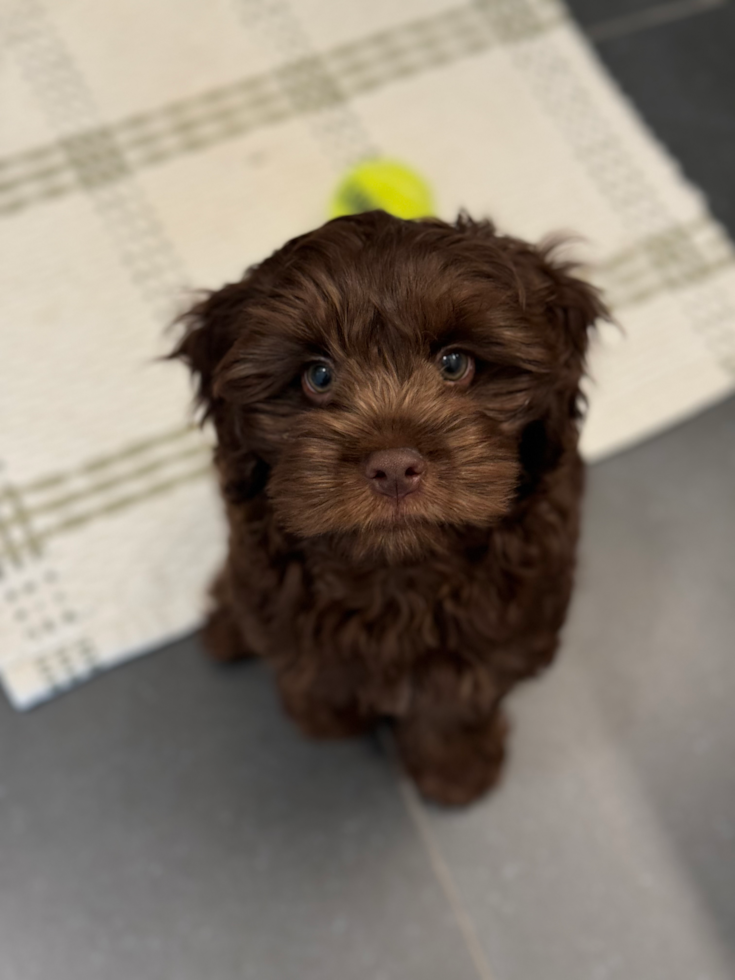
A Cockapoo puppy may suit you better if you want a dog that enjoys proper walks, fetch, exploration, and training but can also fit into a broad range of family routines. Cocker ancestry adds physical ability without automatically creating the same level of mental intensity found in many herding dogs.
Cockapoos can work particularly well for people who enjoy an active companion but still value easy sociability. A well-socialized dog may greet visitors cheerfully, enjoy other dogs, and transition between adventure and quiet family time without needing a new task every hour.
This cross also makes sense for people drawn to sporting dogs but who want a smaller package. A Miniature-Poodle Cockapoo has enough sturdiness for outdoor activity while remaining manageable for apartments, travel, and everyday handling.
Choose a Mini Aussiedoodle if You Want a Highly Interactive Dog

A Mini Aussiedoodle puppy may suit you better if training, hiking, games, and dog-centered activities sound like part of the enjoyment of ownership. These dogs can be remarkably rewarding when their owners like teaching and interacting rather than expecting the dog to spend most of the day entertaining itself.
The cross has particular appeal for someone who loves the intelligence and responsiveness of herding breeds but wants a smaller body and Poodle coat influence. A Mini Aussiedoodle can offer a surprising amount of athletic ability without reaching the size of a full Australian Shepherd.
Mental engagement matters as much as physical exercise. A fifteen-minute scent game or focused training session can add more value to the dog's day than another repetitive walk around the same block.
This is also the dog for someone comfortable setting clear boundaries. Intelligent, observant dogs notice inconsistency quickly, and a Mini Aussiedoodle can become very skilled at training the humans if nobody has established who is teaching whom.
Which Is Calmer: Cockapoo or Mini Aussiedoodle?
The Cockapoo is usually the easier fit for someone who prioritizes calmness, although neither cross is naturally sedentary. Cocker Spaniels balance sporting energy with a strong companion side, and many Cockapoos settle well once they have walked, played, and spent time with their people.
The Mini Aussiedoodle can develop an excellent off switch too, but it may require more deliberate work to get there. Physical exercise alone may not be enough when the dog still has unused mental energy.
Parent lines can narrow or widen the difference. A working-Cocker Cockapoo may be every bit as busy as some Mini Aussiedoodles, while a more moderate Mini Aussie pairing can produce a relatively adaptable dog.
If calm indoor behavior is a major priority, ask about the temperament of both parents rather than choosing solely from the average description.
Which Is More Energetic?
The Mini Aussiedoodle has the advantage for sustained activity and mental drive. Its herding parent was developed for work that requires constant attention and decision-making, while the Poodle adds additional athleticism.
Cockapoos remain energetic enough for long walks, fetch, swimming, and outdoor adventures. English or working Cocker ancestry can push that energy considerably higher, so the cross should not be mistaken for a low-exercise lapdog.
The difference becomes most noticeable in what happens after the walk. Many Cockapoos are happy to settle after a satisfying outing, while a Mini Aussiedoodle may still appreciate a short training session or puzzle before declaring the day's work complete.
For consistently active owners, both can work. The Mini Aussiedoodle simply offers more capacity for a lifestyle where dog-centered activity is a regular feature rather than an occasional weekend event.
Which Is Easier to Train?
Both are highly trainable, but the Mini Aussiedoodle may learn complex tasks faster because both sides of the cross come from strongly work-oriented backgrounds. Pattern recognition, problem-solving, and responsiveness can make training progress remarkably quickly.
That does not necessarily make the Mini Aussiedoodle easier for every owner. A clever dog also notices inconsistency, boredom, and opportunities to make its own decisions. The Cockapoo may be more forgiving for someone whose goals center on reliable household manners and pleasant everyday behavior.
Cockapoos are still excellent training partners. Cocker Spaniels are eager to please and food-motivated, and Poodles add plenty of mental ability.
If training itself is one of your hobbies, the Mini Aussiedoodle may offer more depth. If you mainly want a responsive family dog that learns what it needs to know without turning obedience into a major pastime, the Cockapoo may feel simpler.
Which Is Better for First-Time Dog Owners?
The Cockapoo usually has the easier first-time-owner profile, particularly when it comes from moderate companion-oriented lines. It is intelligent and active but may ask less of an inexperienced owner in terms of herding management, impulse-control work, and mental enrichment.
A Mini Aussiedoodle can still make an excellent first dog for someone willing to learn. A motivated beginner who genuinely likes the idea of daily training, enrichment, and structured activity may find the dog extraordinarily rewarding.
The wrong match happens when “Mini” and “Doodle” are interpreted as meaning easy. A Mini Aussiedoodle can package serious working intelligence into a relatively compact body.
Grooming also deserves consideration with both. A first-time owner needs to learn brushing, coat maintenance, ear care, and professional grooming schedules regardless of which cross comes home.
Which Is Better With Children?
Both crosses can be wonderful family dogs. The Cockapoo may have the simpler advantage with younger children because Cocker Spaniels combine playfulness with a gentle, family-oriented temperament and do not bring herding behavior into the mix.
Mini Aussiedoodles can be tremendous companions for children too, especially older kids who want to teach tricks, play games, hike, or participate in training. Their sturdier athletic build also stands up well to an active household.
The extra responsibility is managing herding behavior. Running children can trigger chasing, circling, or interest in ankles, which needs early redirection before the puppy rehearses the behavior repeatedly.
Whichever cross you choose, children should learn how to give a dog space, avoid rough handling, and respect sleep and meal times. A family-friendly dog still deserves boundaries.
Which Is Better With Cats?
The Cockapoo may have a slight advantage with cats because it lacks the Mini Aussiedoodle's herding instinct. A Cockapoo can certainly chase, especially when sporting ancestry creates interest in movement, but the behavior is less likely to center on controlling another animal's motion.
Mini Aussiedoodles can live very happily with cats when introductions begin early and calmly. The key is preventing chasing from becoming rewarding before good habits have a chance to form.
A confident cat with high escape areas usually has an easier time setting boundaries than a nervous cat that runs whenever the puppy approaches. Management matters more than simply hoping the animals work things out.
Neither cross should be assumed safe around very small free-roaming pets. Sporting and herding ancestry can both create strong interest in movement.
Which Is Better With Other Dogs?
Both can thrive in multi-dog households, but their play styles may differ. Cockapoos commonly bring social enthusiasm and can be happy wrestling, chasing toys, or simply sharing the household with another dog.
Mini Aussiedoodles may interact more intensely. Some monitor, circle, or try to control another dog's movement during play, which can be great fun for an equally active companion and deeply annoying for a quiet senior dog.
Matching energy and play style matters more than choosing one cross over the other. A calm adult Cockapoo may be a poor match for a nonstop adolescent of either breed, just as two energetic young dogs may become inseparable.
Early socialization and supervised introductions allow owners to shape polite behavior before habits settle in.
Which Sheds Less: Cockapoo or Mini Aussiedoodle?
The Cockapoo may offer slightly more predictable low-shedding potential, but there is no universal winner. Both have Poodle ancestry, while both non-Poodle parents naturally shed.
The difference is that the Mini Aussie side contributes a true double coat with a woolly underlayer. Miniature American Shepherds shed a fair amount and experience heavier seasonal periods, so a Mini Aussiedoodle that inherits more of that coat can release noticeable hair.
Cocker Spaniels also shed, but a curly Cockapoo may retain much of that loose hair within the coat. A straight-coated Cockapoo can still shed more than a strongly Poodle-coated Mini Aussiedoodle.
If loose hair matters greatly, inspect the puppy's coat, parents, generation, and adult relatives rather than relying on the mix name. Genetics are more informative than marketing labels.
Which Needs More Grooming?
Both require enough grooming that this category should be considered close to a tie. The main difference is the kind of maintenance rather than the total commitment.
Cockapoos can inherit thick, silky spaniel hair combined with Poodle curl, which creates excellent conditions for mats. Their long ears may also need extra attention, especially after swimming and bathing.
Mini Aussiedoodles with curly coats face similar matting problems. Straighter dogs may require less trimming but more undercoat removal as loose hair works free.
For either cross, a short practical haircut reduces maintenance. Owners who want the full fluffy Doodle look should expect regular brushing and professional grooming throughout the dog's life.
Which Is Better for an Active Lifestyle?
The Mini Aussiedoodle has the advantage for someone whose lifestyle is consistently active. Hiking, advanced training, agility-style games, scent work, and long exploratory outings all make good use of the breed's combination of shepherd and Poodle ancestry.
A Cockapoo can still be a very capable adventure dog. Cocker Spaniels are sporting dogs with real stamina, and dogs from English or working lines may happily tackle long days outdoors.
The difference is that the Mini Aussiedoodle may need those outlets more strongly rather than simply enjoy them. An active routine is closer to a requirement for some individuals.
If your outdoor hobbies happen every week, either can work. If they mostly exist on a list of things you hope to start someday, choosing based on your current routine is much safer.
Which Is Better for Apartment Living?
The Cockapoo is generally easier to fit into apartment life, especially when it falls in the smaller end of the size range. Its exercise needs are substantial enough to encourage daily outings without automatically demanding the level of mental work some Mini Aussiedoodles need.
Mini Aussiedoodles can live successfully in apartments too. Miniature American Shepherds themselves can adapt to city life when owners provide sufficient exercise and activities that occupy both mind and body.
A yard is not the deciding factor. A bored Mini Aussiedoodle in a large yard may be less satisfied than one in an apartment that gets walks, training, sniffing, and genuine interaction.
Noise is worth considering in shared buildings. The Mini Aussiedoodle's greater environmental awareness can make hallway sounds and neighboring doors very interesting, so calm alert training pays off early.
Which Is More Likely to Bark?
The Mini Aussiedoodle may have the greater tendency toward alert barking because shepherds were bred to remain aware of their surroundings. Miniature American Shepherds commonly bark to announce strangers or perceived changes around the home.
Cockapoos can be vocal too, particularly when excited, bored, or seeking attention. A dog that discovers barking makes humans respond may quickly decide it is an excellent communication strategy.
Training and lifestyle can matter as much as genetics. Adequate exercise, calm exposure to normal sounds, and rewarding quiet behavior give both crosses a much better chance of developing reasonable barking habits.
No small-to-medium Doodle should be expected to arrive with a built-in mute button.
Which Is More Affectionate?
Both crosses can be deeply affectionate, but the Cockapoo may feel more openly social, while the Mini Aussiedoodle may show a more focused family loyalty. Cocker Spaniels have a cheerful, people-friendly temperament and commonly enjoy attention from both family members and familiar visitors.
Mini Aussiedoodles can be extremely cuddly but may evaluate strangers more carefully. The Miniature American Shepherd is devoted to family and can be reserved with unfamiliar people until socialization builds confidence.
Neither style means one dog loves its family more. They simply express social interest differently.
For someone who wants a dog likely to greet friends enthusiastically, the Cockapoo may have the edge. For someone who enjoys a dog that keeps particularly close tabs on its own people, the Mini Aussiedoodle may feel especially rewarding.
Which Is Better for Someone Who Works From Home?
Both crosses love human company, but working from home can create different challenges. A Cockapoo may be happy to nap near a desk once it has had a walk and some interaction, though young dogs still need breaks and activity.
A Mini Aussiedoodle may require more deliberate structure. Simply watching someone type for six hours is not meaningful mental stimulation, regardless of how close the dog's bed is to the computer.
A good work-from-home routine might include exercise before work, a food puzzle or chew during a meeting, a short training session at lunch, and another outing later in the day. That structure can make the Mini Aussiedoodle an excellent home-office companion.
Independence practice matters for both. Dogs should still learn that they can rest alone even when their person is technically available.
Which Is Better for Seniors?
The Cockapoo is usually the easier match for seniors, particularly for someone who wants an affectionate dog that enjoys walking without requiring a highly structured activity program. A smaller Miniature-Poodle Cockapoo is also relatively easy to handle physically.
An active older adult could thoroughly enjoy a Mini Aussiedoodle. Someone who hikes, walks long distances, enjoys training, or wants a dog involved in daily outdoor life may find the extra intelligence and energy appealing.
The question is not age so much as routine. A quiet 40-year-old and an active 70-year-old may need completely different dogs.
For anyone concerned about managing puppy energy, an adult dog with a known temperament may be easier to match than either cross as an eight-week-old puppy.
Which Can Handle Longer Walks and Adventures Better?
Both are capable dogs, but the Mini Aussiedoodle usually has the advantage for sustained outdoor activity. Its shepherd ancestry contributes stamina, agility, and interest in working alongside people for extended periods.
Cockapoos are no slouches. The Cocker Spaniel was designed to work through dense terrain, and English Cockers in particular remain athletic sporting dogs with real endurance.
A healthy adult Cockapoo can make an excellent hiking or travel companion, especially when conditioned gradually. A Mini Aussiedoodle is simply more likely to view repeated physical and mental challenges as exactly what the day was missing.
Body size and weather still matter. Smaller dogs, young puppies, seniors, and dogs with medical limitations should have exercise adjusted to the individual rather than to the breed label.
Cockapoo vs Mini Aussiedoodle: The Final Comparison
Choosing between a Cockapoo vs Mini Aussiedoodle comes down to more than deciding which Doodle is smarter, cuter, or more active. Both are bright, affectionate dogs with genuine working ability behind the fluffy coat. The meaningful difference is the kind of instincts that shape how they use that intelligence.
The Cockapoo combines Poodle trainability with the cheerful character and sporting history of the Cocker Spaniel. It is usually social, playful, curious, and eager to join family activities. Many enjoy retrieving, sniffing, exploring, and longer walks while still transitioning comfortably into relaxed companion mode once the fun is over.
The Mini Aussiedoodle combines Poodle intelligence with the alertness and working drive of a herding dog. It is likely to watch the household more closely, need more deliberate mental stimulation, and show greater interest in structured activity. Herding tendencies can appear around children or other pets, but thoughtful training gives those instincts appropriate boundaries.
Size will not always settle the choice because the ranges overlap. Grooming will not either, since both can develop demanding wavy or curly coats. Even shedding depends more heavily on individual coat genetics than on the name attached to the cross.
The better dividing line is how much involvement you want from your dog.
If you picture long walks, a good game of fetch, family outings, friendly social encounters, and then a dog curled up nearby while the evening slows down, the Cockapoo may feel very natural. It gives you an active companion without necessarily asking you to turn dog training into one of your main hobbies.
If your idea of fun includes teaching new behaviors, building reliable off-leash skills, exploring new trails, setting up scent games, and giving a very clever dog regular challenges, the Mini Aussiedoodle may be the more satisfying match. For the right person, that intensity is part of the appeal rather than extra work.
Parentage deserves one final look before making the decision. A Cockapoo from working English Cocker lines may be much more energetic than a dog from calm American Cocker parents. A Mini Aussiedoodle from highly driven Aussie lines can also require more engagement than one produced from moderate companion-oriented parents.
The Cockapoo vs Mini Aussiedoodle comparison gets you close. The temperament, size, coat, and working style of the actual parents tell you what the puppy is most likely to bring into your home.
Frequently Asked Questions
What is the main difference between a Cockapoo and Mini Aussiedoodle? A Cockapoo combines a Cocker Spaniel with a Poodle, while a Mini Aussiedoodle combines a Mini Aussie-type dog with a Miniature Poodle. The Cockapoo usually brings more sporting-spaniel traits such as retrieving interest, scent curiosity, and cheerful sociability, while the Mini Aussiedoodle has more potential for herding behavior, environmental awareness, and sustained mental drive. Both are intelligent and affectionate, so the distinction is less about one being smart and the other being friendly. It is about how each dog tends to use its energy and attention.
Which is bigger, a Cockapoo or Mini Aussiedoodle? The Mini Aussiedoodle is commonly the larger dog, though the ranges overlap. Many Miniature-Poodle Cockapoos weigh around 12 to 25 pounds, while Mini Aussiedoodles frequently fall around 15 to 35 pounds. Cockapoo size can change substantially when Toy or Standard Poodles are used, so the exact parents matter. The same is true for Mini Aussiedoodles, particularly when smaller backcross lines are involved.
Which is calmer, a Cockapoo or Mini Aussiedoodle? The Cockapoo usually has the easier off switch. It still needs daily exercise and mental stimulation, but many adults settle comfortably after a satisfying walk, play session, or family outing. Mini Aussiedoodles can relax very well too, but they may need more deliberate mental work before they are ready to switch off. A bored herding-Poodle cross can remain physically still while its brain is very busy looking for something to do.
Which is more energetic, a Cockapoo or Mini Aussiedoodle? The Mini Aussiedoodle is usually more demanding in terms of sustained physical and mental activity. Mini Aussie-type dogs come from herding backgrounds, while Poodles add further athletic ability and trainability. Cockapoos are still active dogs, especially when English or working Cocker ancestry is involved. They simply tend to channel more of their activity toward play, retrieving, scent exploration, and general family adventures rather than constant observation and problem-solving.
Which is easier to train, a Cockapoo or Mini Aussiedoodle? Both are excellent learners. The Mini Aussiedoodle may grasp complex behaviors faster because both parent breeds have strong working backgrounds, while the Cockapoo combines Poodle intelligence with a Cocker Spaniel's eagerness to please. For a first-time owner, the Cockapoo may actually feel easier because it can be more forgiving of small inconsistencies. A Mini Aussiedoodle may learn the intended rule quickly and notice every exception just as fast.
Which sheds less, a Cockapoo or Mini Aussiedoodle? There is no guaranteed winner because both crosses can inherit straight, wavy, or curly coats. A strongly Poodle-coated dog of either cross may shed very little, while a straighter dog can release more visible hair. The Mini Aussiedoodle has more potential to inherit a noticeable undercoat because Miniature American Shepherds have double coats and shed seasonally. The Cockapoo may therefore be somewhat more predictable for low shedding in some lines, but individual coat genetics remain more important than the cross name.
Which is better with children, a Cockapoo or Mini Aussiedoodle? Both can make excellent family dogs. The Cockapoo may be slightly easier around young children because it does not bring strong herding instincts into the cross, while Mini Aussiedoodles can become particularly fun companions for older children who enjoy training and active play. Families with a Mini Aussiedoodle should watch for chasing, circling, or heel-focused behavior when children run. These are manageable herding traits rather than signs that the dog is unsuitable for family life, but they deserve early training.
Which is better for apartment living, a Cockapoo or Mini Aussiedoodle? The Cockapoo usually fits apartment life more easily because it tends to be somewhat smaller and requires less intensive mental engagement. Daily walks, play, training, and human company can make a Cockapoo perfectly comfortable without a yard. Mini Aussiedoodles can also thrive in apartments when their owners are active and intentional about enrichment. Square footage matters much less than whether the dog gets enough physical exercise, training, sniffing, and opportunities to use its brain.
Does a Mini Aussiedoodle need more mental stimulation than a Cockapoo? In many cases, yes. Mini Aussiedoodles combine two highly trainable working backgrounds, and the herding side in particular can create a dog that pays close attention to patterns, movement, and changes in its environment. Cockapoos benefit from mental stimulation too and can excel at puzzles, scent games, tricks, and retrieving. The difference is that a Mini Aussiedoodle is more likely to treat regular brain work as a genuine need rather than an enjoyable bonus.
Should I choose a Cockapoo or Mini Aussiedoodle? Choose a Cockapoo if you want an affectionate, sociable dog that enjoys activity, training, retrieving, and exploration but usually balances those interests well with relaxed family time. It can be an especially good fit for first-time owners, social households, and people who want an active companion without strong herding behavior. Choose a Mini Aussiedoodle if you want a highly intelligent, athletic dog and genuinely enjoy training, outdoor activities, and mental challenges. Both crosses need grooming, exercise, and close family involvement, but the Mini Aussiedoodle asks for more deliberate engagement while the Cockapoo usually offers the more flexible everyday rhythm.