





Published Monday, October 5, 2026 by Pilesgrove Pups
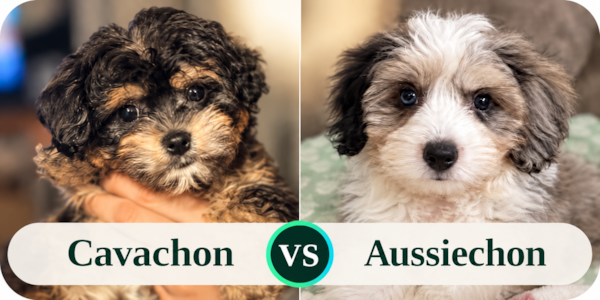
The Cavachon vs Aussiechon comparison can be tricky at first because these two small companion dogs have quite a bit in common. Both have a Bichon Frise parent, both can have soft low-shedding coats, and both are affectionate dogs that form close relationships with their families. They can even look remarkably similar when the Aussiechon has a wavy cream or apricot coat rather than the more recognizable merle pattern.
The differences become clearer once you look beyond size and fluff. A Cavachon combines the Bichon Frise with the Cavalier King Charles Spaniel, while an Aussiechon combines the Bichon with a Mini Australian Shepherd dog. The Cavalier brings centuries of companion-dog history to the Cavachon. The Aussie side brings herding ancestry, athletic ability, alertness, and a strong appetite for mental activity.
That distinction affects everyday life with these dogs. Cavachons usually suit people who want a gentle, affectionate companion with moderate exercise needs and a fairly relaxed approach to the day. Aussiechons can be every bit as loving, but many have more energy, curiosity, and interest in training, games, and whatever their humans happen to be doing.
Neither choice is better across the board. The right one depends on the dog you want beside you on an ordinary weekday.
Table of Contents
- Cavachon vs Aussiechon at a Glance
- Cavachon and Aussiechon Overview and History
- Cavachon vs Aussiechon Appearance
- Cavachon vs Aussiechon Temperament
- Cavachon vs Aussiechon: Which One Should You Choose?
- Choose a Cavachon if You Want a Softer Companion Personality
- Choose an Aussiechon if You Want More Activity and Mental Engagement
- Which Is Better for a Less Active Household?
- Which Is Better for an Active Family?
- Which Is Easier to Train?
- Which Is Better for a First-Time Dog Owner?
- Which Is Better With Children?
- Which Is Better With Other Pets?
- Which Sheds Less: Cavachon or Aussiechon?
- Which Needs More Grooming?
- Which Is Cuddlier?
- Which Has the More Predictable Appearance?
- Cavachon vs Aussiechon: The Final Comparison
Cavachon vs Aussiechon at a Glance
| Trait | Cavachon | Aussiechon |
| Parent Breeds | Cavalier King Charles Spaniel × Bichon Frise | Mini Australian Shepherd × Bichon Frise |
| Size | Small | Small |
| Common adult weight | Around 10–20 pounds | Around 8–20 pounds |
| Coat | Soft, silky, wavy, or curly | Soft, straight, wavy, or curly |
| Shedding | Low in many dogs, but varies | Low in many dogs, with greater variation |
| Common colors | White, cream, apricot, red, chestnut, black and white, tricolor | White, cream, apricot, black, brown, red, blue merle, red merle, parti |
| Eye color | Usually brown or dark brown | Brown, amber, hazel, blue, or mixed colors |
| Energy | Moderate | Moderate to fairly active |
| Personality | Gentle, affectionate, social, playful | Affectionate, clever, playful, alert, active |
| Training | Responsive and people-focused | Quick to learn and mentally engaged |
| Best suited to | Someone wanting an adaptable companion | Someone wanting a more interactive, active small dog |
These ranges describe common traits rather than a strict breed standard. Cavachons and Aussiechons are crossbreeds, so puppies from the same pairing can inherit different combinations from their parents. Coat texture, adult size, activity level, and even body shape can vary more than they would within an established purebred breed.
Cavachon and Aussiechon Overview and History
The Cavachon and Aussiechon are modern companion crosses built around one shared parent breed, the Bichon Frise. The Bichon is a small, social dog with a long history as a companion and entertainer. Its sturdy little frame, cheerful temperament, intelligence, and distinctive coat have made it a natural choice for several modern companion crosses. The American Kennel Club recognizes the Bichon Frise as a purebred breed, but it does not recognize the Cavachon or Aussiechon as separate breeds.
What separates the Cavachon and Aussiechon is the other side of the family tree. Cavaliers belong to the Toy Group and were shaped primarily around companionship, although their spaniel roots still show in their enthusiasm and athletic ability. Miniature American Shepherds and the Mini Aussie lines behind them come from herding stock, so they bring a very different set of instincts and behaviors.
That difference in ancestry explains much of what owners notice later. The Cavachon tends to stay closer to the traditional companion-dog mold, with moderate activity and a soft, people-centered temperament. The Aussiechon adds more of the watchfulness, drive, physical agility, and fast problem-solving associated with a small herding dog.
Cavachon History and Popularity
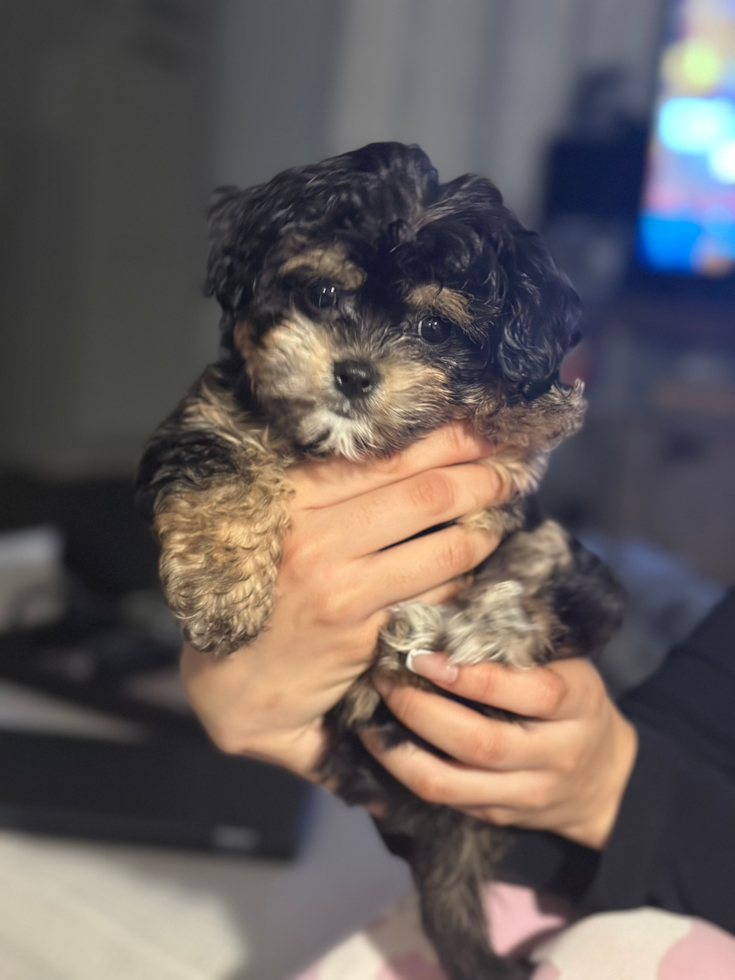
The Cavachon combines the Cavalier King Charles Spaniel and the Bichon Frise. Intentional breeding of the modern cross is commonly traced to North America in the 1990s, although there is no formal Cavachon foundation registry that documents a single universally accepted origin date. It is safer to think of the 1990s as the period when breeders began deliberately developing and promoting the cross rather than treating one particular date as the unquestioned beginning.
Its two parent breeds have histories that stretch much further back. Small toy spaniels appear in European art from centuries ago, and dogs associated with King Charles I and Charles II of England eventually became part of the story behind the modern Cavalier King Charles Spaniel. The breed was later revived around the longer-muzzled spaniels seen in older paintings and received full AKC recognition in 1995.
The Bichon Frise followed a very different path. Bichon-type dogs traveled around the Mediterranean, became favorites of European nobility, and later gained attention as street and circus performers. That latter chapter says quite a bit about the breed even today: Bichons are social, clever dogs that respond well to interaction and can be wonderfully entertaining without needing the intensity of a working breed. The AKC fully recognized the Bichon Frise in 1973.
The pairing made sense for people searching for a small family companion with the Cavalier's soft expression and affectionate character alongside the Bichon's fluffy coat and outgoing personality. Over time, the Cavachon became one of the more familiar small designer crosses. Its appeal is easy to understand. The dog is compact enough for many homes, active enough to enjoy normal family activities, and usually happiest when it gets to spend plenty of time around people.
Aussiechon History and Popularity
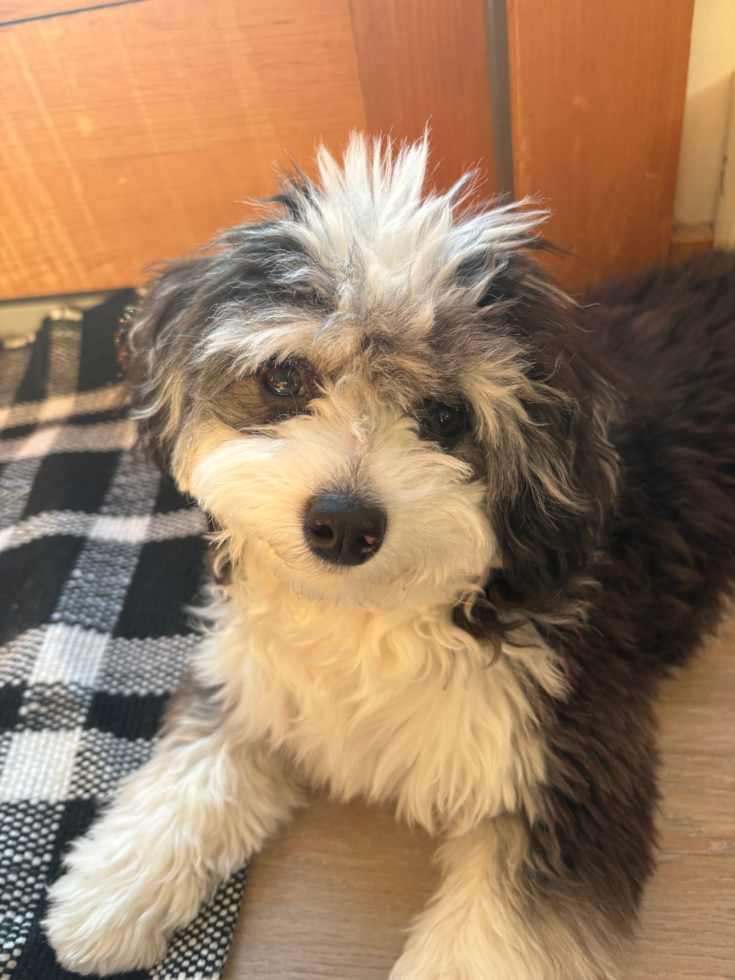
The Aussiechon, sometimes called an Aussie Bichon, combines the Bichon Frise with a Mini Australian Shepherd dog. It is a newer and less historically documented cross than the Cavachon. There is no established registry record that points to one breeder as its definitive creator, so exact origin stories should be treated with caution.
The Aussie side of the pairing has a much clearer documented history. Smaller Australian Shepherds gained popularity in the United States during the second half of the twentieth century, particularly among people involved with horses. Breeders selected for a smaller size while preserving the intelligence, athletic ability, and herding character associated with the Australian Shepherd. Those lines eventually played a major role in the development of the Miniature American Shepherd, which entered the AKC Stud Book in 2015.
Despite its compact size, the Miniature American Shepherd remains a genuine herding breed. The AKC describes these dogs as bright, self-motivated, energetic, versatile, and devoted to their people. They are also highly trainable and enjoy activities that use both their bodies and minds.
Cross that background with the cheerful, companion-oriented Bichon and you get a small dog with an interesting balance of traits. Aussiechons can be cuddly and deeply attached to their people, yet they may also approach the world with more curiosity and intensity than a typical Cavachon. Their colorful coats, especially merle patterns, have also contributed to their growing visibility among people looking for a small companion with a distinctive appearance.
Cavachon vs Aussiechon Appearance
Both breeds fit comfortably into the small companion category, and both can have the soft, fluffy appearance people loosely describe as a teddy bear look. That surface similarity can disappear quickly once you start comparing individual dogs. The Cavalier and Mini Aussie sides contribute very different colors, coat possibilities, eye colors, proportions, and levels of shedding.
The Cavachon has the narrower visual range of the two. Aussiechons can vary substantially because the Mini Aussie side introduces merle coloring, a broader range of eye colors, and a more athletic body type. Even two Aussiechon siblings can look quite different once their adult coats develop.
Cavachon Appearance
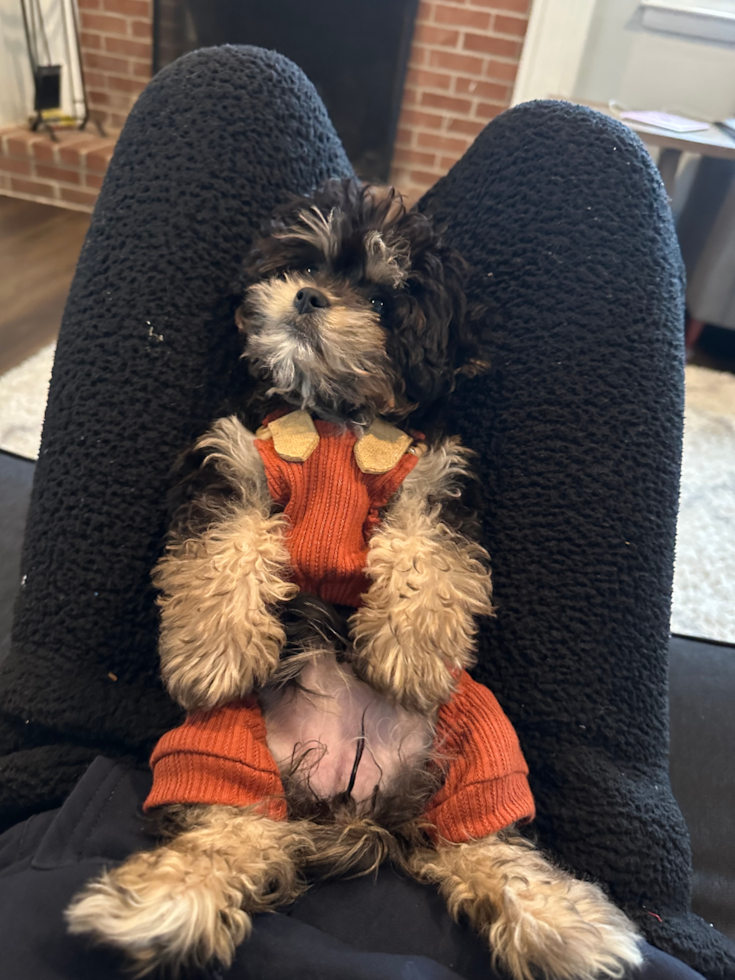
Cavachons are small dogs with compact proportions and a soft expression. Many adults weigh somewhere around 10 to 20 pounds, although the size of the parents has a direct influence on where an individual dog lands. There is no official Cavachon breed standard, so a puppy should not be expected to hit one exact height or weight simply because it carries the Cavachon name.
The face usually shows traits from both sides. Cavaliers contribute large, round eyes, floppy feathered ears, and the gentle expression for which the breed is known. The Bichon can add more fullness around the face and muzzle, especially once the coat grows out. A Cavachon with a shorter teddy bear trim may look round and plush, while one with a longer, silkier coat can show much more obvious spaniel influence.
Cavachon Coat Type and Texture
There is no single Cavachon coat. Some dogs have loose waves and a silky feel, while others develop a denser, fluffier texture with noticeable curl. Plenty fall somewhere in the middle, which can produce a soft wavy coat that looks fuller than a Cavalier's but does not form the tighter curls associated with a Bichon.
Coat texture also changes how the dog looks after grooming. A curlier coat can hold a rounded teddy bear trim particularly well, while silky waves tend to fall more naturally around the ears, chest, and legs. Puppy coat is not always a perfect preview of the finished adult coat either, so texture may become more obvious as the dog matures.
Cavachon Colors and Markings
Cavachons have a broad color range, but their patterns usually reflect what is available in the Cavalier and Bichon parent breeds. Cavaliers come in Blenheim, ruby, black and tan, and tricolor, while Bichons are white with possible cream, buff, or apricot shading. Those genetics can produce Cavachons in white, cream, apricot, red, chestnut, black, tan, and combinations of those colors.
White coats with apricot, chestnut, or tan patches are common and can strongly resemble the Cavalier's Blenheim pattern. Tricolor Cavachons may combine white, black, and tan, while others are predominantly cream, apricot, or another warm shade. Markings can change in prominence as the puppy coat grows and color softens or spreads through the longer adult hair.
Cavachon Eye Color and Expression
Dark brown eyes are the norm in Cavachons because both parent breeds favor dark eyes. The Cavalier is especially known for its large, round eyes and gentle expression, while the Bichon's dark eyes stand out against its light coat and dark nose.
Blue eyes and dramatic mismatched eyes are therefore not characteristic features of this cross. Most Cavachons keep the warm, dark-eyed expression people associate with both parents. Combined with their floppy ears and soft facial hair, this can give adult dogs a distinctly youthful look.
Cavachon Build and Size
Under the coat, the Cavachon is usually sturdier than photographs suggest. Bichons are compact and resilient little dogs, while Cavaliers combine Toy Group size with sporting-spaniel ancestry. A Cavachon may have a slightly longer Cavalier-style body or a squarer, more compact shape from the Bichon side.
This is still a small dog, so size affects handling and family life. Cavachons are easy to carry when necessary and do not need a huge home, but they are capable of proper walks, play sessions, and family outings. They should not be treated as decorative lapdogs that never need to exercise.
Cavachon Shedding and Grooming
Many Cavachons shed lightly, especially when the coat takes strongly after the Bichon. That said, the Cavalier does shed, so a Cavachon cannot be assumed to be completely non-shedding. Coat genetics matter, and dogs with straighter, more spaniel-like hair may release more loose hair than their curlier siblings.
The tradeoff for a low-shedding coat is regular maintenance. Soft hair can tangle behind the ears, under the legs, around the chest, and anywhere a harness or collar creates friction. Brushing several times a week keeps small knots from turning into tight mats, while longer or curlier coats usually need professional trimming on a regular schedule.
Low shedding also does not guarantee that a dog will be suitable for every person with allergies. Dog allergies can involve proteins found in dander and saliva as well as material carried on the coat. Anyone with significant allergies should spend time around the individual dog rather than relying on the word "hypoallergenic."
Aussiechon Appearance
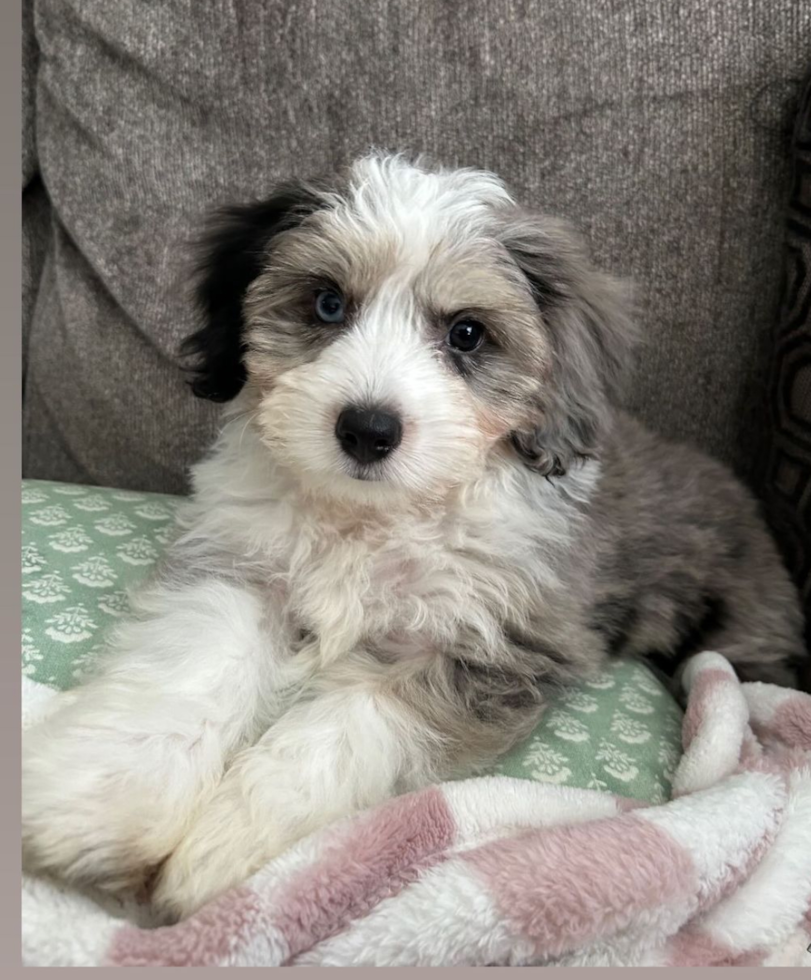
Aussiechons share the Cavachon's small size and fluffy appeal, but their appearance has a wider range. Adults commonly fall somewhere around 8 to 20 pounds, though the exact size depends heavily on the parents used in the pairing. Dogs with more of the Mini Aussie structure may stand taller and look leaner, while others stay compact and distinctly Bichon-like.
This cross can also change dramatically depending on coat and markings. A cream, curly Aussiechon may resemble other Bichon mixes at first glance. A blue merle Aussiechon with one blue eye, stronger facial markings, and longer legs can look entirely different despite belonging to the same cross.
Aussiechon Coat Type and Texture
Aussiechon coats can be straight, wavy, or curly. The Bichon contributes its plush, curly coat, while the Miniature American Shepherd has a medium-length double coat with a longer outer layer and a woolly undercoat. Puppies can inherit traits from either side, which explains why coat texture varies so much within the cross.
A wavy furnished coat is particularly common in the look people associate with an Aussiechon. It has enough texture to appear full and soft without forming tight curls. Other dogs develop more obvious Bichon curl, and some show a straighter coat that reveals more of their herding-breed ancestry.
Aussiechon Colors and Patterns
Color is one of the clearest visual differences in a Cavachon vs Aussiechon comparison. The Miniature American Shepherd comes in black, blue merle, red, and red merle, with white markings and tan points also possible. The Bichon adds white, cream, buff, and apricot to the genetic picture.
As a result, Aussiechons can appear in black and white, brown and white, red, apricot, cream, parti combinations, blue merle, red merle, and several multicolor patterns. Merle creates irregular marbling, patches, and flecks rather than a neat symmetrical arrangement. No two merle coats need to follow the same pattern, which is part of why individual Aussiechons can look so different.
Aussiechon Eye Color
Eye color offers even more variety. Miniature American Shepherds may have brown, blue, hazel, amber, or combinations of these colors, and the two eyes do not have to match. A single eye can even contain more than one color.
Aussiechons can inherit some of that variation, so blue eyes, brown eyes, hazel shades, and mismatched eyes are all possible. Brown remains perfectly normal and common. Blue or partially blue eyes are simply more plausible in this cross than they are in the Cavachon because those traits are present on the Aussie side.
Aussiechon Build and Size
Some Aussiechons inherit a compact Bichon frame, while others look more athletic through the legs and body. The Miniature American Shepherd stands 13 to 18 inches at the shoulder depending on gender and has the structure of a working herding dog, despite its reduced size. That influence can give an Aussiechon a lighter, more agile outline.
This physical difference becomes easier to see when the coat is trimmed shorter. One Aussiechon may look stocky and plush, while another has noticeably longer legs and a sportier shape. Parent size remains one of the best clues when trying to estimate how a particular puppy may develop.
Aussiechon Shedding and Grooming
Aussiechons are commonly described as low-shedding dogs, but there is more room for variation here than many quick breed descriptions suggest. The Bichon releases very little visible hair, whereas the Miniature American Shepherd has a double coat and sheds a fair amount, with heavier periods once or twice a year.
An Aussiechon with a curlier Bichon-like coat may shed very little around the home. A puppy that inherits more of the Aussie coat can release noticeably more hair. For a family that places very high importance on minimal shedding, the actual parents and the puppy's developing coat matter more than the cross name alone.
Grooming needs also depend on texture. Furnished, wavy, and curly coats require regular brushing because loose hair and debris can become trapped close to the skin. Straighter coats may mat less easily in some areas but can shed more, so there is no version of the Aussiechon coat that should be considered maintenance-free.
Cavachon vs Aussiechon Appearance Comparison: The Main Differences
The Cavachon has the more consistent companion-dog look. Dark eyes, floppy ears, a soft face, and warm colors such as cream, apricot, chestnut, white, and tricolor are common. Coat texture still varies, but the range of possible appearances is narrower because the Cavalier and Bichon share several visual traits.
The Aussiechon offers more visual variety. Merle patterns, blue or mixed-colored eyes, stronger contrast between markings, and a more athletic frame can all come through from the Mini Aussie side. Someone who loves unusual coloring may naturally be drawn toward the Aussiechon, while a person who prefers the classic dark-eyed teddy bear look may gravitate toward the Cavachon.
Size alone probably will not settle the decision because the ranges overlap considerably. Coat care is also necessary with both crosses, and neither should be chosen with the expectation of effortless grooming. The more useful appearance question is whether you prefer the Cavachon's softer, somewhat more predictable look or the broader color and structural range found in the Aussiechon.
Cavachon vs Aussiechon Temperament
Appearance may catch someone's attention first, but temperament is where this comparison becomes much more important. Both dogs are affectionate, intelligent, playful, and interested in their families. The difference lies in the style and intensity of that involvement.
The Cavachon's parent breeds were shaped heavily around companionship. The Aussiechon has one companion parent and one parent from a genuine herding background. That does not turn every Aussiechon into a miniature working dog, but it can influence energy, alertness, trainability, and the amount of mental stimulation a dog enjoys.
Cavachon Temperament
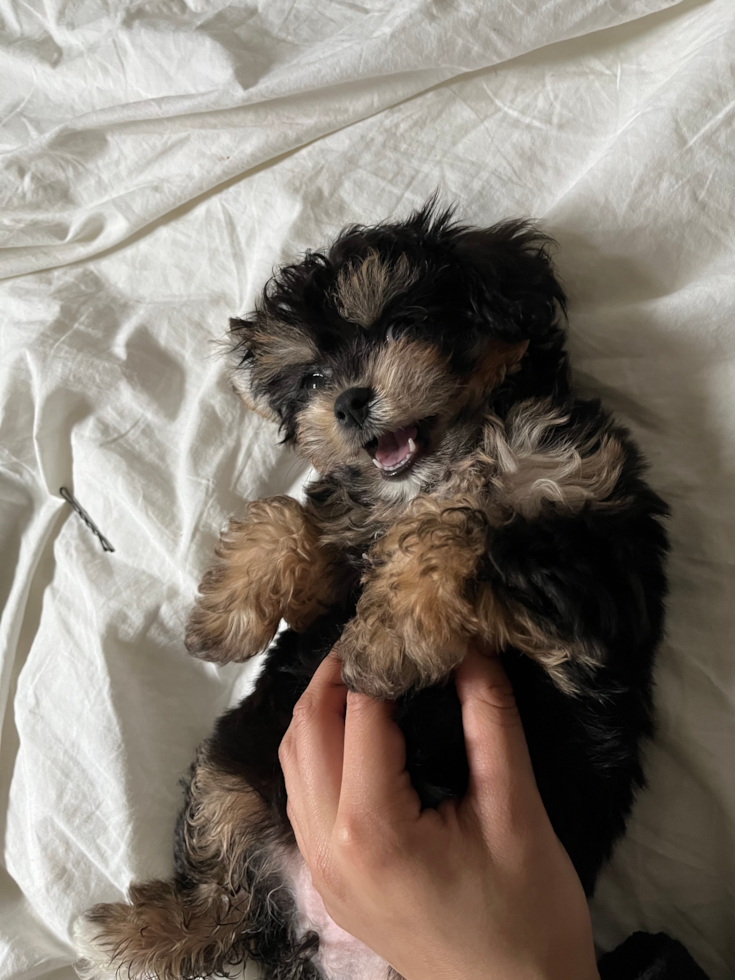
A Cavachon is usually a social, affectionate dog that places a great deal of value on human company. Both Cavaliers and Bichons have strong companion histories, so attention from family members is not merely a pleasant extra for many Cavachons. They want to be part of the household, whether that means going for a walk, greeting visitors, following someone into the kitchen, or settling nearby while everyone relaxes.
Their playful side is real, but it usually comes with a useful off switch. A Cavachon can enjoy a lively game, explore on a walk, learn tricks, and then settle once the activity ends. That balance works particularly well for people who want an involved family dog without committing to the daily demands of a higher-drive working breed.
Affection, Family Life, and Independence
Many Cavachons form very close attachments to their people. They can be cuddly dogs and may happily spend part of the evening on a lap or pressed against someone on the sofa. Their size makes that arrangement fairly easy, although anyone who once said, "The dog won't be allowed on the couch," may discover that Cavachons are persuasive little negotiators.
Their love of company also makes independence training worthwhile from puppyhood. A puppy that spends every waking moment beside someone never gets much practice at being alone. Short, positive periods of separation can teach a Cavachon that family members leaving the room or house is a normal part of life.
Cavachons With Children and Other Pets
A well-socialized Cavachon can fit beautifully into a family with children. Their playful nature gives kids a willing companion, while the softer temperament associated with both parent breeds suits many family homes. Their small size still requires sensible supervision, especially around toddlers who may try to pick up a puppy or turn a gentle game into something much rougher.
Cavachons can also share a home successfully with other dogs and cats. Early introductions matter, as does the personality of each animal, but the cross does not come from breeds known for intense territorial or predatory behavior. In a multi-pet home, that can make integration fairly straightforward when everyone is introduced thoughtfully.
Cavachon Energy and Exercise
Most Cavachons sit comfortably in the moderate-energy range. They need daily exercise and benefit from walks, play, sniffing opportunities, and short training sessions, but they usually do not require hours of hard physical work. A healthy adult can still be quite enthusiastic outdoors and should not be mistaken for a dog that only wants to sit in someone's lap.
This flexibility is a major part of the Cavachon's appeal. The same dog can join the family for a day out and then cope perfectly well with a quieter day at home. For people whose weeks contain a mix of activity and downtime, that middle ground can be very convenient.
Training a Cavachon
Cavachons usually respond well to positive, reward-based training because both parent breeds are intelligent and interested in interacting with people. Food, praise, toys, and attention can all work as motivation. Harsh repetition is unnecessary and can make training less enjoyable for a dog with a softer temperament.
Basic manners deserve the same attention they would with a larger breed. House training, recall, leash skills, polite greetings, handling, and learning to settle are far more useful than a long list of party tricks, although Cavachons can certainly learn those too. Short sessions spread through the day usually fit their attention span well during puppyhood.
Aussiechon Temperament
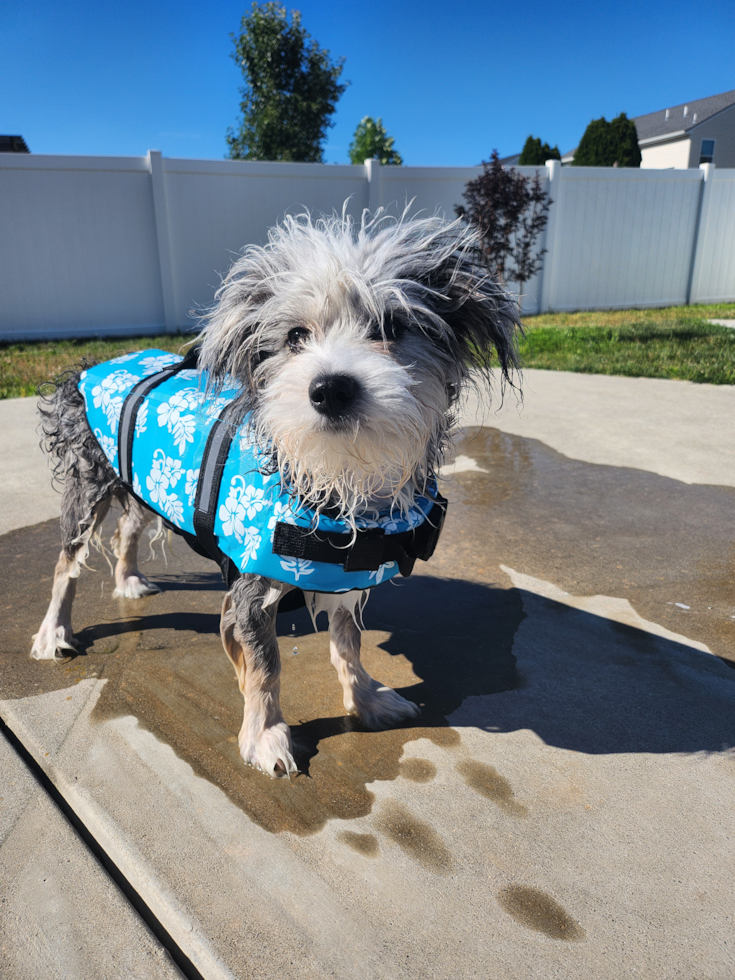
Aussiechons share the Bichon's affectionate, social character, but the Aussie side can add another layer to the personality. Miniature American Shepherds are bright, loyal, lively dogs with genuine herding instincts and a strong capacity for work. They pay attention to their surroundings and learn patterns quickly, traits that can show up even when they are crossed with a companion breed.
For the owner, that may translate into a small dog that wants a little more involvement in the day. An Aussiechon may follow household routines closely, learn words without formal teaching, notice where favorite toys are stored, and anticipate what happens next. It is an appealing quality for people who enjoy an interactive dog, but it also means mental boredom deserves some thought.
Aussiechon Intelligence and Training
Training can be one of the most enjoyable parts of life with an Aussiechon. The Miniature American Shepherd has been developed to respond to people, solve problems, and work with purpose, while Bichons have their own history as trainable performers. Put those traits together and many Aussiechons are quick to understand new cues and routines.
The challenge is less about whether they can learn and more about giving that brain enough useful work. Basic obedience, tricks, food puzzles, scent games, hide-and-seek, retrieving toys, and training during walks all add variety without turning the household into a full-time dog school. Ten thoughtful minutes can accomplish more than mindlessly repeating the same command twenty times.
A clever dog also learns things nobody intended to teach. If opening the pantry once produces a treat, an Aussiechon may remember that lesson exceptionally well. Consistent household rules matter because smart dogs are very good at noticing when those rules have loopholes.
Aussiechon Energy and Daily Activity
The Aussiechon usually sits somewhere between a traditional companion dog and a small active breed. Many are content with normal family life as long as walks, play, training, and exploration are part of the routine. An individual that inherits more drive from the Aussie parent may ask for considerably more activity than a laid-back Cavachon.
Mental exercise deserves equal weight. A dog can come home from a walk physically tired yet still have plenty of brainpower left for mischief. Sniffing new routes, searching for treats, learning small tasks, or playing an interactive game adds a type of stimulation that another lap around the block may not provide.
Herding Traits in an Aussiechon
The herding background can sometimes appear in subtle ways. A young Aussiechon may become very interested in movement, follow running children, circle during energetic play, or try to keep track of where everyone in the household is. Miniature American Shepherds retain real herding ability, so these behaviors have a genuine basis in the ancestry rather than being a quirky stereotype.
That does not mean every Aussiechon will nip at heels or attempt to organize the family into a neat group. Genetics vary, and the Bichon side can soften many working traits. If chasing or heel-nipping does appear in puppyhood, calm redirection and consistent training can establish better habits before the behavior becomes routine.
Aussiechons With Children and Other Pets
Aussiechons can make lively, affectionate family dogs. Older children who enjoy teaching tricks, playing games, and interacting with their dog may find them especially rewarding. Young children need the same supervision required with any small breed because a puppy can be injured by rough handling, and excited running can also invite chasing from a dog with stronger herding instincts.
Living with other dogs is usually very possible, and many Aussiechons enjoy having canine company. Cats can also fit into the household, particularly when introductions start early and the puppy learns appropriate boundaries. A dog that shows strong interest in chasing movement may need more guidance around cats than a quieter Cavachon would.
Affection and Attachment
The extra energy should not give the impression that Aussiechons are less affectionate. Miniature American Shepherds are deeply devoted to their families, and Bichons are famously social little dogs. An Aussiechon can be an enthusiastic playmate one minute and curled against a family member later in the evening.
The difference is that affection may share space with a stronger desire for engagement. Some Aussiechons seem happiest when they have participated in the day first. Give them a walk, a game, something interesting to sniff, and a little training, and settling beside you afterward can come very naturally.
Cavachon vs Aussiechon: Which One Should You Choose?
The Cavachon and Aussiechon overlap enough that both can suit many of the same households. They are small, affectionate, trainable dogs that usually want close involvement with their families. A person who provides good socialization, daily activity, regular grooming, and consistent training can have a rewarding experience with either one.
The deciding factors are more subtle. A Cavachon usually makes sense for someone who values softness, adaptability, moderate activity, and the temperament of a classic companion dog. An Aussiechon is more likely to suit someone who actively enjoys training, wants a little more athleticism, and likes a dog that approaches daily life with curiosity and enthusiasm.
Choose a Cavachon if You Want a Softer Companion Personality
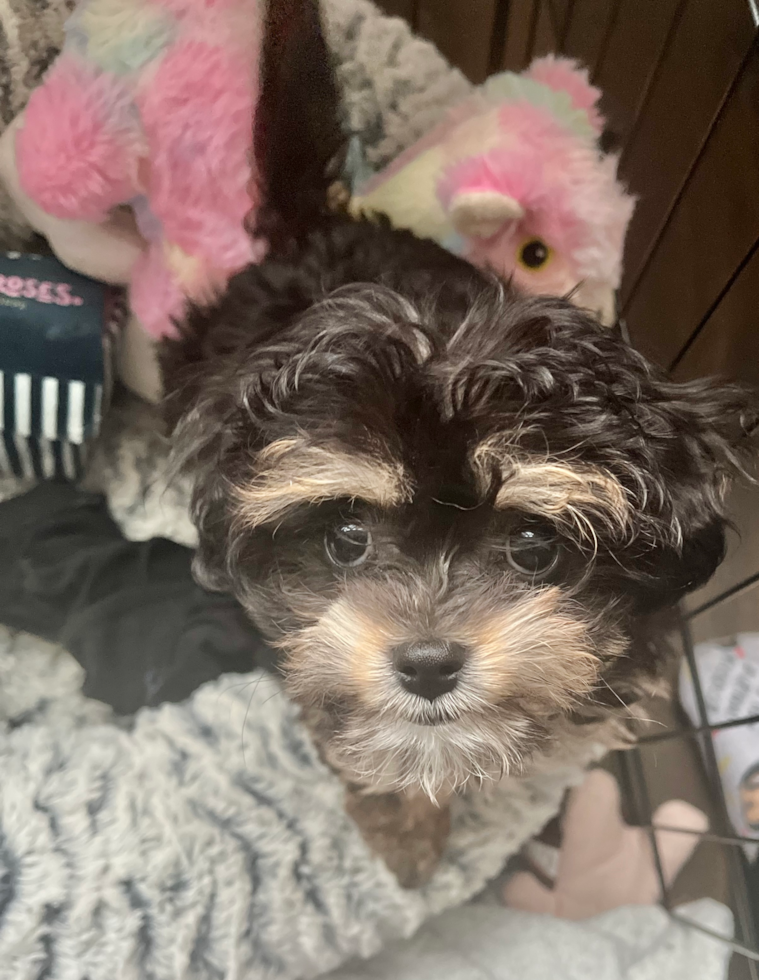
A Cavachon puppy may fit you better if your ideal dog enjoys daily walks and play but is also comfortable with plenty of downtime. This cross suits people who want affection and companionship to sit at the center of the relationship rather than sports, challenging training, or a highly active routine.
Cavachons can work well for singles, couples, families, and older adults because their exercise requirements are manageable for many lifestyles. They still need engagement and should never be treated as dogs that can entertain themselves all day, but their daily needs are usually easier to fit around an ordinary household schedule.
Their appearance may also influence the choice. If dark expressive eyes, floppy ears, warm colors, and a soft spaniel-style expression appeal to you more than merle coats and unusual eyes, the Cavachon naturally has the advantage.
Choose an Aussiechon if You Want More Activity and Mental Engagement
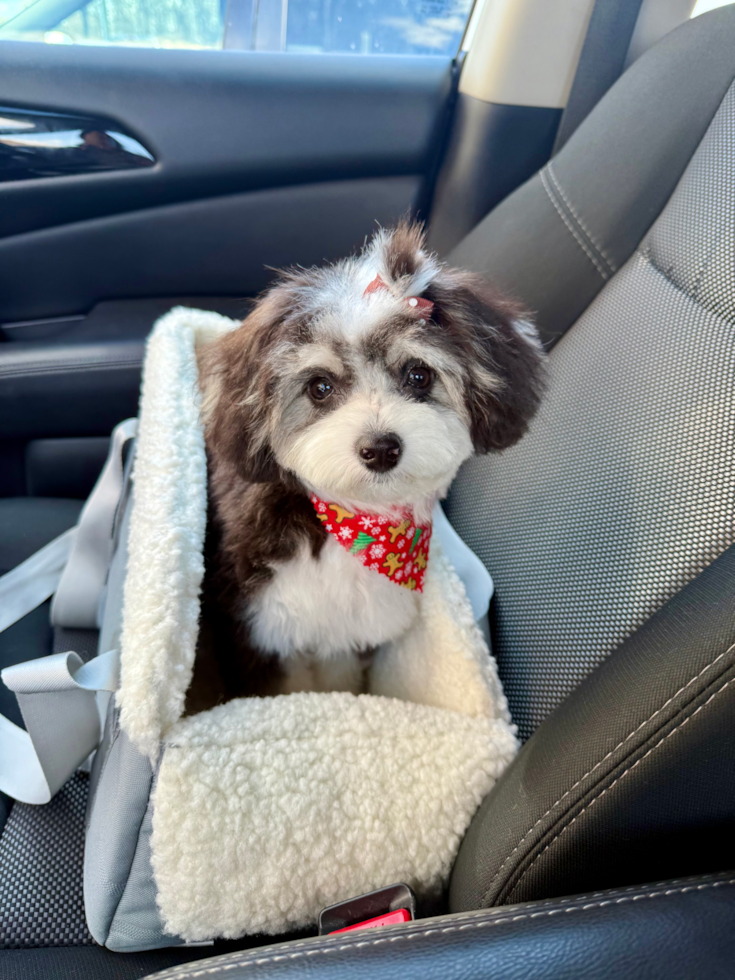
An Aussiechon puppy may fit you better if interacting with your dog sounds like part of the fun of ownership. People who enjoy teaching tricks, playing games, taking regular walks, visiting new places, or experimenting with activities such as scent work may appreciate the extra spark that comes from the herding side.
They are still small companion dogs and do not require life on a farm. The Miniature American Shepherd itself can adapt to urban and suburban life when its exercise and mental needs are met, so the Aussiechon can also do well without a huge yard. What matters more is having owners who make the dog part of the day rather than expecting a quick trip outside to satisfy all its needs.
Appearance gives the Aussiechon another clear advantage for people who love variety. Merle patterns, blue or mixed eyes, strong markings, and different body types create a much broader visual range. For someone fascinated by distinctive coloring, the choice may become quite easy.
Which Is Better for a Less Active Household?
The Cavachon is usually the more natural match for a quieter household. Its Cavalier and Bichon background leans heavily toward companionship, and moderate daily activity satisfies many adults. Walks, playtime, short training sessions, and normal family outings can create a nicely balanced routine.
An Aussiechon does not need constant high-intensity exercise, but some individuals inherit more drive from the herding side. If daily games, training, and active interaction sound like obligations rather than enjoyable parts of dog ownership, the Cavachon may fit more comfortably.
Which Is Better for an Active Family?
The Aussiechon has an advantage for families that genuinely live an active lifestyle. A dog with Mini Aussie influence may embrace longer walks, outdoor adventures, games, and training with considerable enthusiasm. The word genuinely matters here because choosing a breed for the lifestyle we wish we had is a surprisingly easy trap.
A Cavachon can still enjoy active days and should receive proper exercise. The difference appears when activity becomes a regular part of the week. If you want a dog that gets excited about having another job, puzzle, route, or game, the Aussiechon has more genetic reason to lean in that direction.
Which Is Easier to Train?
Both crosses are trainable, but they bring slightly different qualities to the process. Cavachons usually respond well because they enjoy attention and interaction with their people. Aussiechons may grasp patterns and new tasks faster because the herding side adds a strong history of cooperative work and independent problem-solving.
For ordinary household manners, either can do very well. The difference becomes more noticeable if training itself is one of your hobbies. Someone who enjoys trick training, agility foundations, scent games, or teaching a growing list of cues may find the Aussiechon's mental energy particularly rewarding.
Which Is Better for a First-Time Dog Owner?
A Cavachon may be the easier starting point for someone who wants a straightforward family companion. Moderate energy, an affectionate disposition, and a strong desire for human company create a combination that many first-time owners can manage comfortably. Grooming and independence training still require commitment, so small does not mean effortless.
The Aussiechon can also be a great first dog when the owner enjoys learning about training and enrichment. Its intelligence is an advantage when there is structure, but a bored clever dog can invent its own projects. Sometimes those projects involve socks, stolen paper, or discovering exactly how high a puppy can climb when nobody is looking.
Which Is Better With Children?
Both can be excellent family dogs when children understand how to interact respectfully with a small animal. The Cavachon's softer, moderately active temperament may work especially well in homes looking for a gentle companion. The Aussiechon can be a terrific match for older children who want a dog that actively participates in games and training.
No small breed should be left to absorb rough handling because it is friendly. Adults need to teach children how to approach, pet, lift, and play with the dog safely. With an Aussiechon, families should also watch for chasing or heel-focused behavior if running children trigger the puppy's herding instincts.
Which Is Better With Other Pets?
Cavachons have a slight advantage for households that want the more straightforward companion temperament. Their parent breeds are sociable and do not bring strong herding instincts into the mix, which can make them less interested in controlling the movement of other animals.
Aussiechons can live very happily with dogs and cats too. The difference is that an individual with stronger herding traits may pay more attention to a running cat or energetic dog. Good introductions and early boundaries matter more in those cases than the breed name itself.
Which Sheds Less: Cavachon or Aussiechon?
The Cavachon may have somewhat more predictable low-shedding potential, though neither cross comes with a shedding guarantee. The Bichon parent contributes a coat that releases very little visible hair, while the Cavalier sheds more conventionally. Coat texture can therefore influence how much hair a Cavachon leaves around the home.
There is a larger contrast between the Aussiechon's parent coats. The Bichon is at one end of the shedding spectrum, while the Miniature American Shepherd has a double coat that sheds considerably more and experiences heavier seasonal shedding. An Aussiechon with strong Bichon coat traits may shed very little, but another puppy from the same broad cross can inherit more of the Aussie coat.
Which Needs More Grooming?
Neither breed wins a low-maintenance grooming contest. Soft wavy and curly coats need brushing because knots can form close to the skin even when the dog looks perfectly fluffy from the outside. Both may also need regular professional haircuts if the owner prefers a shorter, shaped coat.
Individual coat texture matters more than the breed label here. A tightly curled Cavachon may require more detangling than a loose-coated Aussiechon, while a straighter Aussiechon may shed more despite being easier to comb. Choosing between them should therefore involve accepting regular coat care either way.
Which Is Cuddlier?
Both crosses can be very affectionate, but the Cavachon has the stronger companion-only background. Cavaliers and Bichons have both spent generations close to people, and that can produce a dog that settles into physical affection with very little persuasion. Many Cavachons are happy to alternate between play and serious couch duty.
Aussiechons can be equally loving, but some arrive at cuddle time after they have satisfied their need for activity. They may want the walk, puzzle, game, or training session first. For an owner who likes that back-and-forth between activity and relaxation, this is part of the appeal rather than a drawback.
Which Has the More Predictable Appearance?
The Cavachon has the narrower range. There can still be meaningful differences in size, curl, markings, and facial structure, but both parent breeds share dark eyes, floppy ears, small proportions, and several compatible coat traits. Adult Cavachons therefore stay within a relatively recognizable visual family.
Aussiechons can differ more sharply from one another. Merle genetics, multiple eye colors, different coat textures, varied markings, and the contrast between the Bichon's compact frame and the Aussie's athletic build create more possible combinations. If you have a very specific adult appearance in mind, looking closely at the puppy's parents becomes especially valuable.
Cavachon vs Aussiechon: The Final Comparison
The choice between a Cavachon vs Aussiechon becomes easier once you stop asking which breed is better and start asking what you actually want everyday life with your dog to feel like. Both can offer affection, intelligence, playfulness, and strong family bonds. They simply place the emphasis in different places.
The Cavachon is the stronger fit for someone who wants a gentle companion with moderate energy, a soft temperament, and an easy balance between activity and relaxation. It suits people who want walks and play to be part of the day without feeling that they need to keep inventing new challenges. Its appearance also stays closer to the traditional small companion look, with dark expressive eyes, floppy ears, and familiar cream, apricot, chestnut, white, or tricolor coats.
The Aussiechon makes more sense for someone who wants an interactive little dog with extra curiosity, athleticism, and enthusiasm for learning. Training, games, sniffing adventures, longer walks, and new experiences can become a real part of the relationship. Merle coats, blue or mixed-colored eyes, and greater variation in body type also give the Aussiechon a broader range of looks.
If your ideal evening is a pleasant walk followed by a dog curled beside you while the house settles down, a Cavachon may fit that picture naturally. If you imagine teaching a new trick after dinner, hiding treats around the room for your dog to find, and wondering how something so small already knows you are reaching for the leash, the Aussiechon may feel more like your kind of companion.
The individual puppy still matters. Genetics, parent temperament, early socialization, training, health, and life experiences all influence the adult dog far more than a breed comparison can predict perfectly. Use the Cavachon vs Aussiechoncomparison to identify the traits that fit your household, then look closely at the parents and the puppy in front of you. That is where a useful breed comparison turns into a good real-life match.
Frequently Asked Questions
What is the main difference between a Cavachon and an Aussiechon? The main difference comes from the non-Bichon parent. A Cavachon combines a Bichon Frise with a Cavalier King Charles Spaniel, while an Aussiechon combines a Bichon Frise with a Mini Australian Shepherd-type dog. That usually gives the Cavachon a softer, more companion-focused temperament, while the Aussiechon may show more energy, alertness, and interest in training and mental activity.
Is a Cavachon calmer than an Aussiechon? In many cases, yes. Cavachons usually have moderate energy and are comfortable switching between play, walks, and quiet time at home. Aussiechons can also settle well, but they are more likely to inherit extra drive and curiosity from the Aussie side, so they may need more daily activity and mental stimulation.
Which is better for first-time dog owners, a Cavachon or Aussiechon? Both can work well for first-time owners, but the Cavachon may be easier for someone who wants a straightforward companion dog with moderate exercise needs. The Aussiechon can also be a great first dog if the owner enjoys training, enrichment, and a slightly more active routine. Grooming, socialization, and consistent training are important with both.
Which sheds less, a Cavachon or Aussiechon? Both are commonly low-shedding, but the Cavachon may have somewhat more predictable shedding because the Cavalier and Bichon coats do not contrast as sharply as the Aussie and Bichon coats. An Aussiechon with a strongly Bichon-like coat may shed very little, while one that inherits more of the Aussie double coat may release more hair. Neither cross can be guaranteed to be completely non-shedding.
Which breed needs more grooming? Both need regular grooming, especially if they develop a soft wavy or curly coat. Brushing several times a week helps prevent tangles and mats, and many dogs will need professional trims. Coat texture matters more than the breed name alone, so a curlier Cavachon may require more brushing than a straighter Aussiechon, while a straighter Aussiechon may shed more.
Are Aussiechons more energetic than Cavachons? Aussiechons are usually the more active of the two. The Mini Aussie side can add athleticism, alertness, and a stronger desire for interactive play and training. Cavachons still need daily exercise, but many are satisfied with moderate walks, playtime, and normal family activities without needing as much mental work.
Which is better with children, a Cavachon or Aussiechon? Both can be excellent with children when properly socialized and treated gently. Cavachons may suit families looking for a softer, calmer companion, while Aussiechons can be a fun match for older children who enjoy games, training, and active play. Because both are small dogs, young children should always be supervised to prevent rough handling or accidental injury.
Do Aussiechons have blue eyes more often than Cavachons? Yes. Aussiechons are much more likely to have blue, amber, hazel, partially blue, or mismatched eyes because those traits can come from the Mini Aussie side. Cavachons usually have brown or dark brown eyes because both the Cavalier King Charles Spaniel and Bichon Frise typically have dark eyes.
Which is easier to train, a Cavachon or Aussiechon? Both are trainable and respond well to positive reinforcement. Cavachons are usually cooperative and eager to please, while Aussiechons may learn new patterns and commands more quickly because of their herding-breed ancestry. An Aussiechon may enjoy more advanced tricks, puzzles, and training games, while a Cavachon is usually very capable of mastering household manners and basic obedience.
Should I choose a Cavachon or Aussiechon? Choose a Cavachon if you want a gentle, affectionate companion with moderate energy and a relaxed family-dog personality. Choose an Aussiechon if you prefer a more active, mentally engaged dog that enjoys training, games, and regular interaction. Size, grooming needs, and affection levels overlap quite a bit, so temperament and activity level are usually the most useful deciding factors.